


So, there’s a piece in Jacobin arguing that data center moratoria are a “terrible idea” making the rounds on social media and beyond. It’s pretty easy to see why this makes for some good discourse; naturally, there’s going to be frisson among AI optimists when a perceived opponent—here, the nation’s most influential socialist magazine—makes a case for aligning with the tech industry’s goals.
While I’m pretty unconvinced on all but one or two of the points that the piece itself raises, and I think it seriously misconstrues the class politics of data center fights, I do think it’s worth litigating this idea. Because I do believe we should be thinking about what a broader and more engaged politics of resisting, regulating, and ultimately governing AI might look like. It’s a good occasion, in other words, to ask:
Who is fighting data centers?
Why are they fighting them?
Are anti-data center movements a dead end—or a starting point?
But first: Today’s edition of BITM is sponsored by DeleteMe, whose mission is hunting down and, yes, deleting the data that brokers have hoovered up about you over the years and made available to their clients. DeleteMe is Wirecutter’s top-rated data removal service, and I’ve used it myself, to locate and eradicate scores of sites that were listing and selling personal info like my home address and phone number. If you’re interested in taking DeleteMe for a spin, sign up here and use the code LUDDITES for 20% off an annual subscription. OK! Onwards we go.
The author of the Jacobin piece, Holly Buck, is arguing from what you might call an ‘abundance left’ perspective; she takes a more techno-utopianist tack towards AI in general, and sees it as a force that could generate prosperity if governed properly. She argues that campaigns for data center moratoria, which she says are being led by home owners and affluent environmentalists, are an impediment to that effort, and will wind up pushing data center development offshore and forcing AI companies to raise prices. This will in turn reduce small business owners’, academics, and underprivileged communities’ access to AI.
These efforts seek to use the power and machinery of familiar NIMBY (“not in my backyard”) politics — local opposition, tying up projects in red tape, and so on — to confront the multiple perceived threats of galloping energy demand, carbon emissions, and job loss. Successful moratoria will curb digital growth by starving it of the physical energy needed to train and operate AI models.
Counterintuitively, a moratorium on AI data centers is a terrible idea — one that poses serious equity concerns. A moratorium springs from the desire to stop the concentration of wealth, but ironically, it is likely to exacerbate it. It’s a massive strategic blunder for the Left
Instead, she says, “funders and organizers in environmental groups leading data center blocking efforts should put their attention toward a broader set of solutions—including public engagement and education on the technology, the stakes, and the policy options.” As the headline of the piece puts it, democratic governance of AI is the real solution, not data center moratoria.
Who’s fighting the data centers?
To me, the biggest issue with the piece is that much of the argument rests on the charge that blocking data centers amounts to “class warfare.” Buck argues that “a lot of organizing to stop data centers is coming from wealthier communities and groups,” even though Buck admits “we lack a rigorous study” of who is protesting data centers and why. She writes:
The class particulars matter. What if the picture that emerges of “data center resistance” is one of educated middle-class people — including exurban and rural residents but also professionals who work in knowledge jobs — mobilizing, consciously or not, to protect their class position from the threats AI poses? How many of these people will block data centers but end up paying for a subscription to a frontier model once it is clear how useful it is to navigate daily work and life? It’s not fair for affluent environmentalists and property owners to try to stop development of this infrastructure before most people in the world have even had a chance to work with and learn from these models.
What’s strange about this is that there’s little need for a ‘what if’ here, because there are many organizations and news outlets currently tracking, tabulating, and covering data center development, and one can investigate the particulars of the cases without needing to lean on vibes-based speculation. I do understand where the temptation to invoke the NIMBY stereotype, which indeed foregrounds homeowners and affluent environmentalists, arises from. NIMBYs have been responsible for a lot of class warfare, especially when it comes to blocking housing development, and they’ve often done this under the auspices of pursuing progressive goals.
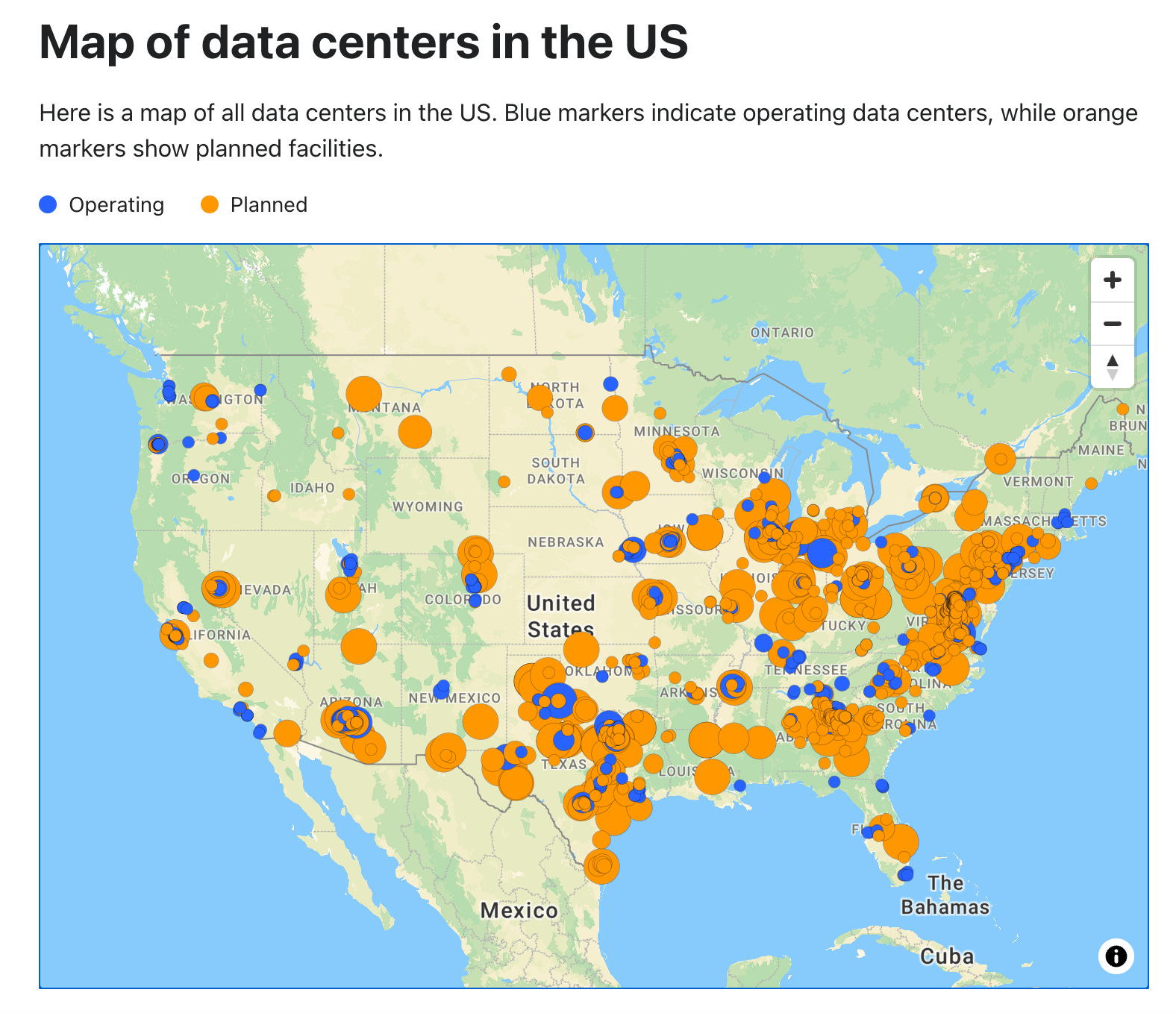
But the class particulars do matter, and in my experience reporting on the data center opposition, it has very much not been the case that “affluent environmentalists” are responsible for galvanizing, organizing, or underwriting the protests. One reason I’m writing this, in fact, is that I read Buck’s piece less than a week after attending a city council meeting in Monterey Park, California where a ban on data centers was under consideration (and ultimately approved). I listened to hours of residents’ animated, informed public comments in favor of banning them, and I found the disconnect between Buck’s assumption and what I’ve seen on the ground pretty yawning.
The residents who gave comment were a remarkably diverse group. There were many union members, and most appeared to be working class, which tracks; according to the most recent US Census data, the average annual income of a Monterey Park resident is $39,857. A couple people mentioned environmental issues, and some were what one could fairly characterize as NIMBYs, but what stuck out to me was the regularity with which residents connected rather reasonable local concerns to the broader picture.
What’s behind the data center fight?
They knew that they were facing higher electricity demand, noise and air pollution, and, sure, an eyesore in their backyards, and they also knew it was in exchange for what they felt was very little; a handful of mostly nonpermanent jobs and a technology that would primarily profit others, perhaps at their direct expense. Some comments connected AI to surveillance and warmaking, and at least one issued concerns about “techno-fascism.”
In that context, it seems condescending to imply that affluent environmentalists are running this movement. I saw a diverse collection of mostly working class people making a considered judgment, trying to protect their home and livelihoods, sure, but also weighing what AI is, and what it is promised to become, against those interests, and acting accordingly. Participating in democratic governance, in other words.
It’s not just Monterey Park, either. Buck asserts that “many data center projects appear to be sited in non-disadvantaged communities.” But, again, we probably shouldn’t just argue from the way things appear, and should instead turn to the available data, which shows that there are lots of projects proposed in disadvantaged communities—ironically, likely for very the reasons that Buck articulates: affluent homeowners and environmentalists are more likely to fight the hyperscalers, and tech companies, private equity firms, and developers would like to avoid those fights. I heard one Monterey Park resident say she assumed developers picked her sleepy town outside of Los Angeles because they thought they could get away with it.
To wit: Mother Jones ran a story just this month about how data center developers are targeting indigenous lands, and how local organizers are working to stop them. Indigenous campaigners, like those in Muskogee (Creek) Nation who successfully blocked a data center, are likely to cite environmental concerns, along with a legacy of colonialism and extraction, but they are not affluent. The median household income in Muskogee City is about $50,000 and 25% of the population lives below the poverty line. (The median household income in the United States is $84,000.) The Seminole Nation of Oklahoma’s tribal council recently voted to pass the first outright data center ban on indigenous land. The median household income there is $39,000.
It’s not limited to indigenous lands or Monterey Park, of course. The city council of San Marcos, Texas (median household income: $51,000, percentage of population below the poverty line: 27%) just rejected a 200 acre data center after overwhelming opposition. Public opposition to a data center in Coweta, Oklahoma (median household income: $67,000) spurred the developer to withdraw the project. Santa Teresa, New Mexico (median household income: $63,000) is home to a feisty fight to stop data center buildout. In Indianapolis, a city council member recently had his house shot at after he voted to approve a data center over community outcry; the median household income of Irvington, the neighborhood where the development is planned, is $59,600, per the most recent available data I could find.
In other words, the data center opposition sure looks like it’s comprised of working class people; I’ve seen and heard from farmers, teachers, students, indigenous activists, union members, community organizers and well-off NIMBYs and environmentalists. In fact, while I agree with Buck that more study of the particulars of data center resistance is needed, it seems to me that it’s just as possible to reach the opposite conclusion she does: that allowing tech oligopolies and private equity firms to dictate how and where AI infrastructure will be built, whether the residents like it or not, is a truer form of anti-democratic class warfare! Why should corporations whose values have been inflated with promises to eliminate millions of jobs be granted carte blanche to reshape communities—including ones that have been historically exploited, and are in fact low-income—and to extract their resources, so that tech firms might sell more and better software products?
The answer, to Buck, seems to be that AI provides enough advantage to users that we need to ensure everyone has access to it. She gives a couple examples:
I took undergraduate courses in calculus and in programming at the state school where I also work as a professor. It’s clear that, for many subjects, the personalized tutoring offered by AI is far better than the outdated lecture-based model still employed by universities.
Buck also celebrates the ways that AI saved her time and money navigating an immigration issue. These are the kind of benefits those with resources to pay for AI will enjoy while working people will not, if data center expansion is halted before they “even had a chance to work with and learn from these models.”
This too strikes me as faintly condescending. It’s been three and a half years since the AI boom began; most Americans have used AI. Just because the author finds value in it does not mean that everyone does, or that everyone finds it useful enough to want to support the current, hyper-capitalized development regime as laid out by profit-seeking firms in Silicon Valley. Or to warrant the social, economic, and environmental costs of AI more broadly. (I also think that many would contest the idea that it’s clear that AI is preferable to a human tutor.) A common knock against AI critics is that they extrapolate from ‘I haven’t found anything useful to do with AI’ to conclude that no one has. Yet the reverse can be true among advocates: many seem to believe since they have found lots of value in using the tool, sooner or later, everyone will. This just may not be true! The democracy-abiding position, the one with maximal solidarity with the working class, may in some cases be respecting its constituents’ refusal of AI as currently structured.
Why not pause the rapid buildout?
To that end, the other major shortcoming of Buck’s argument, in my view, is that she never really explains convincingly why the rush to build out data centers, as it’s happening, on the AI industry’s terms, is so necessary. The project in New Mexico I mentioned is being underwritten by Oracle, which has partnered with OpenAI to spend $300 billion on data center infrastructure. Both companies and their executives, especially Larry Ellison, have close ties to the Trump administration—they’re the key parties to the $500 billion Stargate project, Oracle is Palantir’s cloud partner, etc—and their partnership is predicated on building AI enterprise software. I legitimately don’t understand why the socialist left would want to support the construction of a project that helps these firms meet their goals of building out mass automation and surveillance programs. As others have pointed out, moratoria like the one Bernie Sanders and Alexandria Ocasio-Cortez have proposed are designed to buy time to work questions like that out—to develop good governance and regulation of AI—not install a permanent ban.
So why is it imperative that we build every data center that Google, OpenAI, and Meta want us to? Why can’t we democratically negotiate not just siting issues and infrastructure development but what the actual demand for AI is going to be, the uses to which we want it to be put? There isn’t really an answer in the piece that I see, except a somewhat odd nod to Anthropic’s “too-powerful-to release” Mythos model, which has been widely criticized as a PR stunt, as evidence that the US needs to “develop powerful AI first.” This is the same line that the AI lobby uses to argue that it should not be subject to regulation in general. It also remains unclear to me why the United States, which has now used AI in two separate wartime actions that were not approved by Congress, in Venezuela and Iran, by an administration that is capricious and reckless, has close ties to most major AI firms, and is doing all it can to deregulate the industry, would be a better steward of a very powerful AI than any foreign power.
Finally, I’m skeptical of the idea that shutting down some percentage of data centers through community organizing or statewide legislation will meaningfully create some kind of digital divide between the AI haves and the have-nots. Buck argues that
Offshoring will put limitations on compute that will induce tech companies to raise prices, and small businesses, academic and nonprofit researchers, and individuals would be the first to lose access. Larger companies would just buy access to the top-tier AI. A moratorium will result in a business landscape that favors incumbents. This has global implications for students, small business owners, and first-generation professionals in emerging economies…
…the latest version of the “poverty premium” is shaping up: a society where educated middle-class people like me will pay the monthly fees for these services, learning and moving through life with less friction, while people who can’t afford the subscription are stuck in the system and end up paying more. This AI-enhanced poverty premium is not a distant prospect but a few years away — and it is made more likely by a moratorium that limits computation.
This is indeed not a distant prospect: it’s already happening, data center moratoria or not. Larger companies are already buying access to top tier AI. Universities have less access to compute for AI research than the commercial AI labs; it’s one reason so many academics are turning to the private sector (also: the insane amounts of money on offer). The wealthy already have a huge leg up in terms of AI use: Who can afford to pay $100 a month for premium tier Claude subscription? Certainly not most working class people! Furthermore, AI firms are already raising their rates and intensifying this bifurcation, to begin to try to cover costs of a deeply resource-intensive business that is still not profitable. Even if the data center buildout continues apace, I would bet my life savings on Kalshi that we’re going to see a digital divide exacerbate in coming years, with the rich, Fortune 500 companies, and tech firms not just using the most AI but dictating the terms of that use for everyone else.
This is ultimately the key issue. Tech utopianists and abundists view AI as a potentially equalizing, even liberating force, but history shows us that without political intervention or strong unions, those with the power to deploy labor-saving automation technologies at scale, to use it as leverage against workers who cannot, will themselves concentrate the gains from productivity increases. In their bid to replace labor with software subscription fees, AI companies are effectively attempting a mass transfer of wealth from the working and middle classes to the rich. The most likely outcome of any data center buildout that successfully engenders more capable automation tools is a concentration of wealth and power among the companies selling them. I’m not sure how slowing the buildout of the key capital equipment enabling a handful of firms to pursue mass automation will lead to inequality; if anything it’s one of the few means available to contest the expansion of power of firms like OpenAI and Google.
Fighting data centers is just the beginning
I do agree with Buck on two key points: We should certainly be cognizant of the shaky nature of the political coalitions forming to fight data centers. She’s right that these can also encompass reactionary elements, and in the long run, on their own, will likely prove untenable as a serious political force. But that’s only if no efforts are made to expand the political fights begun at data centers into larger arenas.
Because Buck is also right that shutting down a data centers cannot be viewed as a finish line. Yet where she sees the anti-data center movement as incompatible with efforts to aspire to democratically govern AI, I see them as a potent—even necessary—starting point. AI is widely unpopular; acts of refusal are springing up across the nation. But it’s not the base technology people are angry at; it’s the political economy. It’s the firms promising to kill jobs, unscrupulous billionaire executives at the helm, and hyperscalers descending on communities with enormous infrastructure projects. The big question for the left is, as I’ve written before, how to confront the malign forces while encouraging good, truly democratically guided AI development and use.

So far, of course, we’ve had the opposite of democratic governance of AI, though not for want of trying. Organizers, funders, nonprofits, and local and state level politicians have been pouring time and resources into shaping AI policy; Alex Bores’ recent dividend proposal comes to mind, as well as the rafts of laws proposed in California, New York, Florida, and beyond. Alas, the AI industry’s lobby spent millions thwarting many of those efforts, which have been killed or vetoed. As a result, these data center fights have essentially become proxy sites for democratic governance of AI; places where citizens can still register a vote about their future in a world that feels increasingly dominated by dark money and tech oligarchs.
The left shouldn’t be shunning the data center opposition movement; it should be listening to it, joining it in the trenches, building solidarity, and figuring out how to channel the groundswell of anger at AI into more durable political efforts that will lead to more equitable outcomes, for AI service distribution and otherwise. Can the momentum of the data center movement be tapped to agitate for local labor organizing? Stronger state AI laws? Into more ambitious efforts to expand the social safety net? (If a data center is going to replace jobs, should they be taxed to pay for universal healthcare, etc?) Or, might using the threat to block data centers provide political leverage to push to have AI regulated like a public utility, as Buck has proposed elsewhere?
It should also recognize that if the people manage to shut down a multibillion dollar Oracle/OpenAI data center, they’re shutting down infrastructure that would be used as capacity for mass surveillance and deskilling labor—and understand why many consider that a victory.
Go to a city council hearing on data centers and listen. (Chances are, there’s one near you.) What I expect you will hear is that, from negating democracy, data center opposition is where some of the most promising AI democracy is happening. It’s unruly and politically inchoate, sure, but the data center fight, with farmers and environmentalists and indigenous and working class people side by side, is an opportunity to grow and catalyze working class power. Fighting data centers is where good AI governance begins, not ends.
For what it’s worth, my intent here was not to do a snippy takedown of Buck’s piece, but to think through its implications. I’m glad to see more discussion around how to make AI work for the people rather than big tech, and while disagree with it pretty vehemently, I’m glad Buck ushered in this debate. I had some of my own assumptions and priors challenged, and it clarified my thinking on a few points. And I do recommend wholeheartedly the previous essay she published for Jacobin, with Matt Huber, “Treat AI Like A Public Utility.” It’s an intriguing idea.
Also good in Jacobin this week: A discussion of Harry Braverman, monopoly power, and how management uses technology to degrade work.
Good elsewhere:
Elizabeth Lopatto on Oracle as a bellwether for the AI bubble in the Verge.
Kate Conger and Theodore Schliefer on Google co-founder Sergey Brin’s hard turn to the right in the New York Times. (Lots of wild and depressing details in this one)
WIRED’s coverage of the Musk vs Altman trial over OpenAI.
Ed Ongweso Jr and Jathan Sadowski of This Machine Kills did a segment on the data center debate, too. I saw it come through my feed just as I was wrapping this post; so far it’s a great compliment to some of my arguments, and covers even more ground.
Google employees are speaking out against their company’s new contract with the Department of Defense:


Okay! That’s it for today. Thanks as always for reading, and more soon. Hammers up.
Just reading this was a real threat to my dental health. Early on, I thought, "I'll bet she has at least a bachelor's, probably an advanced degree, likely doesn't know any working class people, she's just doing some reflexive virtue signalling," and sure enough she's a professor. It's particularly infuriating because I live in West Virginia where we don't even get to have hearings to voice our opposition, nor is there an initiative process here. There is opposition to all three of the data centers proposed a year or two ago--now there are two more and I haven't heard about opposition but likely that's because they're new. West Virginia has the lowest average income in the country, and the lowest educational attainment. Hardly a hotbed of liberal elite affluence. Fact is, we're used to be treated as a garbage dump by the rest of the country--stripped for logs, then coal, now natural gas and riding on that, data centers.
I also intensely resent the implication that I should apologize for the fact that my opposition is based on concern for the environment (among other things). Don't you people understand that we all depend on Mother Earth like a newborn depends on its mother, and we're killing her? Climate change, biodiversity loss, PFAS and plastic contamination, sperm counts and insect populations dropping by one to two percent a year--do you not understand that this leads to human extinction in a few decades?
Something that neither she nor you mentioned is the public concern over direct effects of resource extraction entailed by the current generation of data centers. In Arizona we are 25 years into a drought, at levels not seen since the 1500s. The seven states that depend on Colorado River water are in crisis mode, fighting over who gets how much. And then we have a series of proposed data centers, each of which would use as much water as a new city.
The drought also means far less electrical generation from dams on the Colorado, with likely higher energy costs and less grid stability. Yet each new data center would also require vast amounts of energy, which also entails consuming large volumes of water if the generators use steam (as in all the fossil fuel plants and nuclear).
So local opposition has really been across the socioeconomic spectrum, as people worry where their water will come from, and how much they will be charged for water and power. It’s existential, not elitist.