


Last week, hundreds of Google workers, outraged by the federal government’s mass deportation campaign and the killings of Keith Porter, Alex Pretti and Rene Good, went public with a call for their leadership to cut ties with ICE. The employees are also demanding that Google acknowledge the violence, hold a town hall on the topic, and enact policy to protect vulnerable members of its workforce, including contractors and cafeteria and data center workers This week, the number of supporters has passed 1,200; the full petition is at Googlers-Against-Ice.com.
As the signature count rises, employees say that Google is working to stifle speech critical of its ICE contracts: censoring posts on its companywide forum Memegen, issuing warnings to workers who post ICE-related content, and ignoring their calls to address the issue both privately and publicly.
In today’s edition of BITM, an inside look at the Google employees organizing to end the tech giant’s ties to ICE, and the tactics the company is using to silence them. Plus, updates on the widening resistance to big tech in other arenas, from gig work to data centers. Finally, for paying subscribers, the 5 worst AI ads of the Super Bowl, and what they portend for Silicon Valley. As always, thanks for reading, engaging, and supporting this work. And a special thanks to all you paid subscribers who make this entire project possible; I couldn’t do any of this without you.
“I see an outpouring of support for this call,” says Alex, a full-time Google engineer and one of the petition’s organizers. “Almost everybody I spoke to is for divestment from ICE.” Among rank and file employees, he says, “any opposition to that is very rare.”
Yet leadership has not acknowledged the petition, and has thus far dodged all requests to answer questions about ICE, CBP, or Google’s role in supporting the agencies. Like Amazon, Google operates cloud services for ICE and the DHS, and is a partner of Palantir, one of the biggest technology providers for those departments. But despite Google employees’ anger and unease regarding their company’s partnership with ICE, workers are wary of voicing criticism openly.
“Many are hesitant to sign,” Alex tells me. “The expectation of retaliation is very widespread.” Recent rounds of layoffs, and the threat of retaliation, have created a “sense of job insecurity” among many. “The fear of speaking out is very strong,” he says. “Most folks are afraid to discuss anything remotely political at work.”
According to Alex and other employees, Google is stifling and censoring speech critical of the federal government in its internal communication channels. “Recently, the moderation team started banning memes and comments about ICE on the internal meme platform,” Alex says.

That platform, called Memegen, has been a fixture of working life at Google since 2010. Employees use it to generate and post memes throughout the workday, or during town halls, to comment on pertinent subjects. Now, many have found that criticizing ICE, or Google’s role in supporting the agency, is off-limits. Employees estimate that some forty Google staffers have had their memes taken down and received warnings for posting on the platform. Alex says it’s creating a chilling effect on speech at the company. (Google did not respond to a request for comment.)
A takedown notice sent to a Google employee by one of the company’s Memegen moderators and shared with Blood in the Machine read, “Your content violates Memegen’s Community Guidelines, specifically because the content is focused on personal political opinions, statement or news. Please be advised that this is your final warning before a permanent ban.” Some of the posts that point to the Googlers Against ICE petition, Alex says, have been allowed to stay up. Other memes have been taken down minutes after they were posted. One staffer had a post removed that merely shared word of an ICE-related protest.
“Whenever any questions related to ICE pop up in town halls, they either get outright deleted or simply don’t show up in the AI Summarization’ for some reason,” according to Alex. “In rare instances when questions reach leadership, they give non-answers or undermine the premise of the question. Although even that hasn’t happened in a while.”
There has, until relatively recently, been a tradition of tolerating, even encouraging some strains of dissent at Google. Memegen was notoriously feisty (for a corporate message board, anyway) throughout the 2010s, when employees could poke fun at the company, its policies, even its leadership. In 2018, some 20,000 workers walked out to protest Google’s sexual harassment policies. Co-founder Sergey Brin joined a protest of the so-called Muslim Ban instituted early in Trump’s first term.
Those openly protesting against Google’s ICE contracts today, meanwhile, are a small minority. This is not necessarily because most Google staffers’ politics have changed, but because the company has made it clear it will no longer tolerate such dissent, and that it’s explicitly aligned with the Trump administration. (Discussing politics is now technically off-limits on Memegen, though discussing company matters and policy isn’t.) Google CEO Sundar Picchai has been a fixture at the White House, attending parties and events. He oversaw Google’s $22 million donation to the White House ballroom and its $1 million donation to Trump’s inaugural fund. Brin, meanwhile, has become a Trump supporter. And Google has clamped down hard on employee dissent. It fired 50 staffers for staging an internal protest when the tech giant signed a cloud contract with the Israeli military. Those staffers were part of a group called No Tech for Apartheid, which, undeterred, is organizing the current petition, too.
The Googlers Against ICE petition—which received more signees every time I refreshed the page while I was writing this story—is detailed and blunt. A key section reads that:
Google is powering this campaign of surveillance, violence, and repression. Cloud is helping to stitch together CBP surveillance systems along the border and nationwide, while also powering Palantir’s ImmigrationOS system that ICE uses to track immigrants. Google generative AI is being used by DHS and CBP for “workforce enablement” and “improving operational efficiency”. The Play Store has blocked the most effective ICE tracking apps for keeping our communities safe. YouTube has been running ICE recruitment and “self-deport” ads. As the workers who provide the foundational labor in building this technology, we are horrified.
On January 11, Google Chief Scientist Jeff Dean tweeted, “We all bear a collective responsibility to speak up and not be silent when we see things like the events of the last week.” We agree. In that spirit, we are speaking up today as Googlers.
We are vehemently opposed to Google’s partnerships with DHS, CBP, and ICE. We consider it our leadership’s ethical and policy-bound responsibility to disclose all contracts and collaboration with CBP and ICE, and to divest from these partnerships.
For the anti-ICE Google employees and others, the situation has grown all the more urgent. As WIRED reports, ICE is rapidly and dramatically expanding its operations. The DHS has, as WIRED puts it, “carried out a secret campaign to expand ICE’s physical presence across the US.” There are more than 150 leases and office expansions that portend ICE facilities in nearly every state, many of which will be “located near elementary schools, medical offices, places of worship, and other sensitive locations.”

ICE, however, is deeply and increasingly unpopular nearly everywhere, outside the tech companies and in. And Alex is optimistic that this is helping to turn the tide, that more tech workers at Google and beyond will be willing to step up and speak out.
“I believe that the momentum is on our side,” he says. “Many workers see the current moment as critical. They’re ready to act. The public’s opinion has also shifted. There are various external campaigns that demand Google’s divestment from ICE. Google leadership is going to find itself surrounded by pressure from all sides.”
Alex ended our interview with some words for his fellow Googlers and for employees at any other tech company currently partnering with ICE or the DHS:
“You’re not alone. You have support of your fellow workers in your company and across the industry. It’s time we take responsibility for how our products are used for surveillance and violence.”
If you work at Google, Amazon, or any other tech company with ICE contracts, and want to share a story about how workers are engaging the ICE issue at your workplace, you can contact me on Signal or at briancmerchant@proton.me.
Google workers aren’t the only ones standing up to big tech. Some updates there:
-Uber and Lyft drivers are delivering a wage claim petition signed by 10,000 workers, demanding the ride hail companies pay back the wages they stole:
On Tuesday, February 17 at 10am in Downtown LA, drivers will share with the California Labor Commissioner a clear message: Uber and Lyft must pay what we are owed. After years of wage theft, the State of California has sued Uber and Lyft to recover unpaid wages and expenses from 2016–2020—money that adds up to tens of billions of dollars.
Over 10,000 drivers have already signed the wage theft settlement petition, making it clear that any settlement to this suit must deliver dignity to drivers. Join us on Tuesday, February 17th at Pershing Square to make sure that California hears us loud and clear - We Demand Dignity!
“A California community rallied against a datacenter – and won”
From the Guardian:
When a southern California city council proposed building a giant datacenter the size of four football fields last December, five residents vowed to stop it.
Through a frenetic word-of-mouth campaign, the small group raised awareness about the proposed facility in Monterey Park, a small city east of Los Angeles known affectionately as the country’s first suburban Chinatown.
No Data Center Monterey Park organizers – working in tandem with the grassroots racial justice group San Gabriel Valley (SGV) Progressive Action – held a teach-in and rally that drew hundreds of participants, knocked on doors, and distributed flyers on busy streets.
They emphasized how the computer systems facility would strain the power grid, drive up energy rates and create noise pollution. A petition quickly amassed nearly 5,000 signatures. All the materials were shared in English, Chinese and Spanish – a concerted effort to reach Monterey Park’s diverse populace, which is two-thirds Asian and one-quarter Hispanic.
In just six weeks, the community won. City leaders issued a 45-day moratorium on datacenter construction and a pledge to explore a permanent ban.
“It’s like the third act of an Oscar-winning movie,” said Steven Kung, a co-founder of No Data Center Monterey Park.
Over the past year, homegrown revolts against datacenters have united a fractured nation, animating local board meetings from coast to coast in both farming towns and middle-class suburbs. Local communities delayed or cancelled $98bn worth of projects from late March 2025 to June 2025, according to research from the group Data Center Watch, which has been tracking opposition to the sites since 2023. More than 50 active groups across 17 states targeted 30 projects during that time period, two-thirds of which were halted.
The movement against these facilities has even made for strange bedfellows, bringing together nimbys and environmentalists in Virginia, “Stop the Steal” activists and Democratic Socialists of America organizers in Michigan.
“There’s no safe space for datacenters,” said Miquel Vila, lead analyst at Data Center Watch, a research project run by AI security company 10a Labs. “Opposition is happening in very different communities.”
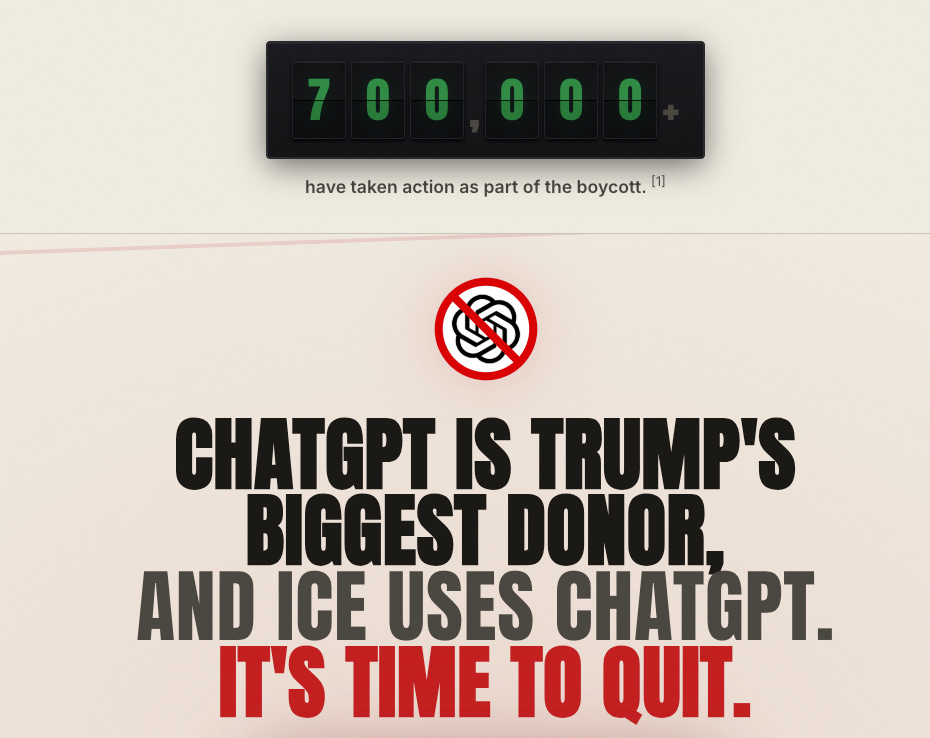
A ‘QuitGPT campaign has been launched by anti-OpenAI activists, claiming 700,000 users have signed on so far.
QuitGPT is a decentralized campaign that has spread through Reddit, Instagram and dedicated websites where users pledge to drop ChatGPT Plus and other paid tiers. Organizers and participants cite several core grievances:
Political contributions by OpenAI leadership: A widely shared claim in the campaign alleges that OpenAI’s president made a major political donation to a pro-Trump super PAC — a move critics argue contradicts the activist values of many Silicon Valley users.
AI use in government enforcement: QuitGPT supporters highlight that tools powered by ChatGPT-style models have been used in hiring or screening processes by agencies such as U.S. Immigration and Customs Enforcement, heightening concerns that AI is being deployed in controversial real-world systems.
Ethical unease and corporate accountability: Beyond specific incidents, the movement reflects a broader uneasiness about who controls the technology users rely on daily and what those leaders’ values say about the tools themselves.
Now, speaking of OpenAI, anyone who was aware of both that particular AI company and the overwrought advertising and halftime show delivery vehicle that is the Super Bowl was likely aware that there was some beef laid out there. Chief OpenAI competitor Anthropic aired some ads ribbing OpenAI for rolling out ads on ChatGPT, and Sam Altman took to Twitter to moan about it.
But Anthropic was far from the only AI company running ads for $8-$10 million a pop during Seattle’s dismal obliteration of the Patriots. There were, as you likely saw, a great many AI ads, and most of them were either terrible harbingers of our dystopian future, or just plain terrible. Here at BITM, I offer you a guide to the worst of the worst.
