


Greetings all,
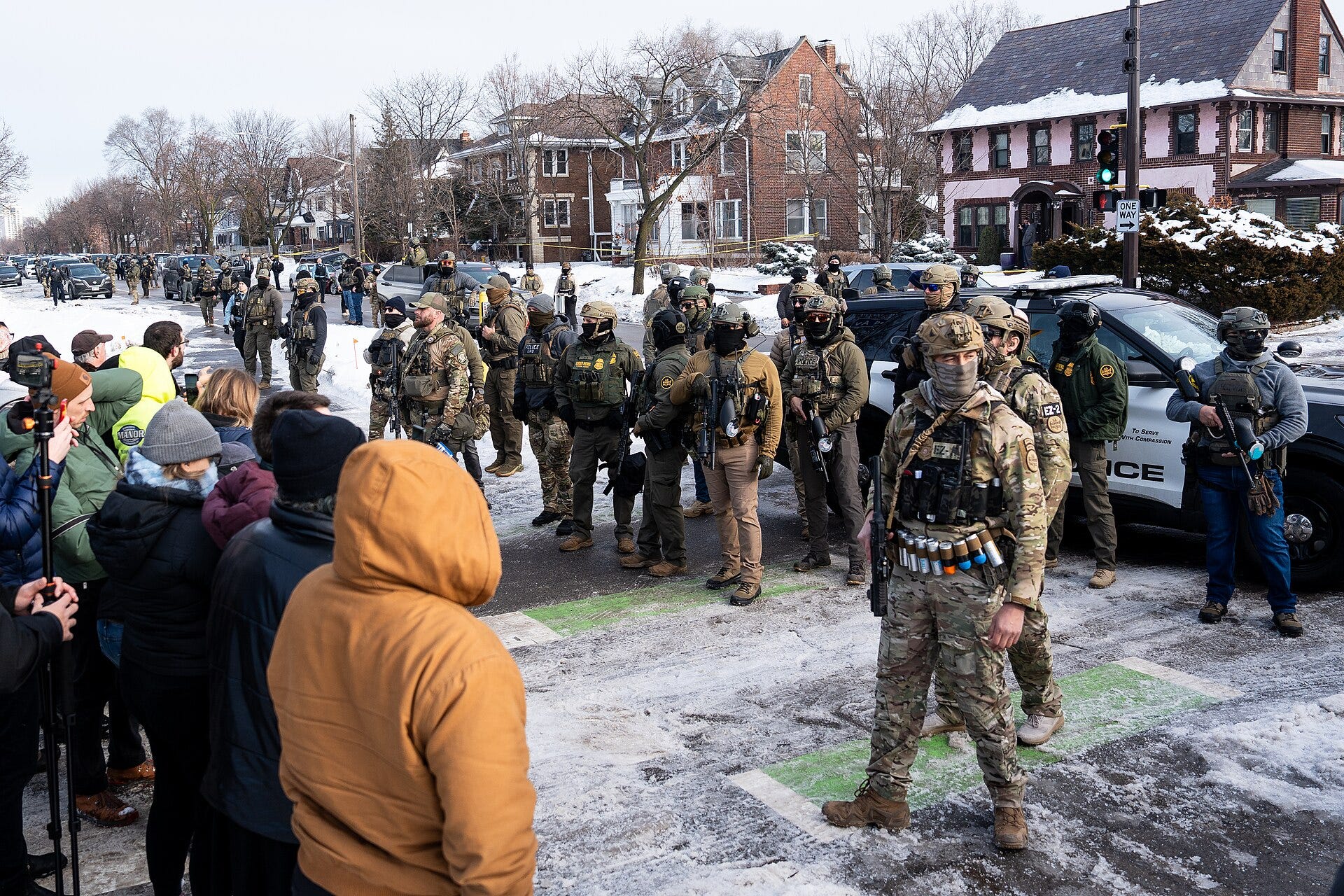
I’ll be honest, I’ve been struggling with how to get the newsletter going again in this already terrible new year. The president of Venezuela is sitting in a Brooklyn jail. The FBI raided the home of a Washington Post journalist. And of course Donald Trump has escalated ICE operations in Minnesota after an agent shot a suburban mother in the head, an action which the president condoned with a rationale that may as well have been AI-generated. ICE officers are now going “door to door” per JD Vance, asking for IDs, and brutalizing migrants and citizens alike. The president of the Minneapolis city council describes it as a military occupation.
The tech elite in Silicon Valley range from complicit to eager participants. OpenAI’s president Greg Brockman was just revealed to be the single largest donor to Trump’s MAGA Inc. Super PAC, to which he gave $12.5 million. Second on the list was Palantir CEO Alex Karp, whose firm has inked multiple deals with ICE. X owner Elon Musk has been rewarded for managing MAGA’s chief digital propaganda platform with another lucrative government contract. Musk himself began the new year by using the platform to spread white supremacist ideas, a trend more tech execs are embracing, and that’s helping to create the conditions for the federal invasion of an American city.
Maybe it’s the whiplash from making an earnest effort to take the holidays off and to attempt to “relax” and delete the social media apps from my phone and all that, and then returning to all this. (I can even isolate the precise moment the brief idyll was ruptured; I asked my wife, “When is your cousin coming over again?” and she replied, looking at a text, “He says we just kidnapped Maduro?”) Maybe it was because during said idyll an inchoate fantasy set in that maybe 2025 would be as bad as it’d get, that Trump might figure his shows of force and violence would suffice, and he’d confine himself to gaudy crypto grifts and self-dealing this year. Maybe it’s that after the US’s Maduro kidnapping, ICE’s killing of Renee Good, and the federal Minnesota occupation, all coming on the heels of last years’ abductions of foreign nationals, initial ICE deployments, and incursions into LA and Chicago, but it sure seems the ‘can it happen here’ question has already been definitively answered. It feels like we’re getting dragged across yet another Rubicon in a fishing net. I had a draft of a post about ‘five predictions for big tech and AI in 2026' that feels pointless to publish now.
Anyway the main thing that you need to know about big tech and AI in 2026 is that they are key pillars of a political economy that is enabling the new American fascism, or whatever it is that you’d like to call the particular brand of dim yet horrifying socially mediated authoritarianism that has crystallized under Trump 2.0.
So forgive me if this is not the most eloquent or streamlined edition of BITM. I am, as I imagine no shortage of you all are, mad and depressed and marinating in dread. But there are some points about what’s happening that might be useful, from the vantage of having covered the tech industry for the last fifteen years, and from having dealt with ICE here in LA in 2025. I just don’t necessarily have the wherewithal to integrate them into a proper “essay” that “flows together” at the moment.
Bullet points first, then I’ll elaborate after the fold.
Silicon Valley and AI have, as many have predicted, helped usher in an age where we find ourselves forced to question the nature of reality itself. But not because AI products are so powerful they now fool us into believing falsehoods about major events. They don’t have to. Tech companies, products (like AI), and platforms like X have chipped away at and undermined our confidence in the nature of “truth,” and in the institutions once entrusted to arbitrate it, and left a vacuum in its place. The Good shooting has clarified that we’re well beyond epistemic closure, that no amount of documentation or evidence matters anymore; the Trump administration understands nothing if not that it can fill that vacuum well enough with a narrative of its choosing. A party in power with its own tech infrastructure and captured media can say and do what it wants, and correctly assume its partisans will support it. And what it wants is a spectacle of violence.
As much as the way ICE is mediating its operation is relatively novel, creating content for dissemination on social media, promulgating highly produced video shorts, and asking its agents to record their own footage, the basic modus operandi is old-fashioned fascism. ICE is waging a nationalistic campaign of harassment and violent subjugation of out-groups and political opponents orchestrated for the benefit of its directors’ imagined audience. Whatever your views on immigration policy, if you don’t find masked agents methodically harassing citizens, throwing people into unmarked vans, and going door to door asking for papers antithetical to American democracy, you’re probably either a Stormfront mod or an ICE agent yourself. Trump is making a spectacle of invading a US state governed by political opponents under the pretense of rounding up a minority group—in Minnesota, it’s Somali-Americans—that his party has worked to smear and malign. It’s domination porn tailored to X, to go along with the AI-generated porn.
Everyone—and especially everyone in politics and the media—needs to understand the specific role that Silicon Valley elites and their platforms have played in ripening the conditions for the ICE raids, Good’s shooting, and the terror now unfolding on American mud. And how they profit directly from the state that is perpetrating it. Google, X, OpenAI, Anthropic, Palantir all cut major deals for federal contracts with the Trump administration last year. The silence of the executives of these companies in the face of the occupation of Minnesota has been noted; their shaping of this authoritarian state less so.
There are glimmers of hope, most of it arising from the people, protestors, neighbors, and community defenders on the ground, who have not been cowed by the omnipresent threat of state violence, and the signs that the public is souring on ICE’s entire project as a result. There are calls for more creative and drastic means of intervention; for economic blackouts and a general strike. What else?

1.
Jonathan Ross’s point-blank shooting of Renee Nicole Good in the head feels exceptional not for its cruelty or even its novelty—this is the United States after all, where a mass shooting or a police killing is always just around the bend—but ultimately, its immateriality to the state. Immediately after Good was murdered, the State Department declared her a “domestic terrorist.” President Donald Trump posted on Truth Social that he’d watched video of the incident—the same video we have all now seen, in which Good attempts to drive her car around and away from Ross, who fires three shots into her head then casually walks over to the crashed car—and decided that Good “viciously ran over the ICE Officer.” Trump adds that “based on the attached clip, it is hard to believe he is alive, but is now recovering in the hospital.”
The surreality of this claim has been much remarked upon already. What’s notable isn’t the lie, since Trump lies copiously and unashamedly (it’s one of his core features, his chief political innovations, even) but the marked disinterest in even appealing to any conception of truth, and the ease with which such a horrific event was slotted into the state’s storyline. How no effort was taken to even bother to square events on the ground. Trump might well have not watched the video at all before he wrote his defense of the ICE agent (pure online poster behavior) his description of its contents was so obviously off base. Trump’s team knows that with enough workable content and the benefit of an official statement, his supporters will advance his preferred narrative; cheerleading, posting support and unwittingly out of context commentary. It might never have occurred to Orwell that authoritarians might successfully beseech their citizens to discount obvious truths simply because they were too lazy to watch a two-minute video clip.
But that’s the point. It didn’t matter. The state is treating this as an online argument that can be won by posting red meat, since Twitter, or rather X, the everything app, is real life now, and the administration no longer feels compelled to even gesture towards the truth. The Trump administration simply declaring what it would like to have transpired, even in the face of ample and obvious documentation to the contrary, works.
This reflects a bleak realization that’s emerged in recent years that confounds one of Silicon Valley’s foundational claims to its role as an engine of progress: That more connection and sunlight do not bring accountability, improve behavior, or deter state violence. Social media, once promised to illuminate the sins of the powerful so as to bring them to justice, have become instruments the rich can easily manipulate to benefit themselves and their interests. Bodycams, once heralded as a high-tech means of promising accountability via transparency, have not curbed police shootings. The violence has continued. On the contrary, ICE officers are now being encouraged to record proactively, to produce their own raid footage and create their own content for dissemination on social media, which is likely why Ross had his phone in one hand taking video while he held his gun in the other when he shot Good.
When more details surfaced, like a video revealing that Ross called Good “a fucking bitch” immediately after shooting her in the face, Trump simply adjusted his story on the fly, saying Good’s crime was being “disrespectful.” It could not matter less whether she was assaulting an officer with her car or just being rude; her death can be explained away, even made useful. The Department of Justice was instructed to open an investigation into her purported terrorist activities that is such an obvious sham that six prosecutors have quit rather than participate.
This is why, to me, these last weeks have been particularly unmooring, even after the endless chemical train wreck of 2025. The media and technology critic Neil Postman famously argued that the incipient American dystopia wasn’t the blunt overpowering fascism of 1984, but rather Huxley’s intoxicatingly mediated brave new world—we were all on the brink of amusing ourselves to death. It turns out they’ve both arrived, in tandem; the state is booming obvious falsehoods in our face and demanding we accept them, and they are simultaneously being packaged into infotainment to delight the converted and enrage the opposed. It’s a feelie that tells us 2+2=5.
We’ve been headed this direction for years, even before Trump; at the dawn of the social media era liberal commentators decried the developing world of post-truth politics. Trump’s adventuring is abetted by an information ecosystem that has grown thoroughly fractured and corrupted, with journalistic institutions hollowed out and undermined, social media networks offering eminently gameable portrayals of the truth, and AI undercutting the entire notion of trusting your eyes, well, here we are.
A violent, revanchist state, motivated by its executives’ petty grievances, racial animus, and a desire above all to create spectacle, can manufacture or elevate any narrative it would like to justify or promote its aims. (Trump would in fact prefer someone else do the manufacturing, which is why the horrors in St. Paul and Minneapolis are the result of a low-rent viral “investigation” by a 23-year-old MAGA influencer that sensationalized already reported and ongoing fraud investigations, but more on that later.) And what it aims to do, for now, is occupy Minnesota, a state governed by high profile political opponents Tim Walz and Ilhan Omar, and that is home to one of the most unjustly maligned migrant populations in the nation, Somali Americans, and, per vice president JD Vance, “go door to door” asking for papers.
So that’s what’s been happening. Two thousand more ICE agents ordered into the state to support the operation, and the week has been a deluge of horror stories: US citizens forcibly ripped from their places of work by ICE agents and then dumped in nearby parking lots. ICE agents demanding entry to a private family home to extract a terrified DoorDash driver they chased into the basement. Disabled women torn out of their cars at gas stations. Those on the ground detail a city lined with abandoned cars, helicopters circling, stores stocked with whistles and plastered with signs exhorting ICE to keep out.
2.
Late last fall, the small church in my neighborhood where my sons take piano lessons and taekwondo, the place that serves as a community center and hosts annual holiday parties, that hung little toys from the trees out front during the early days of the pandemic so kids could have something to look forward to, was taken over by ICE for use as a staging ground. The pastor and church staff didn’t lock the gate to the parking lot, and ICE just rolled in with its vans and SUVs and tactical gear and wouldn’t leave.
My neighborhood is sleepy and residential and pretty small; it’s essentially the church, two public schools, a daycare, a few restaurants, and housing. Notably, there’s a major supermarket with a huge, often-empty parking lot just a few blocks away that ICE easily could have used instead if it was targeting anything other than the aforementioned institutions. I’ve heard speculation that ICE had staged in the church parking lot because the progressive pastor there had spoken to local media about preparing the community for an ICE incursion. Regardless, ICE was in and out—right down the street from me—before I even knew they were there. It’s unclear if they abducted anyone.
It shook me up. I knew ICE was in LA of course, I’d been to the protests downtown, and written about them here. But it’s different when the threat comes home. When you can name the school employees, childcare workers, and instructors who you see around the neighborhood, who have taken care of your kids, who may have been targets, the violence and vileness of what ICE is doing fully takes root.
I got in touch with a group that supports vulnerable local workers and holds fundraisers for families impacted by ICE. I attended a community defense training held at another local church, and spent some time with groups and patrollers doing rapid response work. I went to a supermarket shortly after ICE abducted two day laborers who had stopped in for lunch. Employees there were traumatized, and one shared cell phone video of the raid. The fear and anger is everywhere, even if most of it is still latent.
I’m going to be a little careful about details here, because this kind of community organizing is what Trump’s justice department is now equating with domestic terrorism, as it has accused the late Renee Good of perpetrating. It is of course nothing of the sort: It’s a neighbor-led effort to prevent families from being torn apart. Rapid response and community defense organizations find out and keep track of who has been targeted or abducted by ICE, and where. They inform the families, who often have no idea if their husband or wife or son or daughter has been taken. They try to alert workers and communities when ICE is in the area and keep businesses and individuals informed about how to prevent abductions as safely and legally as possible.
Spend any time with an organization like this, and, thanks to their work, you are likely to realize that
The vast majority of people ICE targets are not dangerous criminals. They are food vendors, day laborers, gardeners; the most vulnerable migrant workers, and thus easiest to pick up. This is one of the first things to become abundantly clear. ICE has quotas to make, this is why they do so much racial profiling and grab those easiest to grab.
These groups are shoestring local operations run out of churches and group chats. They are made possible only by neighborhood folks donating time and donuts and the idea that there’s some liberal megadonor or infrastructure enabling these operations is laughable.
The people at these meetings are obviously not masked antifa supersoldiers; they’re grandmothers and college kids, yuppies and activists, dog walkers and IT guys. They are Renee Good. For every DSA-type in attendance, there are approximately three nervous-looking civilians who are there because of the sheer moral repulsion they feel at what ICE is doing and their deep-seated desire to do something about it.
This not a fringe idea. Polling now shows that more people want to abolish ICE—once considered a demand of the radical left—than keep it. It’s not hard to see why. ICE is radicalizing people against it all on its own; a father of six, who was not a protestor, and was simply trying to drive his children, one of whom is a six-month-old infant, to safety, had to take them to the hospital instead after an agent threw a tear gas grenade at his car.
Watch the video of the event mentioned above, taken in a house in Minneapolis that has been surrounded by ICE agents. It’s not clear what exactly has happened until partway through, and it’s horrifying when it becomes clear. A family ordered DoorDash, and ICE agents followed the delivery driver to the customer’s house, and she ran inside, down into the basement to hide. The family, which has a small child, is on the phone with the police trying to figure out what to do, as the ICE agents threaten to arrest the family for harboring a fugitive. When the family finally swings the camera down to reveal the woman in question, she is paralyzed with fear and begging for her safety.
This stuff is happening all the time now. You may have seen the video of the man dragged out of Target, thrown in a van, apparently beaten, and thrown back out a few blocks away. Or the one where an ICE agent shoves a protestor into oncoming traffic. Or the video of ICE intentionally crashing into a car to remove its driver.
It’s not just Minnesota. In the middle of writing this, I turned on the morning news here in California, and Good Morning Los Angeles was running a story about ICE agents targeting food vendors in LA county. CBS aired another one about ICE’s attempt to grab two landscapers, each of whom held green cards and no criminal history, and who’ve been in the US for 40 years.
But again, the Trump administration and its adherents will likely never bother to watch any of these reports, as they don’t have to. They are after all primarily interested in how the operation is disseminated on X.
3.
Someone quipped in the wake of the Maduro affair and the Good shooting that it looks like consent doesn’t even need to be manufactured anymore. It was a good line, but I would argue that consent is simply being manufactured preemptively, or in realtime, all the time. The consent manufactory is on autopilot, mostly on X, where there is an omnipresent incentive structure for users to create content that feeds the state’s preferred narratives. You could get retweeted by Elon Musk, or JD Vance, after all, and double your audience overnight.
There are few better examples of this than YouTube influencer Nick Shirley’s viral video that helped kick off the latest chapter of this mess in Minnesota. When I started watching this, I almost couldn’t believe how bad it was. It’s unbelievably lazy and slapped together, filled with AI-generated b-roll, it’s based on reporting and cases that are already widely known, and Shirley himself seems not to have read the VO script before recording it, as he’s constantly stumbling over words in the narration. But, and we’re locating a theme here, it doesn’t matter. The tagline and the video’s mere existence were enough to make it useful to X’s algorithm, to Trump, and to ICE; and now there’s a violent occupation of Minnesota.
There’s a case to be made that X is the modern right’s single most important institution. I hesitate to call a glorified 4Chan board with an AI porn generator grafted on an institution, but you know what I mean. Entity, org, whatever. Certainly its most important platform. It’s where the right constructs and processes its political imaginary; where scorn is heaped on the crying libs and where police raids and humiliated minorities are celebrated. As owner, Musk personally participates in this project as well as profits from it. Max Read makes a good argument that Musk’s current, seemingly unimpeachable power stems from his ownership and stewardship of X, and the platform’s centrality to global politics. (Which is why almost none of the world’s most powerful governments are even able to address the platform’s disturbing child sexual abuse material problem.)
But Musk is not simply profiting from his leverage of course, he’s a key sculptor of this political imaginary, too. Apart from maybe Trump, no one sets the standards for how politics are to be performed, and what kind of content will be generated to capitalize on its performance, more than Musk. Along with posting memes and material that support the ICE operation in Minnesota, Musk has been sharing some of the more explicitly white supremacist posts of his tenure, which is of course saying something. He recently shared a thread from an writer whose project is argues that “white solidarity is the only way to survive” and who purports to explain “why racism is moral.” Other execs, like Thiel acolyte and Palantir cofounder Jon Lonsdale, are following suit:


And so the days of dog whistles are over. Thanks in part for Musk’s preference for white supremacist politics, and its dovetailing with Trump’s own, the Trump administration is now using openly white supremacist sloganeering in its comms and recruitment materials online, on X, on Instagram. Per the Intercept:
“There was a sense of plausible deniability before,” said Alice Marwick, director of research at Data & Society. Anti-immigrant backers of Trump’s Make America Great Again movement have long been known to spread extremist language and media, but in the past, “those dog whistles were being done by supporters,” she said. “Now they’re being done directly by the administration.”
How far we’ve come since the “debates” over Trump’s (or Musk’s) racism.
Finally, it needs to reiterate that it’s not just Musk. Much of Silicon Valley is an open and willing participant in all of this. OpenAI inked a $200 million annual contract with the DoD last year. It’s still hoping for support for the Stargate data center megaproject, and federal backing in the event of a collapse. Anthropic, Google, and xAI all have contracts worth up to $200 million each with the DoD, too. Palantir’s latest ICE contract netted $30 million. These companies, Anthropic excepted, joined Meta and other Valley heavyweights like Andreessen Horowitz in lobbying for a moratorium on state lawmaking around AI. They failed to get legislation passed, but they won an executive order they hope has a similar effect. Perhaps unsurprisingly, none of the CEOs from any of the above companies have said anything about the ICE occupation or the shooting of Good.
Some prominent tech workers outside the c-suites, including a handful of well-known figures like Google’s Jeff Dean, are circulating a petition calling on their companies not to work with ICE. Unlike the groundswell of support such sentiments garnered in 2016, the response has been muted; it has at time of writing only 150 signatories. Considering that Google alone has nearly 200,000 employees, and that 20,000 walked out in 2018 in protest of the company’s sexual harassment issues, pay inequality, and forced arbitration policies, the ICE petition number is notable primarily for how strikingly small it is.
4.
If there is any hope at all here, it is, as usual, to be found in those on the ground who despite everything are still standing up for their neighbors. The occupation has ignited a wave of national resistance in other ICE-occupied cities and rapid response groups are in action. Meanwhile, faith groups, community leaders and unions have called for a general strike and an economic blackout on Friday, January 23rd.
CBS Minnesota reports:
Auxiliary Minister JaNaé Bates Imari of St. Paul’s Camphor Memorial United Methodist Church led the conference, calling for Minnesotans to “leverage our economic power, our labor, our prayer for one another.”
“What we have seen and what we have witnessed, what we have all gone through is not normal,” Bates Imari said. “[Renee Good was] standing up for her neighbor. Her whistle blowing was returned by bullets. We will not, we cannot let that stand. Minnesota will not continue to be a testing ground for the kind of fear and violence that is expected for the rest of this country.”
They’re asking for Minnesotans everywhere to stay home from work and school, and to refrain from shopping. Local unions are on board, and rideshare drivers are asking that fellow workers deactivate the apps for the day. Protestors are tired and overwhelmed, with little help on the way from elected Democrats. But the polling suggests most Americans are with them, regardless of the hateful content spun up on X or wherever. This suggests to me that alongside our resistance we must begin thinking far beyond electoral politics and even abolishing ICE—though that is a reasonable starting point—and onto imagining how the socio-technical infrastructure that has undergirded and accelerated this entire project might be dismantled, repaired, replaced.
Let me to get a little corny for a second. I’m tired. These are dark times. Don’t forsake your neighbors. If ICE is operating in your area, there’s much you can do. Talk to your neighbors, pastors, and local businesses. Download Signal. Get in touch with a rapid response network if you want to learn more about other ways to help and feel that you can do so. If you’re going to protest or observe ICE, go to a training first; there are community members and activists who know this terrain. If you’re in LA, reach out to a group like CHIRLA. Report ICE sightings to groups like West LA Rapid Response. But please be safe. And if you’re a politician, for god’s sake, get out there on the streets with your constituents.
Thanks for reading, and more soon.
Some further reading:
“Donald Trump is waging war against human conscience” by Osita Nwanevu. What an essay.
“Renee Good Was the Kind of Person I Should Be” By Jenée Desmond-Harris.
404 Media’s ICE coverage. Follow this.
“We’re all just content for ICE” by Ryan Broderick. Good on the ground reporting from an online culture background.
“My final message before I’m on an FBI watchlist: Palantir, Epstein, & The New York Times” by Juan Sebastian Pinto. Fascinating connecting of the dots from a Palantir whistleblower.
"I am, as I imagine no shortage of you all are, mad and depressed and marinating in dread."
As alarmed as I am as well, I want to advance the following notion - us that have been standing before and that have seen this coming, we of all people should not fall into desperation or marinate in dread.
It is justified. Of course.
It is understandable. Of course.
But also: it's manufactured and absolutely intentional. And I do think we have to make it part of our counterattack to be - also against my own feelings and inclinations - to be as upbeat and as brave and as utopian realist as is possible in any way and to keep each other in that space.
They want us afraid and they want us shaking and we should not give them an inch.
And we don't have to. They are cowards. They are pathetic. And as scary as what you call "being beyond epistemic closure" is, we are better equipped to deal with this than anyone. You are, certainly, too. They are kneecapping their institutions left and right because they quite enjoy being in denial of reality. They are building a house which WILL fall, inevitably, the question is just how much destruction it will cause in the process.
It's going to be fairly dark, you are right, which just means that it's time to light the beacons.
In this spirit, thank you so much for all your work and for keeping us updated, it is invaluable already and gets more important by the minute. May we all live to see a day when we can go back to wondering whether what we are doing matters at all, because now it does.
I am grateful and happy that you are around, I am grateful and happy that you are still standing, and I am grateful and happy for all these people in the States that show up every day and prove that no amount of brainwashing and institutional failure will make them succeed.
We're going to have this. And we're all going to keep each other safe. These pigs got nothing on us.
Venceremos, comrade.
Well this is totally expected. OpenAI has just announced they are introducing ads to ChatGPT. They must be feeling awfully sure of themselves. Here's the announcement and it's very creepy.
https://openai.com/index/our-approach-to-advertising-and-expanding-access/