


Last Friday, Amazon’s anodyne corporate campus in Santa Monica, California was overrun with protestors. Hundreds gathered on the corner of Olympic and 26th, some waving signs with messages like ‘AMAZON POWERS ICE’. Cheers from the crowd erupted at one point as a contingent of high schoolers showed up and marched down the sidewalk en masse. The demonstration was part of the ‘ICE Out’ day of action arranged in solidarity with Minneapolis; the site had been chosen, organizers said, because of the tech giant’s role in ICE’s operations. Amazon signed a $25 million contract with ICE last year to operate its cloud services and databases.
“Our goal today was to draw the connection between ICE’s cruelty and the digital infrastructure that Amazon provides to give them the ability to target and capture migrants,” Carter Moon, one of the event’s organizers, told me.
“Big tech has not caught enough heat for this,” said Olga Lexell, a screenwriter and former tech worker. “It’s people like Elon Musk, Jeff Bezos, Sam Altman, Mark Zuckerberg—the tech CEOs who are using their tools to facilitate these deportations. They can actually do more now than anyone in our government probably can.”
Lexell said that when she was on the metro on way to the protest with other demonstrators, she overheard a pair of Amazon workers worriedly discussing the backlash. They had evidently not been aware Amazon was a partner with ICE at all. This was part of the reason Lexell says she joined the protest, to try to get Amazon employees like them to learn about their company’s associations with ICE and the Trump administration—and, ideally, to walk out.
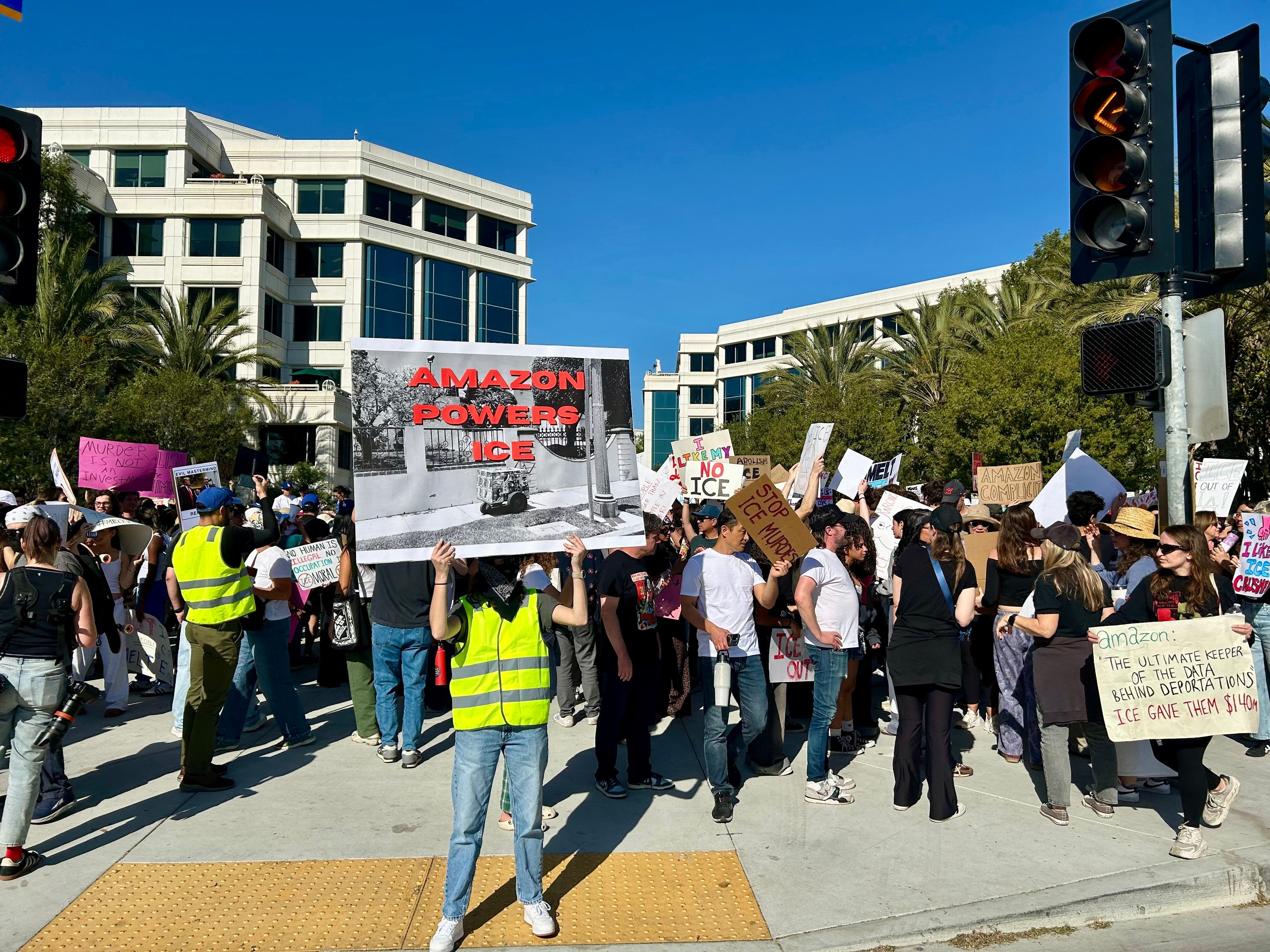
So far, none had, as far as anyone could tell. It can be difficult to absorb, perhaps, both for consumers and employees, the full extent to which Amazon and its leadership have become instrumental to effectuating the state’s authoritarian projects. Perhaps events of the following days made it a little bit clearer.
The week after the ICE Out Amazon protest, Jeff Bezos, who in 2013 bought the Washington Post, laid off 30% of its staff. He eliminated the newspaper’s books and sports sections, gutted critical tech, climate, and international coverage, fired decorated war correspondents while they were still in a combat zone in Ukraine, and “reset” the paper to focus on national security and American politics, according to NPR. IE, subject matter areas that are less likely to offend or unduly complicate matters for Donald Trump. (There have of course been plenty of bleak jokes about the paper’s motto.)
The Post’s former top editor, Marty Baron, says he thinks Bezos’ layoffs stem from a single motivation and that motivation is appeasing the president. Here’s Baron on MS Now:
“Trump came into office again. He had promised vengeance against his perceived political enemies. Jeff Bezos was seen as a political enemy by Donald Trump for one reason and one reason only, and that was the coverage of the Washington Post.”
….Bezos feared “reprisal” against not just Amazon, but also against what the former Washington Post chief described as the “object of his passion,” Blue Origin, the private space company that holds significant government contracts. “And so he has sought to navigate this administration during the second term.”
Bezos has done this navigating much the way the other tech oligarchs have, with obsequious gestures of ring-kissing and flattery and ample naked transactionalism. With Amazon’s role in ICE operations under greater scrutiny and Bezos’ dismantling of the organ that once proudly declared itself on being a defender of democracy, it’s worth recounting and examining just how closely intertwined Amazon, Trump, and the federal government have become—and how closely aligned their projects are.

Amazon donated $1 million to Trump’s inaugural fund; a symbolic gesture of goodwill. It also made an in-kind donation worth $1 million by livestreaming the inauguration on Prime. In the run-up to the election, Bezos intervened to kill the Post’s endorsement of Kamala Harris, and then reorganized the paper’s opinion section to focus exclusively on subjects that championed “personal liberties and free markets,” both moves seen at the time as aimed at placating Trump.
The same is largely assumed to be the intent behind the $40 million that Amazon spent for the Melania vanity documentary project—a full $26 million more offered by the next-highest bidder, Disney. Amazon then spent $35 million conspicuously marketing the film; more than it has budgeted for any other documentary. The day after Alex Pretti was shot and killed by federal agents in Minneapolis, current Amazon CEO Andrew Jassy attended a private screening of the film at the White House, with other tech elites like Tim Cook. The company issued no statement.
Amazon’s entreaties have worked; government contracts have been signed, Amazon execs and Bezos have been regular attendees at White House events, and both sides have seen benefits to working in tandem. When Amazon leadership threatened to list the additional cost of products incurred by tariffs, a phone call from Trump was all it took to dissuade them. (“Jeff Bezos was very nice. He was terrific,” said, per CNN. “He solved the problem very quickly. Good guy.”)
As the former Post editor Marty Baron pointed out, part of this favor-trading is aimed at staying in Trump’s good graces to advance Bezos’s personal projects—Blue Origin has continued to reap contracts and favorable treatment—but perhaps a larger part is to advance Amazon’s material business interests. The federal government, after all, is an enormous purchaser of Amazon’s services.
In September 2025, Amazon signed the aforementioned $25 million contract with ICE to help run the agency’s cloud services. As Forbes put it, “under the second Trump administration, ICE has spent more on cloud services from Amazon and Microsoft than ever before, according to federal contracting records.” Under Trump, Amazon Web Services also entered into a deal worth $1 billion to help manage other civilian government services. AWS also hosts the software run by Palantir—perhaps the biggest ICE contractor in tech.
That’s pennies, however, compared to Amazon’s other contracts with other federal agencies. In 2021, during the Biden administration, Amazon inked a 10-year, $10 billion deal with the National Security Agency. The NSA, of course, is the spy agency that was marred by scandal in 2013 when Edward Snowden revealed it had illegally been collecting and storing extensive phone and online data from American citizens. Along with Google and Oracle, Amazon has a $9 billion contract with the Pentagon to operate the Joint Warfighting Cloud Capability program. Amazon Web Services manages many other smaller contracts for the government as well, including with the CIA and the Navy; those mentioned are just the largest.
Suffice to say that the tech giant has insinuated itself rather deeply into the routine operations of the federal government through the management of a large swath of its digital infrastructure and database systems. Amazon is providing the technical architecture for the federal security state—for ICE, the NSA, the Pentagon, and many others—that is actively enabling that state to surveil residents of the United States, and to conduct its ongoing campaigns of violence. Remember, it’s not just databases of migrants the federal government is managing, but of American citizens marked as “domestic terrorists,” which includes an ever-expanding group of people, like Rene Good, who are community organizers, protestors, and legal observers. Tom Honan, Trump’s border czar, has called for the creation of databases of anyone opposing or interfering with DHS actions.
Amazon is providing the bulk of the cloud architecture to make all of that possible, and it’s making billions in the process.
But it’s not merely the technological architecture the state is implementing, but Amazon’s ideological architecture, too. This April 2025 report from a border security conference held in Phoenix the Arizona Mirror made the rounds last year, and it’s worth revisiting now:
The leader of Immigration and Customs Enforcement said that his dream for the agency is squads of trucks rounding up immigrants for deportation the same way that Amazon trucks crisscross American cities delivering packages.
“We need to get better at treating this like a business,” Acting ICE Director Todd Lyons said, explaining he wants to see a deportation process “like (Amazon) Prime, but with human beings.”
This is what Bezos or one of his remaining sufficiently ideologically restricted opinion writers might call a free exchange of ideas: Jeff Bezos has learned that he can submit the free press to authoritarianism to serve his interests, while the authoritarians have learned they can behave more like Amazon to serve theirs.
The convergence makes sense. Amazon fueled its rise by dehumanizing its own workforce, demanding machine-like productivity from workers and so relentlessly surveilling and tracking their movements and time-on-shift that some famously felt they had no choice but to pee in bottles to avoid being penalized. ICE’s project is of course predicated on surveilling and dehumanizing immigrants and political opponents, and it’s little wonder it finds Bezos’s regimen so appealing. Or that Amazon is letting ICE raid its facilities across the country, helping to move those workers it does not see as human from one assembly line to another.
All that’s standing in the way, as in Minneapolis, are peers; ordinary citizens, neighbors, and coworkers. Which brings me back to the hundreds of people—high school students, Santa Monica moms, DSA members, tech workers, and everyone else—who turned up at the ICE OUT AMAZON protest last week.
“You know, a key part of fascism is the alliance of corporations and the state, and a mutually beneficial relationship of them profiting off of the government’s cruelty, which is exactly what we’re seeing here,” the organizer Carter Moon said. “I don’t know how much leverage we have to get Congress to get their act together, but I do think we have leverage to pressure places like Amazon to drop their contracts. You know, they need our Prime subscriptions. They need us to keep shopping at Whole Foods.”
In that vein, actors from across the political spectrum, from activists in the Nation to the business professor and podcaster Scott Galloway, are calling on people and consumers to boycott Amazon (and the other tech companies enabling ICE operations). Consumer boycotts are of course a notoriously challenging protest tactic, but anti-ICE sentiment is through the roof. And realistically, it’s going to take all hands on deck at this point.
“In the grand scheme of things, I don’t think that Amazon will ever cut contracts with ICE or anything like that,” the protestor Levell said, “but I do ultimately think that the workers within Amazon can do a lot to prevent Amazon from being able to facilitate this stuff.” Even before the ICE out event, last year, small groups of Amazon workers were organizing rallies calling for the company to cancel its ICE contracts. We can only expect those calls to grow. Just today, as I was wrapping this post, news broke that 800 Google workers had formally demanded that their company drop its ICE contracts. It was organized by No Tech for Apartheid, a group of Amazon and Google workers who had previously protested their companies’ military contracts.
(This is the kind of thing that the Washington Post’s tech reporters might have covered, had they not been fired. Among those let go were Nitasha Tiku, one of the very best critical tech reporters working today, and, of course, the great Caroline O’Donovan, who covers, you guessed it, Amazon.)
The lines have been drawn, and Amazon has chosen its side. It’s going to take this kind of ground-up organizing and protest, and much more of it, to challenge its entrenchment with the state. Jeff Bezos and the executives at Amazon are transforming the institutions they control into willing instruments of authoritarianism. And calls are rising for white collar Amazon workers to step up.
“Many of the people who work here are ultimately neighbors in this community,” Levell said, gesturing at the Amazon Studios buildings behind her. “And they should know that the neighborhood knows that they’re complicit in the kidnapping of our other neighbors.”
Another bad week in the books, eh. There was a bright spot, I should mention—on Tuesday, I traveled to Sacramento to speak at a conference put on by the California Federation of Labor Unions, called Taking on Tech. There were lots of talks and great conversations with some of the smartest folks working on this stuff today, and reason to think that unions are starting to more forcefully mobilize around AI, job, and workplace impacts.
Alas, I had to jet back home and missed the second day, due to the norovirus absolutely ripping through the household back home. The kids were home sick from school most of the week, puking away; my poor guys. (This, I will add, is why this week’s edition is so late. Sorry! I’m scrambling to publish before I succumb to it as well.) At least I got to catch some of Porco Rosso, a delightful and anti-fascist Studio Ghibli film I’d never seen before.
Things I’m looking forward to reading after I come up for air:
-This whole exchange of essays between Evgeny Morozov and Aaron Benanav in the Ideas Letter, over how to approach AI.
-This letter from Senator Ed Markey to autonomous car companies about their business practices, safety policies, and labor impacts. Waymo is in especially hot water after hitting a kid outside an elementary school and not stopping for school buses in Austin.
-Move Slow and Upgrade, a book by the philosophy professor Evan Selinger and Albert Fox Cahn, the Surveillance Technology Oversight Project's founder and executive director.
While I’m assigning homework, consider checking out and signing this petition—the California State University system is currently spending millions on OpenAI contracts while laying off human faculty:
And finally, a little further reading on the Washington Post debacle:
-How Jeff Bezos Brought Down the Washington Post, by former Post reporter Ruth Marcus in the New Yorker.
Fun/bleak one from friend of the blog Dave Karpf:

Okay, that’s it for today. Thanks as always for reading, and a short reminder that paid subscribers make this entire project possible. It’s your backing that allows me to head out to cover ICE and Amazon protests, to interview tech workers and activists, to travel to labor conferences to talk to leadership about AI—these are unpaid gigs—and to take time off to take care of my kids while they are in the throes of sweaty delirium yet still finding the will to bicker with each other over what movie to watch.
Thank you all, and hammers up.
I don't think we should boycott Amazon. I think we should endeavor, as much as it is possible for each of us, to NEVER BUY ANYTHING FROM THEM AGAIN. The goal is not to pressure them to change their practices--that is unlikely to be effective (we'll get at best, cosmetic or temporary change). The goal is to drive them to bankruptcy, along with X, and Google and Open AI. There are alternative ways to buy books, and everything else; deliveries can be by US mail or UPS/Fedex. Finding better, more local or more self-provisioning ways to meet needs is good practice for when things break down further, and withdraws support from the system. We can't vote this shit away, the Dems are not much better. Oh, and don't use AI! A mass refusal to use it will cause the bubble to pop sooner, and save us from some of those data centers, along with some of the rest of the dystopias these powerful psychopaths are dreaming up.
“Better to be a pig than a fascist” — Marco “Porco” Pagot (Porco Rosso). Great film!