


Just take a second and scan these headlines. You’ve probably seen many more just like them.


You’re also perhaps familiar with the gist of what that they describe: Americans overwhelmingly hate data centers. They overwhelmingly dislike Flock surveillance cameras. And now it seems they overwhelmingly despise Meta’s newest product, AI-infused Ray Bans that have been widely termed “pervert glasses,” too. Enveloping all of the above trends is a general, percolating dislike of Silicon Valley’s marquee pursuit, generative AI; a sentiment underscored, again, by a slate of recent polls.
(I will note that, if you’ve been reading this newsletter, you’ve been well aware of each of these trends for many, many months at this point.)
Here are a couple more headlines, for good measure:


A grand jury refused to indict a man caught destroying Flock surveillance equipment on camera. Data center and Flock protestors are cheered as heroes, and finding viral fame. Grifty content farms have sprung up to churn out anti-tech memes because the genre is so popular.
It’s almost funny to think back to the mild wave of public consternation and Congressional wrist-slapping that pundits termed “the techlash” in the heady days of the first Trump administration, over concerns of disinformation on Facebook and social media, compared to what we’re seeing now. That is, a genuine, sustained demonstration of rage at some of the modern tech industry’s key aims.
And all of this has become so clear, so palpable, and so widespread that it’s apparently causing tech industry leadership and pro-AI policy wonks to enter either a state of denial or something more akin to fevered delusion.
I’m back on a weekly writing schedule after a spell of getting the podcast up and running. Subscribers will get (at least) one written newsletter edition sent to their inboxes each week, typically, ideally, Tuesday or Wednesday, as well as one episode of Blood in the Machine: The Show, which will go live every Friday. I can only do all of this with the support of readers like you, so if you find value in independent, critical tech journalism and analysis, please consider becoming a paid subscriber. I want to keep as much of this un-paywalled as absolutely possible, and there’s been a pretty intense period of churn lately. Many thanks to all who continue to chip in, it’s very much appreciated. Cheers and onward.
Back in the spring, when a series of anti-AI and anti-data center actions caught national attention, many in the industry reacted with what was at least surface-level contrition. They were taken aback by the magnitude of the outrage, and some lamented that AI companies and executives had failed to issue positive messages for their products, so most Americans didn’t know how useful and good AI could be.
Ultimately, the industry decided not to change much of anything at all, whether the messaging—not that I think it would have mattered much—or the approach to their business in general, and, surprise, opposition to data centers has continued to spread.
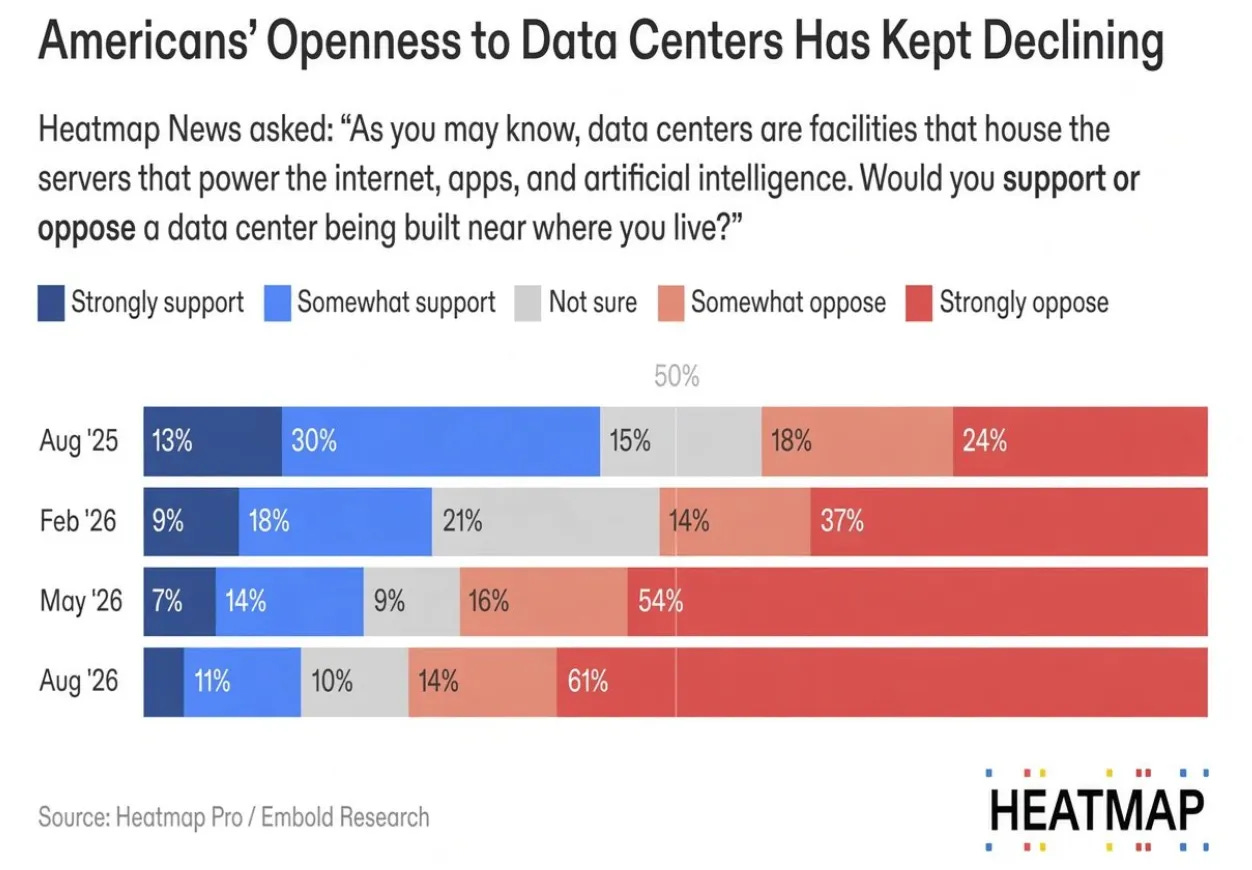
Last week, in response to a fresh round of politicians announcing policies to slow or pause data center development, and the release of two new polls, including a Heatmap survey that found 75% of Americans would now oppose data centers being built where they live, AI industry players eschewed gestures towards contrition and essentially just melted down.


Many have been reduced to accusing the anti-data center movement of being a ‘psy-op’ funded by the Chinese Communist Party or the product of “psychosis”, or arguing that actually, we shouldn’t need to defer to ordinary people on matters regarding technological development anyway, or claiming that the movement was propped up by paid shills backed by the AI safety industrial complex, or even, in by far the funniest example, that opposing data center construction is inhumane because it amounted to genocidal population control on soon-to-be sentient AIs.
It’s a thing of beauty, really.
In short, it’s getting unhinged out there. And there are similarly calibrated if slightly less insane efforts to pick apart the Flock protests and the widespread disdain for AI, too. These pundits and industry leaders are affecting a kind of stricken bafflement over it all, which is pretty embarrassing for them. I guess we have to break out Upton Sinclair’s line about the difficulty of getting a man to understand something when his salary depends upon his not understanding it again.
What’s happening, after all, is pretty simple: Tech companies have encroached into Americans’ personal lives and public spaces, with both development projects and surveillance products, and people find the tradeoffs unacceptable. It’s really not complicated. Data centers, Flock cams, and AI glasses have been thrust into the public sphere by tech companies, with little to no preceding democratic input, and they are being rejected with extreme prejudice, because people do not like what these things do or what they represent. There is an additional layer of anger because people feel that they weren’t consulted; these vast infrastructural buildouts and high tech privacy violators pretty clearly tap into a shared sense of resentment and powerlessness.
One of the big stories of the last decade plus has of course been the story of rising inequality, and of working class Americans becoming economically and politically disempowered. What serves as a better totem to this sentiment better than a megaproject erected under the cover of a panoply of NDAs to build a mass job automator for a trillion-dollar tech company? Or an assemblage of spy cameras that scan your vehicular movements in public and share data with ICE so they can track down and deport migrant workers? The pitch appears to be “Your neighborhood will be transformed and surveilled, not for the benefit of you, but for a distant tech company and an increasingly authoritarian state” and people are, shockingly, not buying it.1
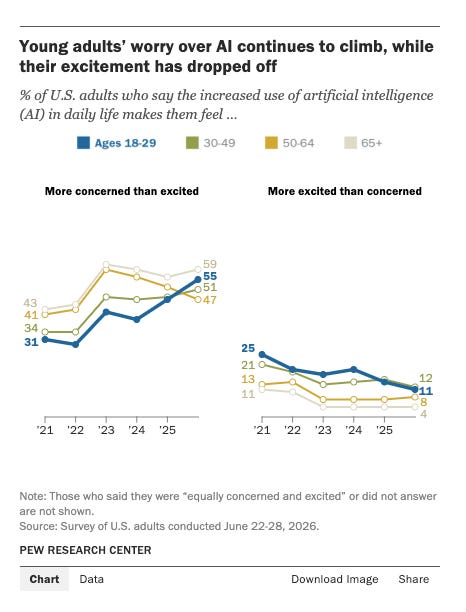
It doesn’t help that people dislike the broader project the data centers and surveillance devices are enabling, either. Recent public polling bears this out. It’s not reaching the same pitch as data center opposition, but sentiment is quite negative on AI, and still falling:
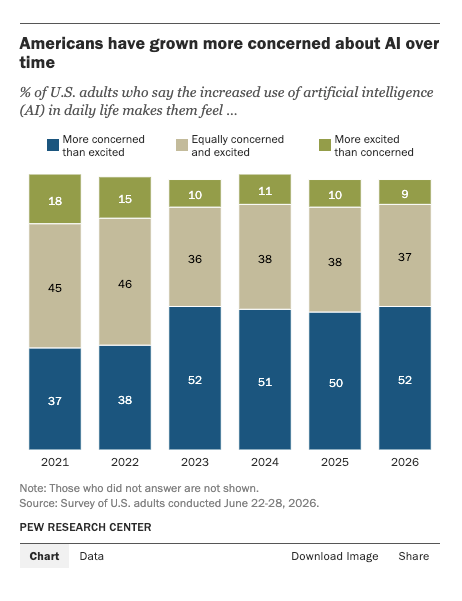
And only 9% of Americans are more excited about AI than concerned about it:
Meanwhile, young Americans overwhelmingly distrust the tech executives at the helm of the data center expansion and the AI booms alike:
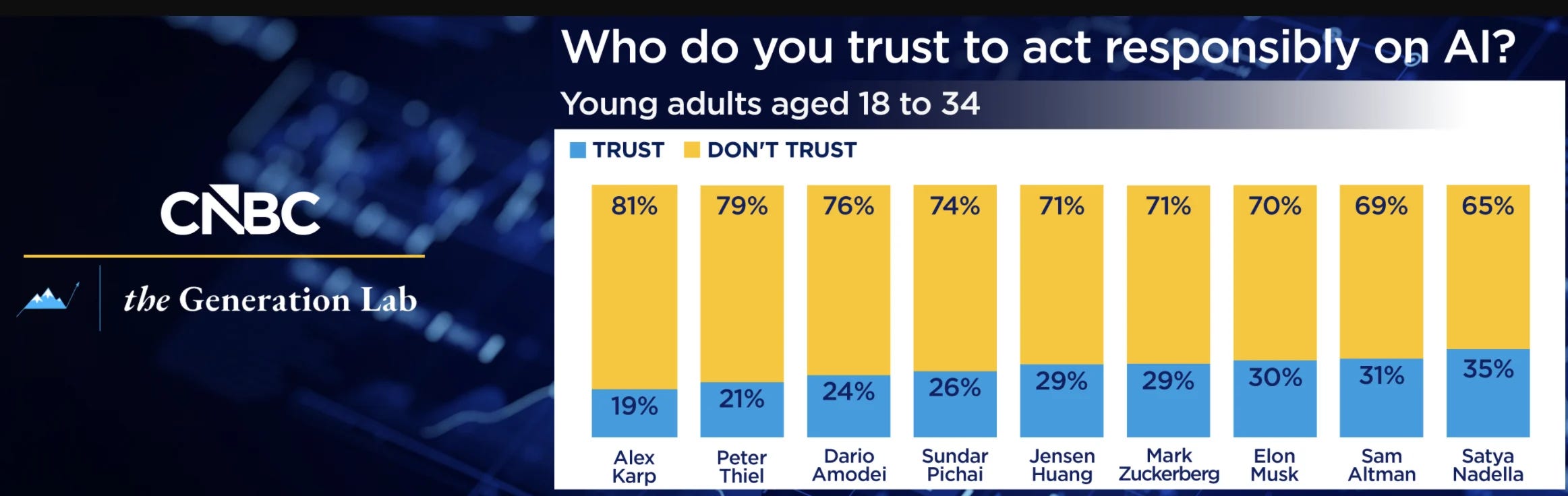
Remember! The above CEOs have spent years publicly promising to replace millions of jobs with their software. At a moment when consumer confidence is in the toilet, and, thanks to inflation, a profoundly and tragically stupid war in Iran, and, yes, AI, attitudes towards where the economy is heading are grim as well. And did I mention that US workers’ share of national income fell to a new low this year, to just 53.7%?
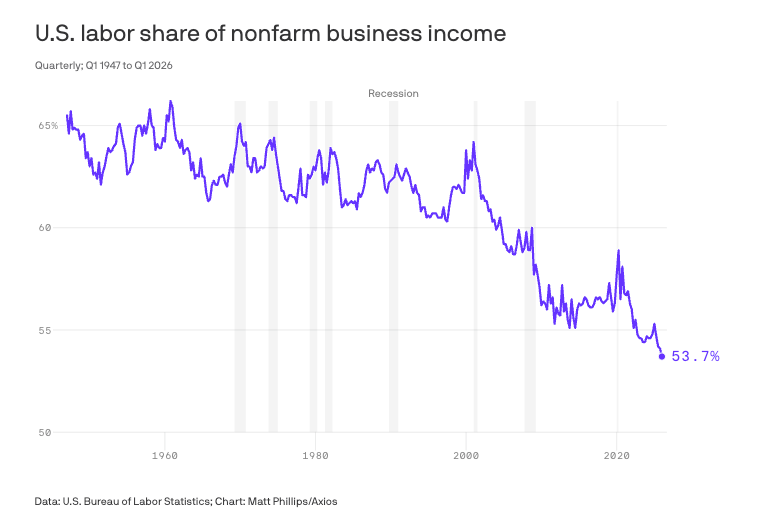
So no, I don’t think any of the backlash is particularly mystifying. It’s exactly the opposite; people who are joining the mass opposition to big tech’s AI infrastructure and surveillance efforts are behaving in an utterly rational and justified manner. This, ultimately, is why I think so much of the tech industry and its supplicants are incapable of performing an honest accounting of this widescale backlash against tech, and against data center opposition in particular. The resistance may be messy and inchoate, but it amounts to a direct repudiation of Silicon Valley’s core project.
The industry is all in on AI, on rapid expansion, on the mass extraction of public data for private benefit. If it turns out the public is incensed by the core tenets of a project like that, well, too bad. There’s too much at stake, best plug our ears and blame the CCP or a psy-op or the media. For anyone promising its investors $30 trillion in revenues with a straight face, no (or even a pause) is not an option.
What most data center protestors seem to have in common, whether they are environmentalists or conservatives or big tech haters or NIMBYs, and what so many pundits and AI guys find it impossible to grasp for some reason, is that they don’t find these intrusive projects worth the costs. A few temporary jobs and fewer permanent ones for a blight on their community that pumps diesel gas, makes noise, and sucks down power? And to help a billionaire somewhere run a faster chatbot?
Data center buildout advocates say that people wouldn’t protest a steel mill or other industrial projects. But steel mills create good, permanent jobs that the community can presumably access! Data centers create some part-time construction jobs and a post for an IT worker or two. Others say they’re going to come for wind farms and the like next. But wind power supplies the grid with clean power. And look, some people still are against both steel mills and wind farms, and some communities have shut those things down; others have embraced them because they decided that the jobs or the clean power were worth the construction costs, the disruption, the change to the environment.
Aside from comparisons of direct local harm and number of jobs, a steel mill produces a useful product. A data center produces AI slop, mass surveillance, an assist to hideously immoral wars, an increase in mental health issues and alienation, and cements the control over all of us of a faceless, anonymous bunch of racist psychopaths. A steel mill produces steel.
this is spot on. i did 52 interviews over the summer with data center protest groups and i heard the same thing from them.