


Silicon Valley is tightening its ties with Trumpworld, the surveillance state is rapidly expanding, and big tech’s AI data center buildout is booming. Civilians are pushing back.
In today’s edition of Blood in the Machine:
Across the nation, people are dismantling and destroying Flock cameras that conduct warrantless vehicle surveillance, and whose data is shared with ICE.
An Oklahoma man airing his concerns about a local data center project at a public hearing is arrested after he exceeded his allotted time by a couple seconds.
Uber and Lyft drivers deliver a petition signed by 10,000 gig workers demanding that stolen wages be returned to them.
PLUS: A climate researcher has a new report that unravels the ‘AI will solve climate change’ mythos, Tesla’s Robotaxis are crashing 4 times as often as humans, and AI-generated public comments helped kill a vote on air quality.
A brief note that this reporting, research, and writing takes a lot of time, resources, and energy. I can only do it thanks to the paid subscribers who chip in a few bucks each month; if you’re able, and you find value in this work, please consider upgrading to a paid subscription so I can continue on. Many thanks, hammers up, and onwards.
Last week, in La Mesa, a small city just east of San Diego, California, observers happened upon a pair of destroyed Flock cameras. One had been smashed and left on the median, the other had key parts removed. The destruction was obviously intentional, and appears perhaps even staged to leave a message: It came just weeks after the city decided, in the face of public protest, to continue its contracts with the surveillance company.
Flock cameras are typically mounted on 8 to 12 foot poles and powered by a solar panel. The smashed remains of all of the above in La Mesa are the latest examples of a widening anti-Flock backlash. In recent months, people have been smashing and dismantling the surveillance devices, in incidents reported in at least five states, from coast to coast.
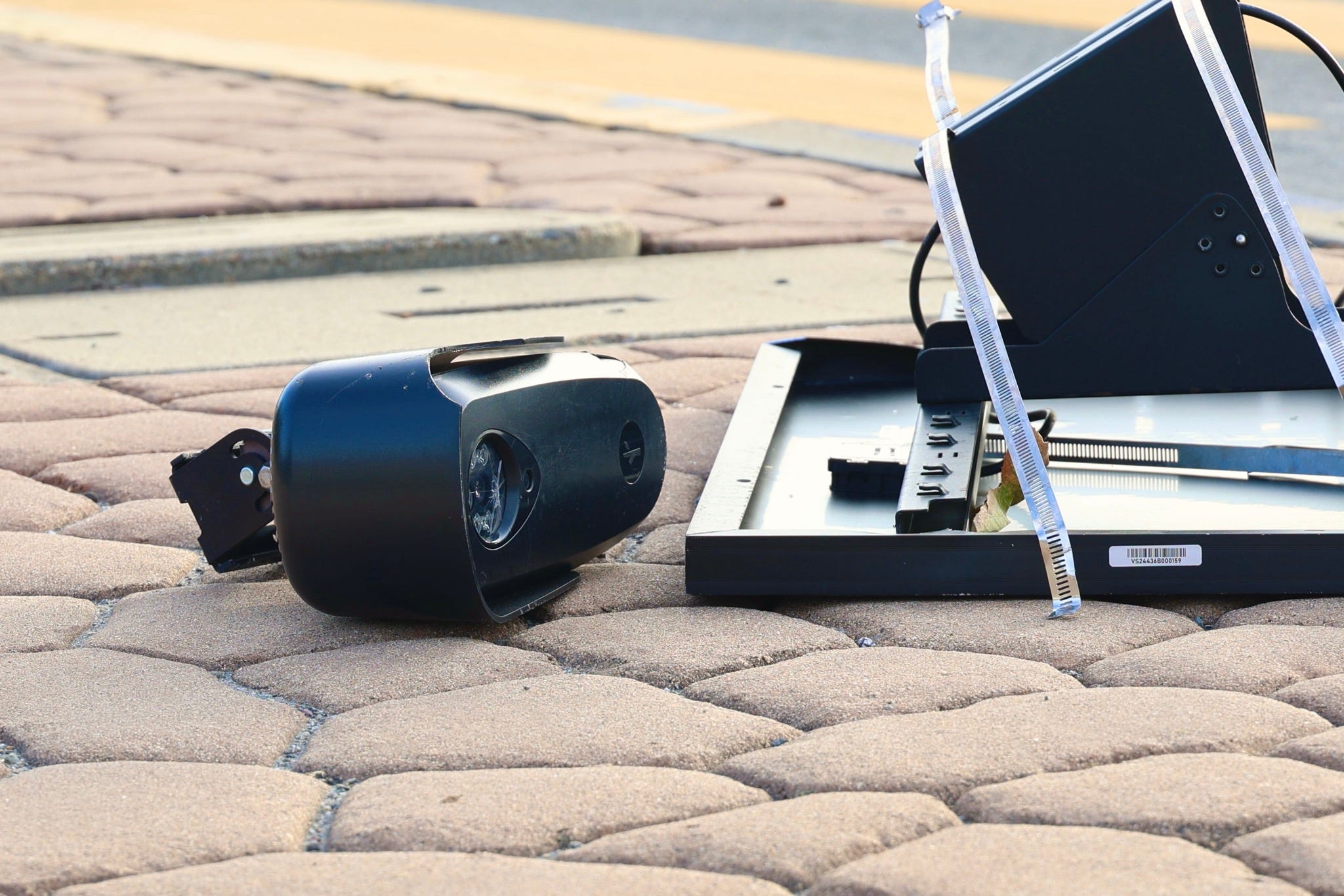
Bill Paul, who runs the local news outlet San Diego Slackers, and who first reported on the smashed Flock equipment, tells me that the sabotage comes just a month or two after San Diego held a raucous city council meeting over whether to keep operating the Flock cameras. A clear majority of public attendees present were in favor of shutting them down.
There was “a huge turnout against them,” he tells me, “but the council approved continuation of the contract.”


The tenor of the meeting reflects a growing anger and concern over the surveillance technology that’s gone nationwide: Flock, which is based in Atlanta and is currently valued at $7.5 billion, operates automatic license plate readers (ALPR) that have now been installed in some 6,000 US communities. They gather not just license plate images, but other identifying data used to ‘fingerprint’ vehicles, their owners, and their movements. This data can be collected, stored, and accessed without a warrant, making it a popular workaround for law enforcement. Perhaps most controversially, Flock’s vehicle data is routinely accessed by ICE.
If you’ve heard Flock’s name come up recently, it’s likely as a result of their now-canceled partnership with Ring, made instantly famous by a particularly dystopian Super Bowl ad that promised to turn regular neighborhoods into a surveillance dragnet.
Meanwhile, abuses have been prevalent. A Georgia police chief was arrested and charged with using Flock data to stalk and harass private citizens. Flock data has been used to track citizens who cross state lines for abortions when the procedure is illegal in their state. And municipalities have found that federal agencies have accessed local flock data without their knowledge or consent. Critics claim that this warrantless data collection is Orwellian and unconstitutional; a violation of the 4th amendment. As a result, civilians from Oregon to Virginia to California and beyond are pushing their governments to abandon Flock contracts. In some cases, they’re succeeding. Cities like Santa Cruz, CA, and Eugene, OR, have cancelled their contracts with Flock.
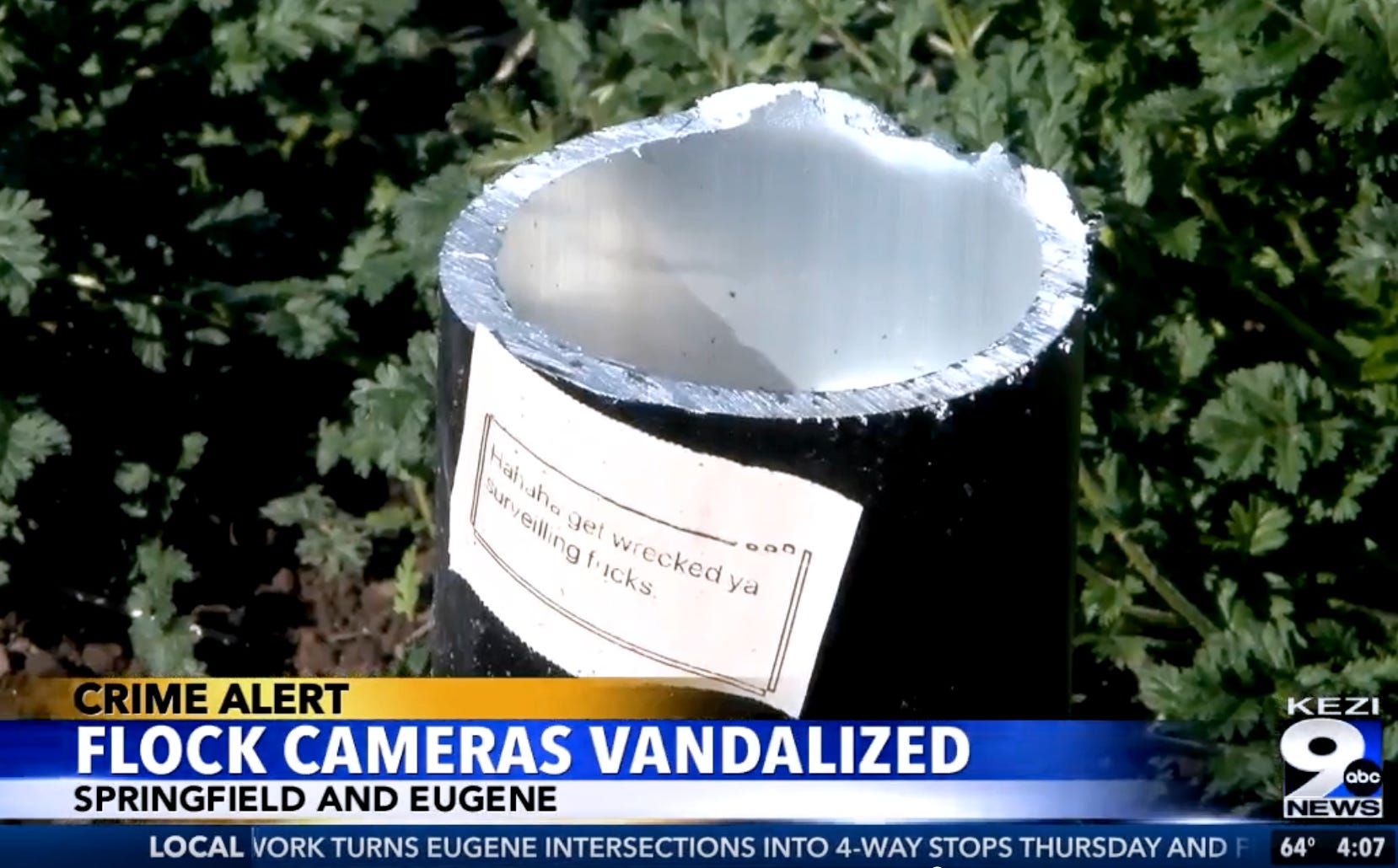
In Oregon’s case, the public outcry was accompanied by a campaign of destruction against the surveillance devices: Last year, at least six Flock license plate readers mounted on poles located in Eugene and Springfield were cut down and destroyed, according to the Lookout Eugene-Springfield.
A note reading “Hahaha get wrecked ya surveilling fucks” was attached to one of the destroyed poles, and somewhat incredibly, broadcast on the local news.
In Greenview, Illinois, a Flock camera pole was severed at the base and the device destroyed. In Lisbon, Connecticut, police are investigating another smashed Flock camera.
In Virginia, last December, a man was arrested for dismantling and destroying 13 Flock cameras throughout the state over the course of the year. He’s apparently already admitted to doing so, according to local news:
Jefferey S. Sovern, 41, was arrested in October after detectives say he “intentionally destroyed” 13 Flock Safety cameras between April and October of this year. He was charged with 13 counts of destruction of property, six counts of petit larceny and six counts of possession of burglary tools.
Sovern admitted to the crimes, according to a criminal complaint filed in Suffolk General District Court, going as far as to say he used vice grips to help him disassemble the tow-piece polls. He also admitted to keeping some of the wiring, batteries and solar panels taken from the cameras. Some of the items were recovered by police after they searched the property.
After his arrest, Sovern created a GoFundMe to help cover his legal costs, in which he sheds a little light on his intentions:
My name is Jeff and I appreciate my privacy. I appreciate everyone's right to privacy, enshrined in the fourth amendment. With the local news outlets finding my legal issues and creating a story that is starting to grow, there has been community support for me that I humbly welcome.
(I reached out to Sovern, who is out on bail, for comment, and will update or follow up if I hear back.)
Sovern points his GoFundMe contributors to DeFlock, a website aimed at tracking and countering the rise of Flock cameras in US communities. It counts 46 cities that have officially rejected Flock and other ALPRs since its campaign began.
In fact, it’s hard to think of a tech product or project this side of generative AI that is more roundly opposed and reviled, on a bipartisan level, than Flock, and resistance takes many forms and stripes. Here’s the YouTuber Benn Jordan, showing his viewers how to Flock-proof their license plates and render their vehicles illegible to the company’s data ingestion systems:
In response to such Flock counter-tactics, Florida passed a law last year making it illegal to cover or alter your license plate.
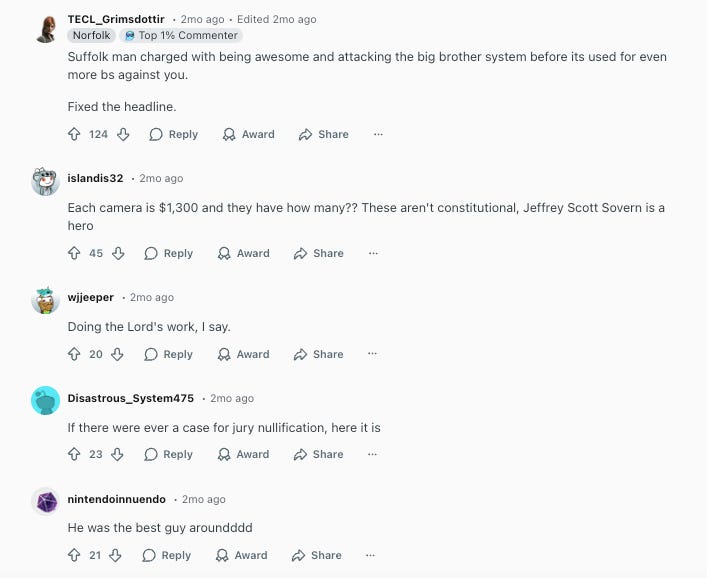
In his GoFundMe, Sovern also mentioned the support for him he’d seen on forums online, so I went over to Reddit to get a sense for how his actions were being received online. Here was the page that shared news of his arrest for destroying the Flock cameras:

There was, in other words, nearly universal support for Sovern’s Flock dismantling campaign. Bear in mind that this is r/Norfolk, and while it’s still reddit users we’re talking about, it’s not like this is r/anarchism here:
The San Diego reddit threads carrying news of the destroyed Flock equipment told a similar story:
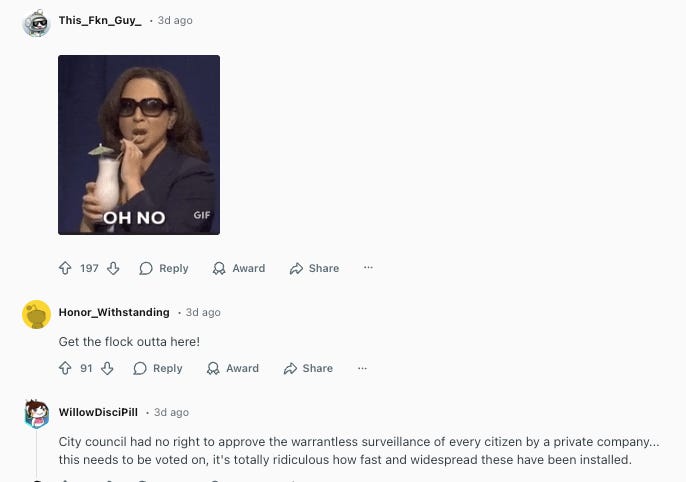
There were plenty of outright endorsements of the sabotage:
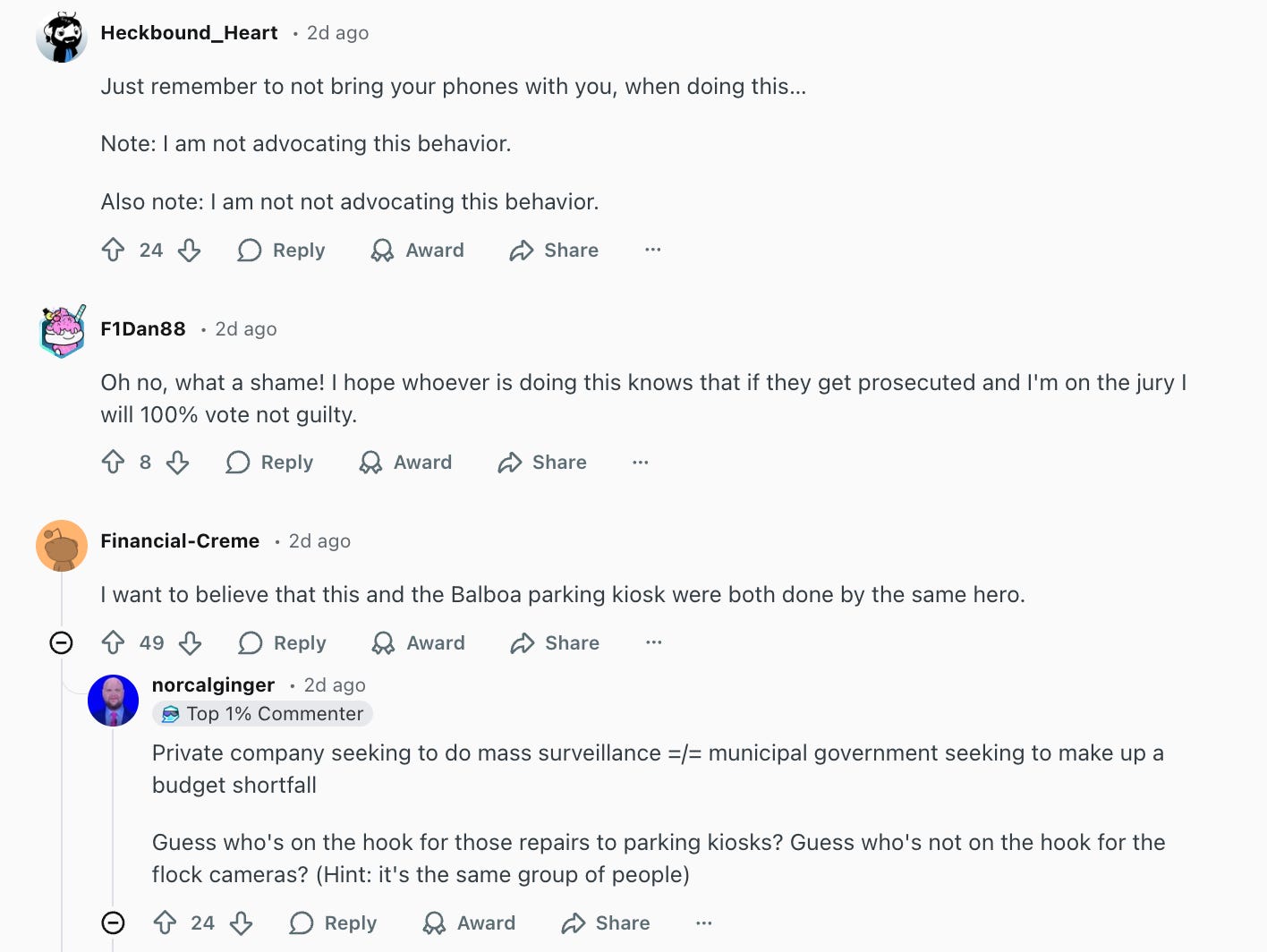
Off the message boards and in real civic life, Bill Paul, the reporter with the San Diego Slacker, says anger is boiling over, too. He points again to that heated December 2025 city council meeting, in which public outrage was left unaddressed. The city, perhaps aware of the stigma Flock now carries, apparently tried to highlight that their focus was on the “smart streetlights” made by another company, while downplaying the fact that those streetlights run on Flock software.
“San Diego gets to hide behind a slight facade in that their contract is with Ubicquia,” the smart streetlight manufacturer, Paul says, “but the software layer is Flock. You can easily see Flock hardware on retail properties, looking at the same citizens, with zero oversight, and SDPD can claim they have clean hands.”
Weeks later, pieces of smashed Flock cameras littered the ground.
Across the country, in other words, municipal governments are overriding public will to make deals with a profiteering tech company to surveil their citizens and to collaborate with federal agencies like ICE. It might be taken as a sign of the times that in states and cities across the US, thousands of miles apart, those opposed to the technology are refusing to countenance what they view as violations of privacy and civil liberty, and are instead taking up vice grips and metal cutters. And in many cases, they’re getting hailed by their peers as heroes.
If you’ve heard stories of smashed Flock cameras or dismantled surveillance equipment in your neighborhood, please share—drop a link in the comments, or contact me on Signal or at briancmerchant@proton.me.
Thanks to Lilly Irani for the tip on the smashed Flock cams in San Diego.
In case you missed it, I shared my five takeaways on the most recent round of ultraheated AI discourse here:
Five takeaways from an unhinged AI discourse

The AI discourse has been particularly, let’s say, “heated” lately. It’s hitting a lot of the beats we’ve heard before—people are not ready for what’s coming, critics are too dismissive, and at everyone’s peril, “the left” is getting AI all wrong, etc—but delivered at a fever pitch.
Critical AI Report 2/2026
An Oklahoma man was arrested for (barely) exceeding his allotted 3 minutes to offer a public comment opposing a local data center project.
The exchange was filmed and recorded on YouTube:
Matthew Gault at 404 Media reports the details:
Police in Claremore, Oklahoma arrested a local man after he went slightly over his time giving public remarks during a city council meeting opposing a proposed data center. Darren Blanchard showed up at a Claremore City Council meeting on Tuesday to talk about public records and the data center. When he went over his allotted 3 minutes by a few seconds, the city had him arrested and charged with trespassing.
The subject of the city council meeting was Project Mustang, a proposed data center that would be located within a local industrial park. In a mirror of fights playing out across the United States, developer Beale Infrastructure is attempting to build a large data center in a small town and the residents are concerned about water rights, spiking electricity bills, and noise.
The public hearing was a chance for the city council to address some of these concerns and all residents were given a strict three minute time limit. The entire event was livestreamed and archive of it is on YouTube. Blanchard was warned, barely, to “respect the process” by one of the council members but was clearly finishing reading from papers he had brought to read from, was not belligerent, and went over time by just a few seconds. Anyone who has ever attended or watched a city council meeting anywhere will know that people go over their time at essentially any meeting that includes public comment.
Blanchard arrived with documents in hand and questions about public records requests he’d made. During his remarks, people clapped and cheered and he asked that this not be counted against his three minutes. “There are major concerns about the public process in Claremore,” Blanchard said, referencing compliance documents and irregularities he’d uncovered in public records.
Blanchard was then arrested as the crowd jeered in disbelief. Also disconcerting was the way the local news framed the event, with a local anchor defending authorities by claiming he was “warned multiple times.” Seems like a pretty surefire way to make people hate data centers and the governments protecting them even more!
10,000 Uber and Lyft drivers call for the gig giants to repay stolen wages
On Wednesday, I headed to Pershing Square in downtown Los Angeles, where dozens of gig workers and organizers with Rideshare Drivers United had assembled to deliver a petition to the California Labor Commission signed by thousands of workers, calling on the body to deliver a settlement on their behalf. Organizers made short speeches on the steps of the square while local radio and TV stations captured the moment. “
“They’re robbing us!” A speaker yelled. “Wage theft!” the crowd replied.
The Labor Commission is suing the gig companies on drivers’ behalf, alleging that Uber and Lyft stole billions of dollars worth of wages from drivers before Prop 22 was enacted in 2020. The commission is believed to be in negotiations with the gig companies right now that will determine a settlement.
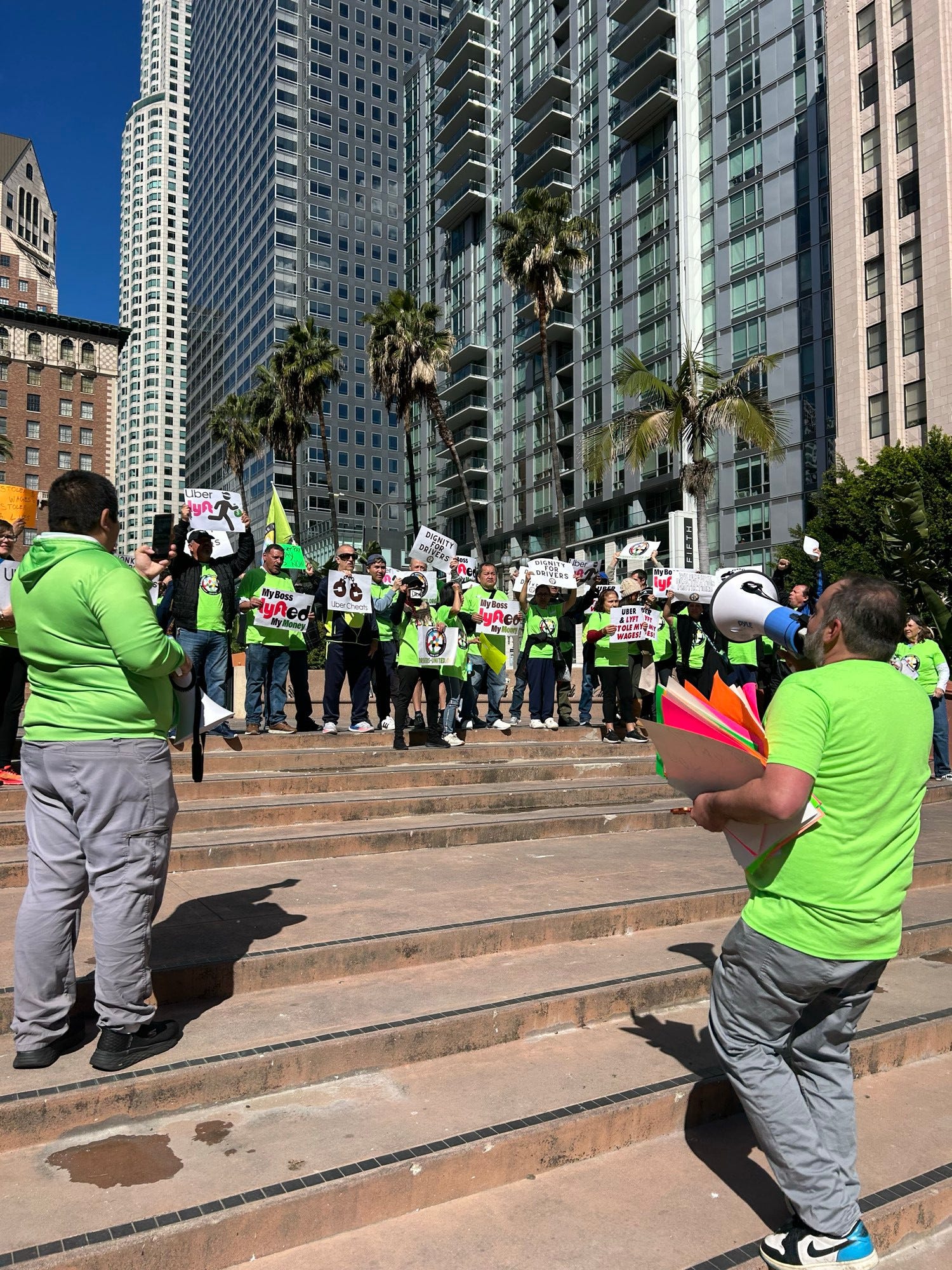
I spoke with one driver, Karen, who had traveled from San Diego to join the demonstration, and asked her why she came. “It’s important we build driver power” she said. “Without driver power, we won’t get what we need, and we just want fairness.” She said she was hoping to claim at least $20,000 in stolen wages.
“We’re fighting for wages that were stolen for us from us and continue to be stolen from us every single day by these app companies from hell,” RDU organizer Nicole Moore told me. “So we’re marching in downtown L.A. to deliver 10,000 signatures of drivers demanding that the state fight hard for us, and don’t let these companies rip us off.”
Tesla’s Robotaxi launch in Austin is not going well
According to Tesla’s own numbers, its new RoboTaxis in Austin are crashing at a rate 4 times higher than human drivers. The EV trade publication Electrek reports:
With 14 crashes now on the books, Tesla’s “Robotaxi” crash rate in Austin continues to deteriorate. Extrapolating from Tesla’s Q4 2025 earnings mileage data, which showed roughly 700,000 cumulative paid miles through November, the fleet likely reached around 800,000 miles by mid-January 2026. That works out to one crash every 57,000 miles.
The irony is that Tesla’s own numbers condemn it. Tesla’s Vehicle Safety Report claims the average American driver experiences a minor collision every 229,000 miles and a major collision every 699,000 miles. By Tesla’s own benchmark, its “Robotaxi” fleet is crashing nearly 4 times more often than what the company says is normal for a regular human driver in a minor collision, and virtually every single one of these miles was driven with a trained safety monitor in the vehicle who could intervene at any moment, which means they likely prevented more crashes that Tesla’s system wouldn’t have avoided.
Using NHTSA’s broader police-reported crash average of roughly one per 500,000 miles, the picture is even worse, Tesla’s fleet is crashing at approximately 8 times the human rate.
BLOODY LINKS
-“The Left Doesn’t Hate Technology, We Hate Being Exploited,” by Gita Jackson at Aftermath.
“Meta drops $65 million into super PACs to boost tech-friendly state candidates,” by Christine Mui in Politico.
-A great new report from climate researcher Ketan Joshi, “The AI Climate Hoax: Behind the Curtain of How Big Tech Greenwashes Impacts,” has been making headlines and is well worth a read. Perhaps we’ll dig deeper into it in a future issue.
-The LA Times reports that the Southern California air board rejected new pollution rules after an AI-generated flood of made-up comments. Here’s UCLA’s Evan George on how AI poses a unique threat to the civic process.
-A good profile of Nick Land, “Silicon Valley’s Favorite Doomsaying Philosopher,” by James Duesterberg.
Okay okay, that’s it for this week. Thanks as always for reading. Hammers up.
Thanks for reporting on this Brian. I've been covering this issue and fighting these cameras in Prescott AZ along with other colleagues. Not many people know about these cameras, but those that do - don't like them.
Let me know when AI can solve homelessness.
The fate of the world is in the hands of fools and greedy ghouls