


Take a look at this chart from a new report published by Glassdoor, the popular website where workers publish ratings of/complaints about/screeds of righteous fury aimed at their workplaces. Chris Martin, Glassdoor’s resident economist, analyzed how and how often AI was mentioned in workers’ write-ups about their jobs and employers, and whether that commentary skewed positive or negative.
Here, he breaks down the jobs for which people described AI most positively:
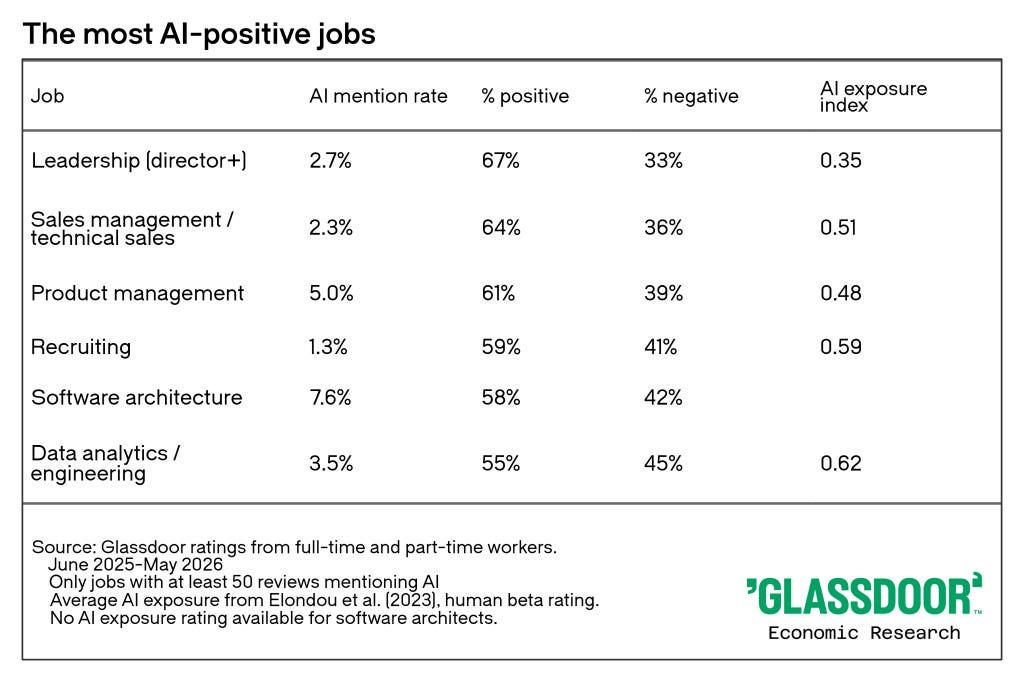
Those who described AI in the most positive terms were, overwhelmingly, in leadership roles; those with director-level positions or higher exuded the most AI positivity. Sales managers—the heads of sales teams, essentially—were also much happier with AI than not, by a similar-ish margin of around two to one. Product managers, recruiters, and software engineers skewed positive too, before the sentiments taper off towards parity.
Now look at this second chart from the same study, showing those who describe AI in the most negative terms:
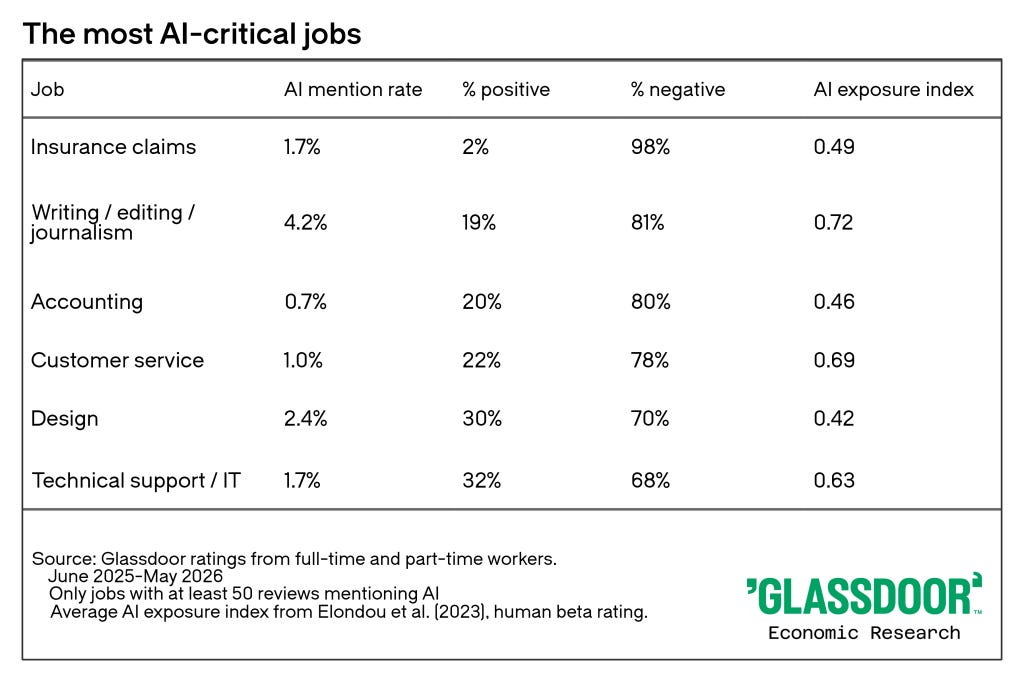
I was not prepared for the sheer amount of hate insurance claims adjusters held in their hearts for AI. Martin, who writes the rest of the report in restrained economist-speak, permits himself to acknowledge that claims adjusters “are shockingly negative about AI.”
I get it. I tend to link overwhelming levels of AI resentment to teachers and writers (who also hate AI quite a bit, per the data) and so on. 98% negativity is a truly rarefied tier of profession-wide AI hate. The only other comparable stat I can recall in this neighborhood is the one from a survey that found 99% of artists disliked AI. (Artists are likely underrepresented in Glassdoor data since they do what’s commonly freelance or contract-based work.) But the insurance claims adjusters’ resentment actually makes a lot of sense, and we’ll get to why in just a minute.
First, a few more notable findings from the report:
Workers have a lot to say about AI, and it’s turning negative.
AI mentions in Glassdoor reviews were up 240% from May 2025 to May 2026, now appearing in a significant proportion of reviews.
Historically, reviews used to mention AI in a positive way (81% positive in 2019), but these reviews are becoming increasingly negative about AI - falling to only 43% positive, 4% mixed, and 53% negative in 2026.
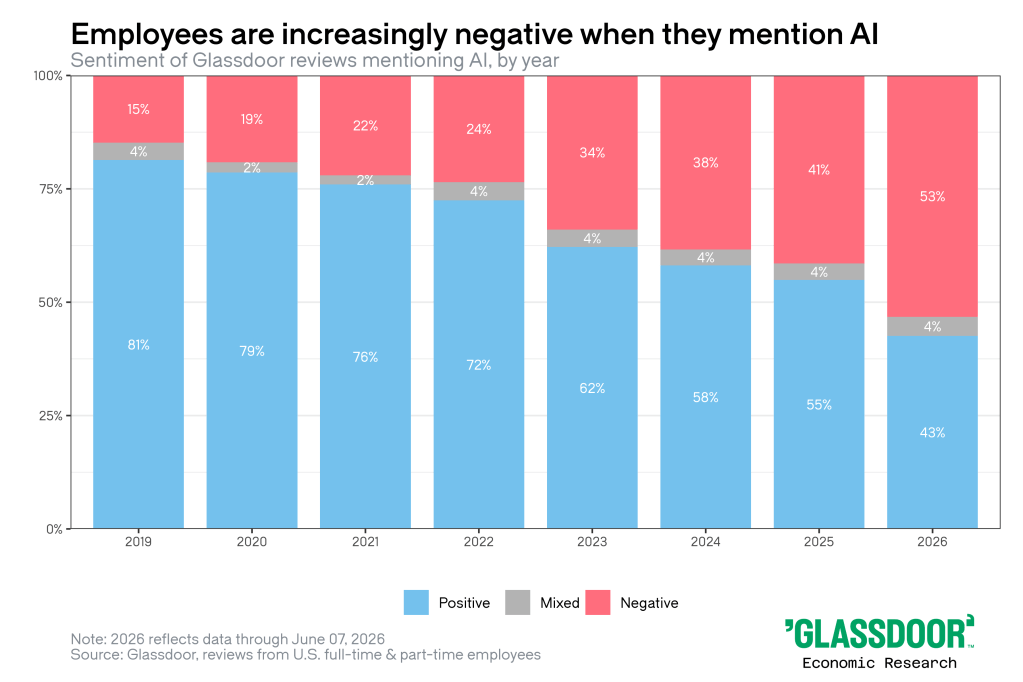
This shift towards negativity comes after many corporations have embraced AI enterprise automation products en masse, imposed companywide AI usage mandates, and generally encouraged managers and workers to accelerate AI adoption. Yet it appears that the more workers are exposed to AI, the less they like it. As the report emphasizes, workers’ negative comments are not only relegated to fears about losing their jobs. Far from it. While job loss is still the leading reason workers say they dislike AI, it doesn’t even constitute a plurality among the issues they have.
Many workers are concerned about AI replacement (20%), while others resent being force-fed AI tools (14%) or think their company is focused on AI at the expense of their core business (13%). Other criticisms include using AI for worker communications or surveillance (10%), moving too slowly on AI (9%), having unrealistic expectations about AI gains (8%), and being in a line of business that is likely to be disrupted or replaced by AI (7%).
Meanwhile, per the report, “AI-positive comments tend to focus on the company benefitting from the AI boom (44%) or using AI well internally (41%).”
So what can we glean from all this? To me, it’s pretty clear, and it essentially boils down to: Your feelings about AI on the job are likely determined by how much power you have in the workplace. In order to feel positively about AI at work, you need both power over how to decide when (and when not) to use it, and enough power to feel adequately insulated from job replacement, surveillance, or degradation.
This dynamic likely won’t come as a surprise to longtime readers of this newsletter; we’ve considered before how enthusiasm for AI is largely dependent on class position. We’ve also discussed how AI executives’ proclamations of a fast-arriving jobs apocalypse pairs awfully well with selling management on AI automation and labor-saving tools, which has undoubtedly underwritten much of the investment in the AI boom.

But it’s not just that bosses are more likely to embrace the idea that AI can offer them new ways to cut labor costs, new opportunities to exert surveillance and control over their workforces, or provide them new leverage against organizing efforts, unions, or workers seeking higher pay or better conditions. It’s also because bosses are much less accountable for their AI use. They may use it to write emails and company memos or to experiment with task automation, but they’re not going to be disciplined or fired if there are errors or inconsistencies in that stuff. (Not to mention that this is a moment where CEOs at the 100 lowest-paying US companies make 614 times as much as their average worker, and the chasm between executive leadership and the worker has never been higher. Bosses are less likely than ever to grasp how their frontline workers are going to feel about anything, AI included.)
Yet office workers dealing with new AI mandates and production rules are absolutely on the hook for the work they generate. That’s why the Most Negative chart is filled with jobs like accountant, customer service, and IT worker. These are jobs that demand high levels of accuracy and concrete problem solving, and for which workers are most likely to feel a stark tension between ‘the boss says the whole company has to use AI’ and ‘if you get anything wrong it’s your fault and you’re responsible.’ It’s imperative that accountants get the numbers right, or they risk landing their clients in legal jeopardy. Meanwhile firms like the accounting giant H&R Block are heavily pushing AI. The quality of their AI product? As the Washington Post’s Geoffrey Fowler put it simply: “It’s awful.”
I’m also struck by the finding that engineers and software architects are among the most positive towards AI, while IT workers rank among the most negative. A possibility here is that engineers whose work involves generating new code are enthusiastic about new AI automation tools because they make their jobs easier and faster, while the technical workers who have to troubleshoot the architecture when it breaks down or fails its users are much less so. Engineers may not all be bosses, but in the tech industry, many have the power to use AI how they think it will benefit their work and themselves; a boon at a time when certain executives are demanding high volumes of code. IT workers have to solve specific institutional problems and can only automate that which yields durable solutions; they’re more frustrated and negative than positive about AI. And they’re held accountable if they can’t fix something.
Which brings us to insurance claims adjusters. WIRED’s Kate Taylor wrote an entire piece on how claims adjusters experience AI at work, building off the Glassdoor data, and it’s well worth a read. Here’s a pertinent bit:
Typically, insurance adjusters complain about “AI-obsessed leaders forcing error-prone AI on them and their clients,” according to the research. When AI falls short in this job, adjusters say, they have to clean up a very human mess.
Take Ahmad Jackson. About a year ago, he was working in the claims department for a major insurance company. His employer decided to use AI for initial loss reporting, which involves setting up claims and gathering information when someone first discloses an incident. It was supposed to be a boon for employees and policyholders alike, streamlining simple claims while transferring more complex situations to actual people.
Instead, Jackson says, he and other adjusters faced a sudden influx of misclassified claims that required rerouting to the correct department. He encountered AI-driven hallucinations while reading claims summaries; when he inadvertently relayed those errors to claimants or their attorneys, he bore the brunt of their fury.
He quit the company not long after, switching to a different insurance carrier. AI is “getting things wrong,” Jackson tells WIRED. “And it’s implementing more work onto the adjusters.”
I’ve heard so many stories like this one, in so many different fields. Anecdotally, and in my interviews for AI Killed My Job, I’ve found it’s much more common for workers to have their lives made miserable by their companies’ AI policies than it is for them to lose their jobs outright. The Glassdoor data supports this generalization, as well as the notion that AI is becoming increasingly unpopular at work the longer and harder bosses push it. Again, what’s notable here is that negative attitudes are growing—pretty significantly—rather than declining, as workers better understand the AI products they’re made to use. This was supposed to be going the exact opposite direction; AI was supposed to make work easier, faster, more rewarding.

Recall again that a recurring theme this year has been firms pulling back on AI spend after finding it difficult to show a return on investment. Just as often as it’s successfully automating code production for engineers or giving your boss something to opine confidently about while golfing, it’s aggravating workers elsewhere, creating more work, stress, and burnout. This is likely a contributor to the continued decline of general sentiment towards AI in the US, too, as Pew Research and other pollsters have documented.
This spreading dissatisfaction with AI in the workplace dovetails with the broader contours of the anti-data center movement, the Flock protests, and the revolt against Meta’s AI glasses, all of which are examples of the public resisting the undemocratic imposition of commercial technologies into our shared spaces. At work, if you feel like you’re being forced to use a technical system that benefits your employer at your expense, that you’re powerless to refuse it or reap much of the benefit, and even that it might ultimately take away your job and earning power; well, all but the thickest-tongued bootlicker would resent it. And if Glassdoor’s data accurately reflect broader worker sentiment towards AI, that means there’s quite a bit of resentment just like that boiling out there.
These look like mutually reinforcing trends; aggravation over your boss pushing AI in the workplace is likely to color your impression of data centers that enable AI, of AI products elsewhere, and of the industry more generally. We’re fast approaching the point when AI executives say that their products will replace millions of workers. It hasn’t, but AI has left them feeling anxious, overworked, and unhappy. And it’s making them mad.
Thanks for reading everyone. And here’s my quick obligatory note that I can only do all of this with the support of readers like you, so if you find value in independent, critical tech journalism and analysis, please consider becoming a paid subscriber. All subscribers get (at least) one written newsletter edition sent to their inboxes each week, typically, ideally, Tuesday or Wednesday, as well as one episode of Blood in the Machine: The Show, which goes live every Friday. I want to keep as much of this un-paywalled as absolutely possible, and paid supporters keep the bulk of this free for everyone else. So many thanks to all who chip in, it’s very much appreciated. Hammers up.
I am surprised and disheartened to see how "positive" software engineers are around the technology. Above 50%, to me, seems already high, as I feel I am very much in a minority. Based on Nick Suresh's take, I think I need to find another place to work but honestly.. I am wondering where is it :)
BTW: any chance you might get Nick on the pod? I would imagine it would be a great fit.
Hey, I'm a "software architect" - I usually say "developer", but I design entire systems - and I've worked in "data analytics/engineering" too - I was the house "data scientist" at a start-up-ish company for a couple of years - so let me push back on that first set of numbers: I detest what currently passes for AI. It's the most overhyped technology I've ever seen, its social, environmental, and probable eventual economic effects are hideous, and many of the people promoting it are atrocious.
"Those who described AI in the most positive terms were, overwhelmingly, in leadership roles": In other words, Business Idiots, as Ed Zitron calls them. They do little or no real work themselves and can't tell whether other people's (or bots') work is good or bad. So naturally, they love chatbots, the ultimate crutch for the mentally lame and lazy. Besides, they're hoping to fire most of their underlings and collect more money themselves. (I'm caricaturing a bit, but really not very much.)
"A possibility here is that engineers whose work involves generating new code are enthusiastic about new AI automation tools because they make their jobs easier and faster": Another possibility is that many of us who know better have voted with our feet. I quit that "data scientist" job to become a freelance software developer, partly because I didn't enjoy the environment at that company, whose CEO made stupid decisions that led to tanking revenue and firing about a third of my colleagues. And that was before the slopnami hit. I expect the environment at many companies is much worse now. In general, good engineers don't need to put up with that.
I don't expect it will, but this growing resentment of "the undemocratic imposition of commercial technologies into our shared spaces" should lead to overthrowing the Business Idiots and the politico-economic system that exists mainly to serve them at everyone else's expense. Occasionally and idly, I wonder how bad life has to get for most ordinary people before it dawns on them that many things routinely reviled as "unrealistic" or "socialism" are not only practical but essential for preserving any possibility of a decent life for most people. (I'm not holding my breath.)