


Generative AI has upended few fields as thoroughly or as rapidly as the visual arts. Over the last three years, I’ve written a lot about the ways AI has impacted working artists; I’ve interviewed illustrators pursuing class action lawsuits against AI firms, attended rallies, conferences and legislative hearings where artists, designers, and animators have confronted those seeking to automate their labor, and published dozens of testimonies from artists about how AI is disrupting their work.
Those stories have largely described an industry on a grim trajectory: Opportunities and pay rates declining as clients and employers embrace generative AI. Artists getting more touch-up jobs and fewer well-paying, sustainable gigs. Pessimism, anger, and even despair, growing common, if not universal, in the field. The constant simmering outrage on social media, in other words, has felt pretty reflective of the reality on the ground. But then again, I’m just one guy. I’d tried to piece together as representative picture of the state of the industry as I could, but there was no wide-ranging study about the labor impacts of AI on artists to lean on, at least until now.
Three researchers at Carnegie Mellon University, Harry Jiang, Jordan Taylor, and William Agnew, surveyed nearly 400 professional visual artists about how generative AI has changed their working lives, income, opportunities, and outlook, and compiled the results into a paper they presented at the ACM (Association for Computing Machinery) CHI conference in April. Their findings are stark and alarming. They all but confirm that artists are experiencing nothing short of an AI-inflected crisis. In some cases, conditions are even more dire than I’d thought. But the work also offers keen insights into the details about how it’s all playing out, and even, dare I say, some reasons for hope.
Before we press on, I want to take a moment to shout a number of very worthy initiatives and projects on the AI resistance front. First, DAIR, the Distributed Artificial Intelligence Research Institute, is launching a Luddite Lab. It’s a resource hub, training center, and meeting place for workers resisting AI, automation, and big tech. It’s beautiful. The inaugural event will be held online next week; you can register here. Alex Hanna, DAIR’s director of research, shot me a note explaining the remit:
The Luddite Lab develops case studies, resources, and political education for unions and worker organizations who want to push back against “AI” and automation in the workplace and ensure that technology works for them, without undermining workplace democracy. We do this with workers, whether during the bargaining process, member education initiatives, or when they are simply trying to get their bearings. Our research and training is worker-led: we learn from other workers and translate that knowledge into case studies and primers available for other workers. We currently provide three different offerings: 1) an accessible resource hub which outlines case studies and strategies for governance and oversight of technology at work, both in general and for specific worker groups; and 2) office hours for workers interested in AI issues, and 3) training and curriculum for unions and other worker organizations around automation and AI.
Excellent. Second, the AI Now Institute, where I’m a journalist in residence, is hiring some key roles. Come join a great org. THIRD, speaking of great orgs, the latest edition of Academe, the magazine put out by the American Association of University Professors, is all about critical approaches to AI. Britt Paris is the head of AAUP’s AI committee, and she helped put the issue together; I haven’t finished reading through it all, but there’s so much good stuff, that I am looking forward to doing so. FOURTH, another friend of BITM, Lorena Gonzalez, the head of the California Labor Federation, represented the US at a recent tech conference at the Vatican, where she delivered this barn burner of a speech arguing for the dignity of workers in the age of AI.
Finally, if you’re in the LA area on May 23rd, I’ll be joining Zoe Bernard and Anya Jaremko-Greenwold for their first Stuffed event, Rage Against the Machine. They’ll be holding fireside chats in arty spaces with food from a top-tier chef. Tickets are here. Whew. As always, if you find this work useful or valuable, consider upgrading to a paid subscription; this newsletter is made possible entirely by readers like you. To anyone already chipping in, a million ludditic thanks. OKOK. Hammers up, and onwards.
Surprise: Artists really, really hate AI. In fact, one of the Carnegie paper’s most striking findings is the sheer extent to which artists are refusing and abstaining from the technology. Sure, it’s been easy enough to intuit from any glancing contact with artists on social media that they harbor a great disdain for generative AI. But the numbers are something else. According to the survey, 99% of artists “disliked” AI; for 92%, the dislike was “strong.”
And that distaste translates into action, too. Per the survey, 85% of artists completely abstain from using AI at all. And 88% percent refusal use AI to generate images. That’s about as overwhelming a rejection of the technology as you’re likely to see in any field. It’s especially notable considering the gap is made up by those artists who feel forced to use AI by clients or by management.
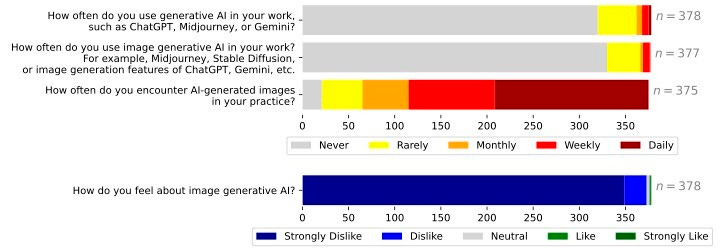
The survey finds that artists concerns with the technology are rooted in both ethics and functionality. Two representative comments from artists reflect this:
“I have attempted to use some of these tools to assist in still image and short animation creation, but they have consistently failed to produce useable results.” (P311 ○V; illustrator, designer)
“I experimented with NightCafe and Midjourney when they were being developed (in beta). When I learned they were sourcing their art without permission of the artist, I stopped using them.”
“Participants viewed genAI as an intrusive technology within the creative domain,” the study’s authors conclude (emphasis mine; it’s a key concept). “We find that artists poorly receive genAI, while they are frequently faced with the artifacts of the technology; simultaneously, artists reject genAI by abstaining from the technology.”
Also quite striking is that all of the above remains the case while, as you can see in the chart above, a majority of artists encounter AI-generated images at work every week, and many encounter them every day. This is because so many of their clients and employers have taken to sending artists AI-generated images for “brainstorming” or for touching up directly. These numbers suggest that we’re looking at the degradation of a skilled trade in realtime, and the extent of the aggravated resentment artists feel make perfect sense. Here’s a technology product, after all, that’s been trained on their work without their consent, and is now producing subpar output that’s driving down their wages and rendering work less rewarding. And many have to encounter the AI-generated artifacts that make this fact unignorable every day. That, my friends, is how you get 99% of workers across an entire industry to dislike your technology.
These findings are also evidence that in many cases, AI image generation hasn’t replaced art outright (though in some cases it has), likely because it’s too homogenous, too unappealing to the public, and impossible to copyright as IP without alteration. But image generators are grinding down the craft, robbing it of key human elements, and pushing down wages, pay rates, and opportunities.
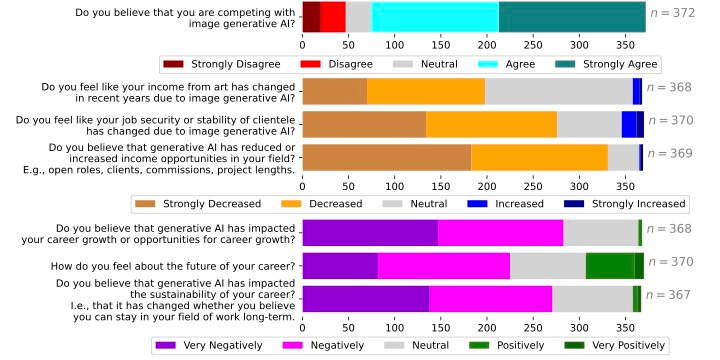
Most artists say that they feel that they’re now competing with AI-generated artwork on the marketplace. Well over half say that they’ve lost income due to image generators, while an overwhelming majority feel that their livelihoods have become more precarious and insecure, and 90% feel that AI has taken away commissions, jobs, and career opportunities.
The following quotes, pulled from the survey, help illustrate all of the above:
“They fired me, so it has been a very hard pill to swallow.” (P270 ○V ; art director, concept artist, 3D artist)
“I’m working on getting out of the field and planning to get my PhD in something non-art related because I can’t see my current work as being sustainable when I see them actively replacing me [with] chatGPT”. (P214 ○V ; costume designer, illustrator)
Demoralization, disempowerment, disrespect, stress, and fear are also commonly expressed, not only regarding individual careers but also extending towards the field at large: “It’s been pretty demoralizing at times seeing a lot of younger artists giving up because they don’t see a future in art. That they’re abandoning their creative passions because of AI.” (P40 ○V ; illustrator)
Some also lamented the public’s lack of appreciation of art in their adoption and consumption of genAI and its outputs: “It has been demoralizing largely because generated a.i. images look like crap but there is a segment of the population who seem not to care.”

All of these stories rhyme with the ones that were told to me, too.
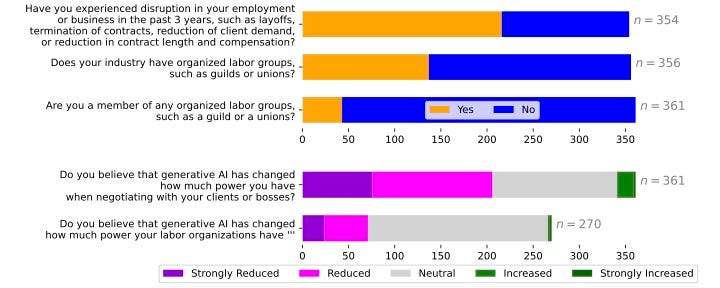
AI appears to be a contributing factor to layoffs as well, and artists feel more generally that it’s eroded their power to negotiate with clients and bosses.
All of this is exactly in line with how automation has historically unfolded in impacted trades; the automation technologies allow bosses to wield leverage over workers, grant them a justification for lower prices, speeding up work, and replacing key meaningful tasks, if not eliminating the worker’s job altogether.
Now, there is dignity and value to be found in so many jobs, but it remains particularly galling, and particularly alarming to me, that in the AI industry’s assault on art—perhaps best evidenced recently by the mass layoffs at Disney, which were linked to a drive to use more AI—we are witnessing the attempted mass automation of artistic practice. That AI products are immiserating so many artists should be an urgent reason as any for us to stand up and ask, why? This is not limited to a Benjaminian concern over the fading aura of the work of art in the age of mechanical reproduction, or if it is, it’s exponentially aggravated. We are facing what might not be hyperbolic to describe as an existential threat to the very concept of the working artist itself.
I know, I know, I promised some good news, and so far this has very much not been that. Well, here it is, in the top line of the final chart:
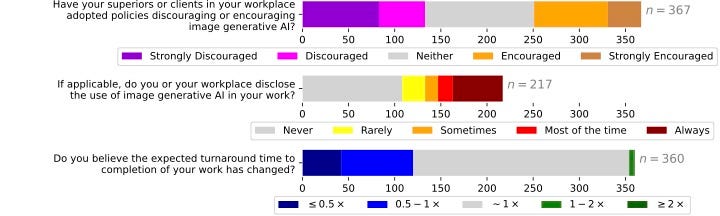
While some industries, like advertising, have generally encouraged artists to use AI, others, like publishing, trended toward the opposite direction. Many artists surveyed noted that clients that put a premium on human-created work and promote high artistic standards have policies banning or discouraging generative AI use. Furthermore, use of AI is stigmatized among practitioners themselves in such fields.
Some key responses published in the survey:
“My clients in publishing definitely discourage AI and strongly enforce against using the technology. However, in advertising it is less so; we see it increase through ads in subways, video, etc.” (P35 ○I ; illustrator)
AI (non) use was also shaped by peer influences: “Being caught with AI art is a death sentence as an illustrator in any serious field. Art Directors will blacklist immediately” (P228 ○V ; scientific illustrator, concept artist),
“Our [tattoo] shop tends to be pretty vocally opposed, but not everyone in the shop is” (P319 ○V ; tattoo artist, illustrator, 3D artist). Among those who said their work discouraged genAI, most artists were freelancers or had client-facing work.
Participants reported that thier clients typically discouraged genAI use due to concerns over copyright, quality, and reputation: “Many clients have discouraged it, particularly in creative fields that value human work, but also in some fields where copyright, data protection, and NDAs are a concern, where we aren’t permitted to use it out of the safety of the company or the integrity of the data/work/research.”
P83 (○V ; illustrator, traditional printer) felt that the spread of AI-generated art “just brought me more customers and has shown me, that people do care about handmade things much more than one thinks!”
That bifurcation here suggests that there will be a sustained interest in—and market for—art created by humans, and, perhaps more importantly, a potential source of political power for artists to tap into to bolster their position with employers in fields where that premium is placed.
“The narrative is that everyone is pushing for [AI],” as Jordan Taylor, one of the researchers, tells me. “The split in workplace encouragement,” between those that push AI and those that forbid it, “emphasizes that GenAI is not inevitable.”
To that end, Harry Jiang, another study author, notes that there are a number of implications raised by their findings. “I think on a small-p politics level, legislators and policymakers need to be careful about who they talk to,” he tells me. “It’s abundantly clear that the opinions on generative AI grow more positive and less anchored in labor reality the higher up someone is in the management level, so if that’s all legislators and policymakers are talking to, then they’ll be writing some seriously deficient bills.”
The researchers think that their findings might make it easier for artists to collectively bargain, and to push for AI usage disclosure, IP protections, and more data rights. “Tools shouldn’t be able to use your own data to replace you,” as Taylor puts it.
“On a more tangible level, it’s going to be quite clear that AI policy is labor policy,” Jiang adds.
You’ll find no arguments here.
Some Bloody media hits
I did a couple media spots over the last week or two that I enjoyed, on 404’s podcast and Tech Won’t Save Us. Those spots are here:
Last but not least, thanks to everyone who came out to the talk at Oregon State University, and to Alicia Patterson, Megan Ward, the union (thanks for the shirt!), the wonderful students there, and the organizing crew. We had such a good chat about AI, automation, and the Luddites, and it was great to meet so many readers afterwards.
OK, that’s it for the week. Until next time, keep after that machinery hurtful to commonality.
I work as a sales/mktg director at a small university press. We use human artists for covers. If authors come and say they’ve got this AI design idea I shut it down immediately. “We use human artists and we’ll do a great cover for you but we’re not using generative AI.” It’s not much but it’s what I can do to push back. Ditto as a consumer. Big music fan but if I see a band/artist with an AI cover I won’t listen buy or stream!
They had to call it generative because they couldn't use creative. That is the difference between human and machine.