


As AI sweeps through the American education system and US tech workers stare down the specter of mass layoffs, thousands of IT employees across the statewide University of California system have voted to unionize. They join over 6,000 tech workers already represented by University and Professional Technical Employees (UPTE), expanding the total to 8,400 workers across the bargaining unit. That makes the new unit the largest tech worker union in the nation.
UPTE calls it “a major victory for workers’ rights in the technology sector,” and that feels apt. Historically, the tech industry has been under-organized; for decades, tech firms have sought to pre-empt or ward off unionization by offering cushy perks and leaning into the entrepreneurial, laissez-faire ethos of Silicon Valley. But times are changing, and organized labor has made inroads. Hundreds of Google employees and contractors voted to form the Alphabet Worker’s Union in 2021—it doesn’t have full bargaining power but has proved influential nonetheless—and workers at tech companies like Kickstarter and at the New York Times’ tech desk (which was previously the nation’s largest tech worker union) have successfully organized in recent years. More recently, workers at Google’s DeepMind headquarters in London have voted to unionize.
The UC tech workers’ victory could thus not come at a better time, both for the thousands of employees themselves, and for a public that could use some working examples of how AI might be democratically implemented and governed. There’s been plenty of handwringing, after all, over how we might navigate the rise of AI in the workplace, orchestrating good technical governance of the systems, and the threat of ever more layoffs blamed on AI, but here we have a rather straightforward and obvious part of the solution: Give workers a seat at the table in formulating how to use (or not to use) the technology, and a democratic means of determining how task and labor replacement might be administrated.
“Honestly I’m elated,” Max Belasco, a business systems analyst at UCLA, tells me. “I think it’s very easy to feel siloed or removed from your coworkers in IT/tech,” he continues. “But that so many of us clearly feel the same way has felt so empowering and vindicating.”
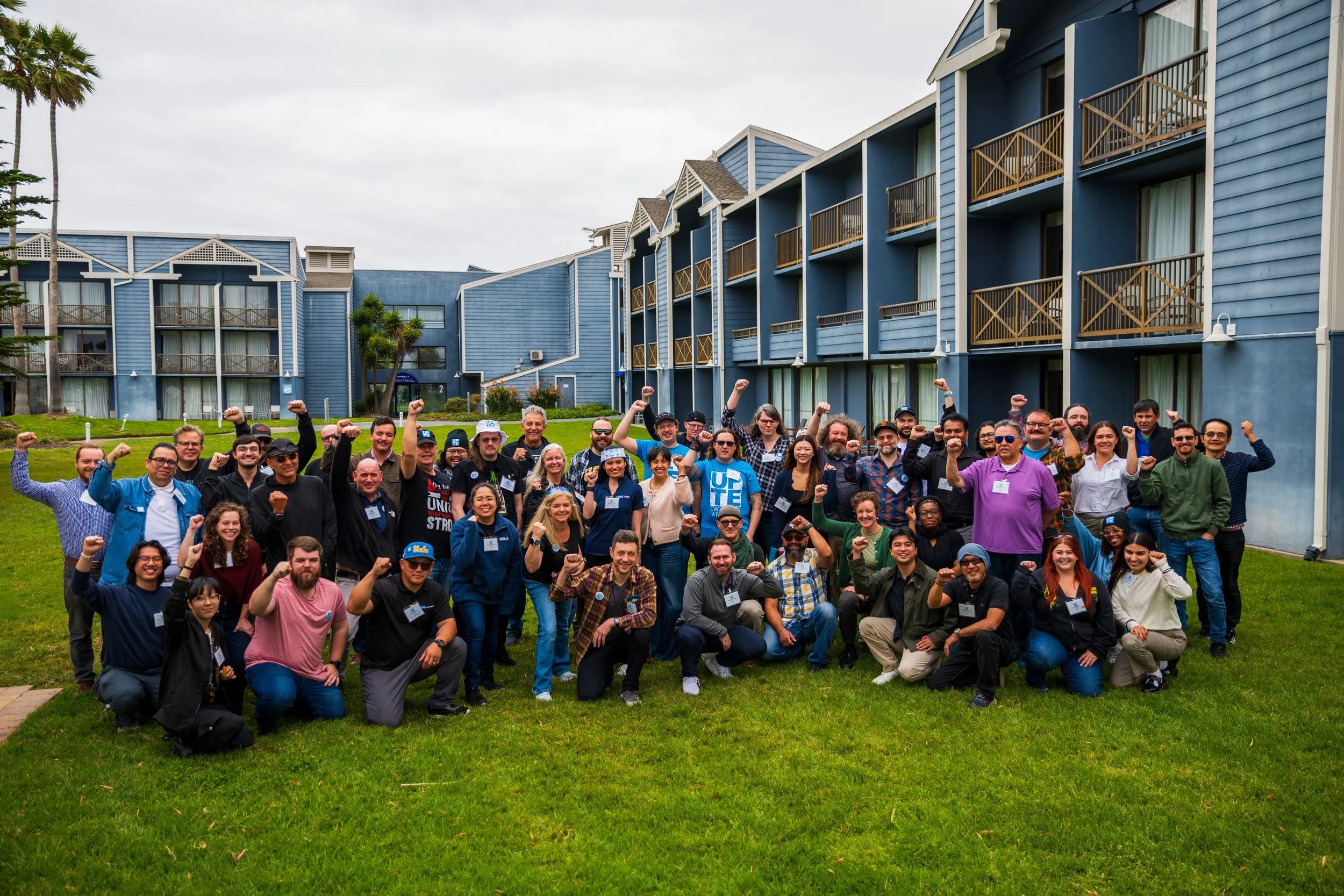
The campaign to expand the UPTE union picked up steam over the last year, focusing on layoff protections, wage increases, and AI governance as key issues. (For non-Californians, the reason the union is so big and potentially influential is because the UC system itself is enormous: It comprises ten campuses, including UC Berkeley, UCLA, and Santa Cruz, as well as multiple research centers and major healthcare providers. It’s a massive institution. To wit: I’m an alum of UC Santa Barbara and UCLA is my healthcare provider. My son was born at a UCLA hospital.)
With the victory, thousands of tech workers join an existing UPTE contract that grants them raises and improved benefits, as well as layoff protections that compel the University of California to offer employees who would otherwise be laid off the first vacant position that they’re qualified for. “That type of job security is unheard of in the current tech market,” Belasco says.
“Some of us worked in industry before coming to the UC, and now we’re in this environment right now where tech companies are laying off people by the tens of thousands, and that precarity has lent a level of urgency to the whole campaign,” Belasco says. “The narrative in tech now is all about the unilateral power executives wield over our workplace circumstances, and I think many of us felt in the UC that creeping sense of being left out of decision making in how to implement technology for the public good.”
To that end, the contract includes the right to collectively bargain over the introduction of new AI tools in the workplace, offering workers a direct say in how they will be used.
“We know when you try to make quick, dirty decisions to cut labor through AI, you’re actually creating a more vulnerable system,” Dan Russell, a UC Berkeley business technology support analyst and the president of UPTE, said in statement. “On paper, AI can make us more ‘productive’ at our jobs, but the people making those recommendations to UC are management consultants who don’t have the knowledge or expertise we have as workers.” Russell also notes that he hopes the contract will “set the tone” not just for UC workers but everyone who relies on the system for education and healthcare.1
Veteran tech worker organizers say they’re encouraged by the news, especially given how bleak conditions have been on the ground in Silicon Valley recently.
“This is a really important development,” says JS Tan, a tech worker organizer and the author of the forthcoming book, Against Tech Oligarchy: Worker Resistance in the World’s Most Powerful Industry. “It is happening at a time when tech employers are increasingly hostile to organizing and using AI as cover for mass layoffs—conditions that have, for most of the industry, chilled organizing efforts.”
To that end, Belasco hopes that the worker-led tech governance they aim to engage in can begin to forge a different vision for approaching AI development and integration than the top-down, profit-led model embraced by Silicon Valley. He had some trenchant thoughts here, so I’ll quote him at length:
The current tech sector is how it is because the unilateral power of the Silicon Valley CEO is the only model. There is no alternative. We want to demonstrate another alternative where workers have a voice in their compensation and how our expertise can be applied for the public good. Innovation and creative solutions to tech questions in education, healthcare, and research can be brought to bear from workers that have the space and protection to be creative. Innovation doesn’t have to come from competition setting coworkers against each other…
And not for nothing I would personally like to see us demand more transparency in how our public institutions relate to tech companies… how is data being shared with companies, and what kind? How does making these agreements to use AI that relies on resource heavy data centers relate to the UC’s often touted energy efficiency plans? But that also relates to what is the long term vision of administration for AI, which I think undoubtedly gets to questions of layoffs, staffing, and work/life balance
At the end of the day, who AI benefits and who it immiserates often is based on who gets to decide how it’s used. We know how tech is used on the day to day, and we’re familiar with the abilities and clear limitations of LLMs and other AI tools, often more so than those who make major decisions on how they are used. We should be at the table as well, and we feel the way we get real decision making power at this point is collectively through unionization.
[Emphasis mine.]
To me, this is beautiful.
A few things I want to note here, all of which I think serve as important reminders as AI matures as a product category and key pillar of the tech industry:
The vast majority of tech workers, at least those who I have encountered in my many years of reporting, are not vampiric Silicon Valley tech bro caricatures, they are folks like Belasco, Russell, and Tan, who both like working with tech and ultimately want to see it serve the public good.
The caricatures that are more accurate are, alas, those of the occupants in the c-suites of AI companies, those in positions of power, and helming the most aggressive AI startups. They are the ones who must be confronted if we’re ever going to see anything resembling democratic governance of AI.
They can nonetheless be overcome.
“This drive should remind tech workers across the country that building power is still possible,” says Tan, the tech worker organizer and author, “and in fact evermore crucial as employers are forcing AI tools into the workplace with little input from its workers.”
It’s frankly inspiring to see the freshly victorious tech workers at UPTE aspiring not only to improve their own working conditions and to mediate the labor automation of AI, but to proactively engage the key role they play as technicians in determining how the systems they oversee and maintain impact the experience of the broader public. More organizing, more aggressive worker campaigns, and more proactive union contracts around AI may be our best hope for stopping management from using AI as an excuse to exploit and automate their workforces. It’s also a crucial step—necessary, not sufficient—towards legitimately democratic governance of AI in general. This is the way.
Next up, getting organized tech workers at the UC system and beyond working with rank and file tech workers in the Valley and beyond.
Elsewhere in the ‘unions are crucial to good AI governance Dept,’ Politico is disbanding two AI programs that management had deployed on the website without informing the staff. Those deployments violated language in the staff’s union contract about AI use—management is required to inform staff of the decision to use such tools in advance, and give them an opportunity to assess and bargain over it.
As BLOOD readers may recall, Politico did neither, and just went and launched the buggy AI tools during a couple of the highest-profile political events of the year in 2024. The AI tool proceeded to make mistakes, misspell names, and use language forbidden to human reporters in the style book. The PEN Guild, which represents Politico and E&E News, filed a grievance, and the journalists have been duking it out with management ever since. An arbitrator sided with the Guild over management last year, and now Politico is officially canning the faulty AI products. It took time, and sweat and tears, but in the end, the news site and its staff will all be better off, and the use cases for AI tools more clearly defined. Another why worker power and strong unions are crucial for AI governance.
As Ariel Wittenberg, the PEN Guild chair, said in a statement: “This is an extraordinary win not just for our members, but for everyone who believes journalism must remain in human hands. We refused to back down, and POLITICO heard us loud and clear that these tools do not belong in our newsroom.”
You can catch up on the whole saga with these two stories here:


(SIDE NOTE: I’m not sure I’ve mentioned it in these pages before, but eons ago, I helped organize a union drive at a tech company, too. I was working at Medium, and in our case, engineers and programmers joined with the site’s staff writers and editors to try to form a companywide union. It would have been pretty novel for the industry. A key goal for the engineers was winning more worker power over the site’s tools and general direction. The effort came up short after Medium brought in a union-busting law firm and the CEO, Twitter co-founder Ev Williams, undertook a personal campaign to dissuade employees from voting in favor. The drive failed by one vote. Good times.)
Blood in the media:
This week, I joined Madeline Brand on Press Play to talk about the data center opposition movement, and Monterey Park’s move to ban data centers from its city limits.
We covered some similar ground on Adam Conover’s new Factually spinoff talk show, as well as getting into Boomer wealth hoarding and the California governor’s race:
The booing continues
Last week, I dedicated much of the newsletter to unpacking why hundreds of college grads would aggressively boo their commencement speaker for describing AI as “the next industrial revolution” and why a clip of the event went so viral afterwards.
Since then, let’s just say that the hits have kept on coming: Days after the first viral heckling, grads at the University of Arizona relentlessly booed former Google CEO Eric Schmidt as he declared AI the future. Elsewhere, grads booed music industry exec Scott Borchetta as he insisted AI was transforming audio production. And last but not least, grads booed a community college administrator who announced that they had used an AI system to read graduating students’ names—and apologized that said system had omitted hundreds of them, depriving them of the chance to walk the stage to receive their diploma.
Three makes a trend, and we’re well beyond that now; mainstream media is running with the story of college kids shouting down AI. If anything, I think the proliferation of these events only underscores each of the points I made last week.
Some bloody updates:
Not one but TWO great initiatives launched this week, DAIR’s Luddite Lab and the AI Resist List, a project guided by Empire of AI author Karen Hao. Both are excellent projects and resources, and should be on any good luddite’s list to follow.
Closer to home, you may have noticed that I’ve been writing only one newsletter edition a week lately. That edition is approximately 90,000 words long, but still. This is largely because there are some big plans and changes underway at Blood in the Machine Inc, and I will be able to announce them in greater detail soon. But let’s just say for now I’m very enthused.
EVEN closer to home, I cannot help but share some proud dad stuff here. My 10 year-old loves science. He does experiments in the backyard with his friends, often involving baking soda and vinegar and decent-sized messes. He’s a big Mark Rober fan. I’ve woken up on Saturday morning to find he’s using his TV time to watch NASA documentaries. He also thinks a good deal about climate change and environmental issues, and this year he decided to do his science fair project on insect larvae that can break down plastics. As a result, we’ve had wax worms, giant mealworms, and soldier fly larvae living in our house the past few weeks, eating away at styrofoam and plastic sponges. Did you know a super worm can survive entirely on a diet of plastic? Or that wax worms eat beeswax, which has a similar molecular structure to plastic, and so they can break the stuff down? I did not. He won the sustainability award for his project at his elementary school, and the image of him running down the auditorium aisle to retrieve it from the principal will be one I likely never forget. He worked hard; recording observations, writing up results, even making a slide presentation you can access via a QR code. Anyway, he subscribes to the newsletter (I swear I did not make him do this) and even tells me he reads it “sometimes.” If you’re reading this one, I’m so proud of you buddy.
More from the kids are alright dept:
In the rare ‘good AI policy enacted’ dept:
Okay! That’s it for today. I’ll be back next week, hopefully sooner rather than later, with some thoughts on Google’s sure-to-be disastrous hard(er) pivot into AI-ifying Search. Until then, hammers up.
To that end, Belasco says that “I think another important thing to note is that UPTE also represents a large number of healthcare workers at the UC. AI is also trying to insert itself into that field. And I’m excited to be working with union family that are medical interpreters and other healthcare professionals to see how we can mount a united front in defending patient care.”
Proud member of local 2627, IT professional employees of the City of New York, DC 37. I was wondering if you knew anything about what I guess I would call 'ethical' LLM models, that is, models that don't use copyrighted material or rip off artists, etc. There is a model in Switzerland (!) associated with an organization call Public AI, https://chat.publicai.co/, which claims to adhere to strict standards, and they have an 8b and 70b parameter model (just ask the chatbot). I've not been able to find any other models like this, but people should be using them, instead of frontier models, if they exist. Thanks for all your work, Jon
"At the end of the day, who AI benefits and who it immiserates often is based on who gets to decide how it’s used."
Indeed, I think works should a say in AI is used - but perhaps more importantly, whether it is used at all ...