


Greetings machine breakers, and welcome to a special midweek omnibus edition of BLOOD IN THE MACHINE. Today, we have an encouraging story about journalists taking on their bosses’ overzealous use of AI in the newsroom, fresh word of artists preparing to fight for AI transparency—and their livelihoods—in the heart of Silicon Valley, and an interview with author, video games journalist, and Aftermath co-founder Nathan Grayson. We had a good chat about AI, labor, and covering the behemoth industry.
Here’s the obligatory but brief reminder that paying subscribers keep this thing going, as BITM is a one-human, 100% independent operation. I’m also running a 20% off discount this week, so now is a good time to subscribe to save a few bucks and support this work. Many thanks everyone, and onwards.
Earlier this year, I reported that journalists at Politico were formally pushing back after their bosses deployed two different AI products without warning or oversight. Management launched a feature atop the widely-visited Politico homepage that automatically published AI-generated headlines and snippets during the Democratic National Convention and the vice presidential debates in 2024, promptly making obvious errors each time.
Then, again without consulting the newsroom, Politico began offering AI-generated “reports” to premium subscribers that were full of mistakes, factual errors and misrepresentations of staffers’ work.

Unlike many newsrooms, however, Politico journalists had a clearcut legal mechanism for fighting back: A union contract that prohibits the undisclosed and unsupervised use of AI. Per the contract, Politico’s leadership is required to give the staff 60 days notice before deploying AI products, for one thing. For another, they’re supposed to ensure that AI products both adhere to all editorial guidelines that human journalists do and are subject to human oversight. After Politico refused to admit wrongdoing, its journalists’ union, the PEN Guild, filed an official grievance and took them to arbitration.
In a ruling handed down this week that the union is hailing as a “landmark,” it just won a major victory. The arbitrator ruled that Politico officially violated the collective bargaining agreement by failing to provide notice, human oversight, or an opportunity for the workers to bargain over the use of AI in the newsroom.
“If the goal is speed and the cost is accuracy and accountability,” the arbitrator wrote in his decision, “AI is the clear winner. If accuracy and accountability is the baseline, then AI, as used in these instances, cannot yet rival the hallmarks of human output, which are accuracy and reliability.” He also confirmed that the report-building product contained “erroneous and even absurd” AI-generated materials.
This is an important ruling on a number of fronts. First and most immediately, it means that Politico has to engage the newsroom over its AI use, and bargain with the union about how it will do so. AKA Politico has to get input from the reporters, writers, and editors actually doing the journalism on how they want (or don’t want) to see AI used in their workplaces. Any AI integration must be democratic, in other words, just how industry advocates are always saying it should be.
Second, it stands to set a meaningful precedent for how journalists and workers can successfully push back against undisclosed, reputation-damaging, and labor-threatening AI products. Politico is owned by the multinational conglomerate Axel Springer, which also owns Business Insider, BILD, and Morning Brew, and is one of the most aggressively pro-AI in media. This kind of organizing is one of the most effective—and for now, perhaps one of the only—ways to help pump the brakes on management’s overzealous use of AI.
“This ruling is a clear affirmation that AI cannot be deployed as a shortcut around union rights, ethical journalism, or human judgment,” Ariel Wittenberg, the unit chair of the PEN Guild, said. “This is a win for our members at POLITICO fighting to ensure that AI strengthens our newsroom rather than undermining it.”
Now, the PEN Guild are not kneejerk anti-AI reactionaries, or even fundamentally opposed to the technology. They’ve said all along they want AI to work for journalists, not against them—to make sure it’s not generating bad information, trashing their reputation, or eroding their working conditions.
“One of my favorite lines in the arbitration decision talks about how while it is understandable management might want to ‘give the people what they want’ in launching AI products, ‘It is also understandable that journalists would want to hold the line against publication of substandard reporting’,” Wittenberg told me.
She continued:
We are going to continue holding the line. This ruling is a great example of the important role unions play in ensuring workers have a say over working conditions--including the rollout of new technologies. I hope it emboldens our colleagues at other news shops across the country fighting AI deployments that similarly degrade ethical standards, and I hope it sends a message to managers at POLITICO and news executives everywhere that adopting new technology cannot come at the cost of accuracy and accountability.
As such, by working to establish and uphold some common sense guardrails for AI, the union is functionally doing management a favor; both sides, after all, should want journalism that’s accurate, fair, sustainable, and well-edited. Unfettered AI use would only run the site’s readership and reputation into the ground. I hope Wittenberg is right, and we do indeed see more efforts like this take shape next year.
To that end, it’s worth noting the NewsGuild, one of the nation’s largest newspaper unions, and the umbrella org to which PEN Guild belongs, has launched a week of action, starting December 1st. It’s called, fittingly, NEWS NOT SLOP. Sign the petition to keep journalism human-first and slop-free here, and, if you’d like, join a town hall with top journalists, union organizers, and yours truly, to discuss AI in the newsroom, and how to stop it all from going off the rails.
A quick word about DeleteMe, who’s the sponsor of today’s newsletter:
Over the years, a host of largely invisible companies have compiled astonishingly detailed data profiles of you and I, and then made that data available on the internet. DeleteMe’s whole raison d’etre is hunting down and, yes, deleting the data that brokers have hoovered up about you and offered up for sale to their clients. DeleteMe is Wirecutter’s top-rated data removal service, and I’ve used it myself, to locate and eradicate 100 or so sites that were listing and selling personal info like my home address and phone number. To protect your personal data, take DeleteMe for a spin, sign up here and use the code LUDDITES for 20% off an annual subscription.
HOUSEKEEPING:
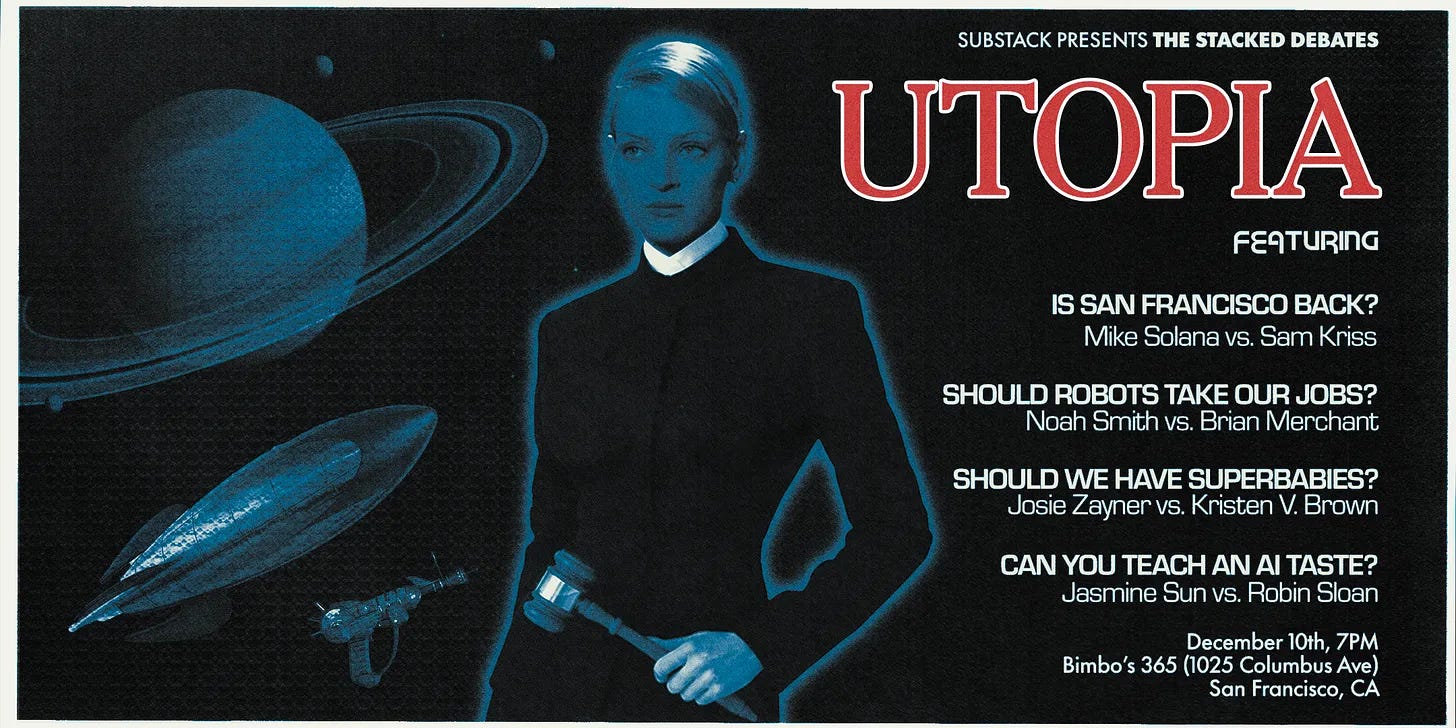
NEXT WEEK, I’ll be in San Francisco for a Substack live event, where I will be debating Noah Smith over the question of whether robots should take our jobs. I will, perhaps unsurprisingly, be arguing the “no” side. Tickets are free but apparently in limited supply; if they “sell out” let me know as I can likely get some passes. I could probably use the backup, seeing as how this is a Substack event in San Francisco, and they may just try to automate me in realtime.
AI RESISTANCE ACTIONS:
A CALL FOR ARTISTS TO SUPPORT THE AI COPYRIGHT TRANSPARENCY ACT
Next Monday, the California legislature is holding a hearing on AB-412, the AI Copyright Transparency Act, at Stanford University. As has been documented in this blog, AI has been a bonesaw to the creative industries, and *especially* to visual artists. This act is one of the best hopes artists have for protecting their livelihoods amid the AI onslaught. If you’re in SF, and you’re a working artist—or simply want to support a world in which such a thing can exist—artist trade groups are asking that you show up.

I’m going to try to be there myself.
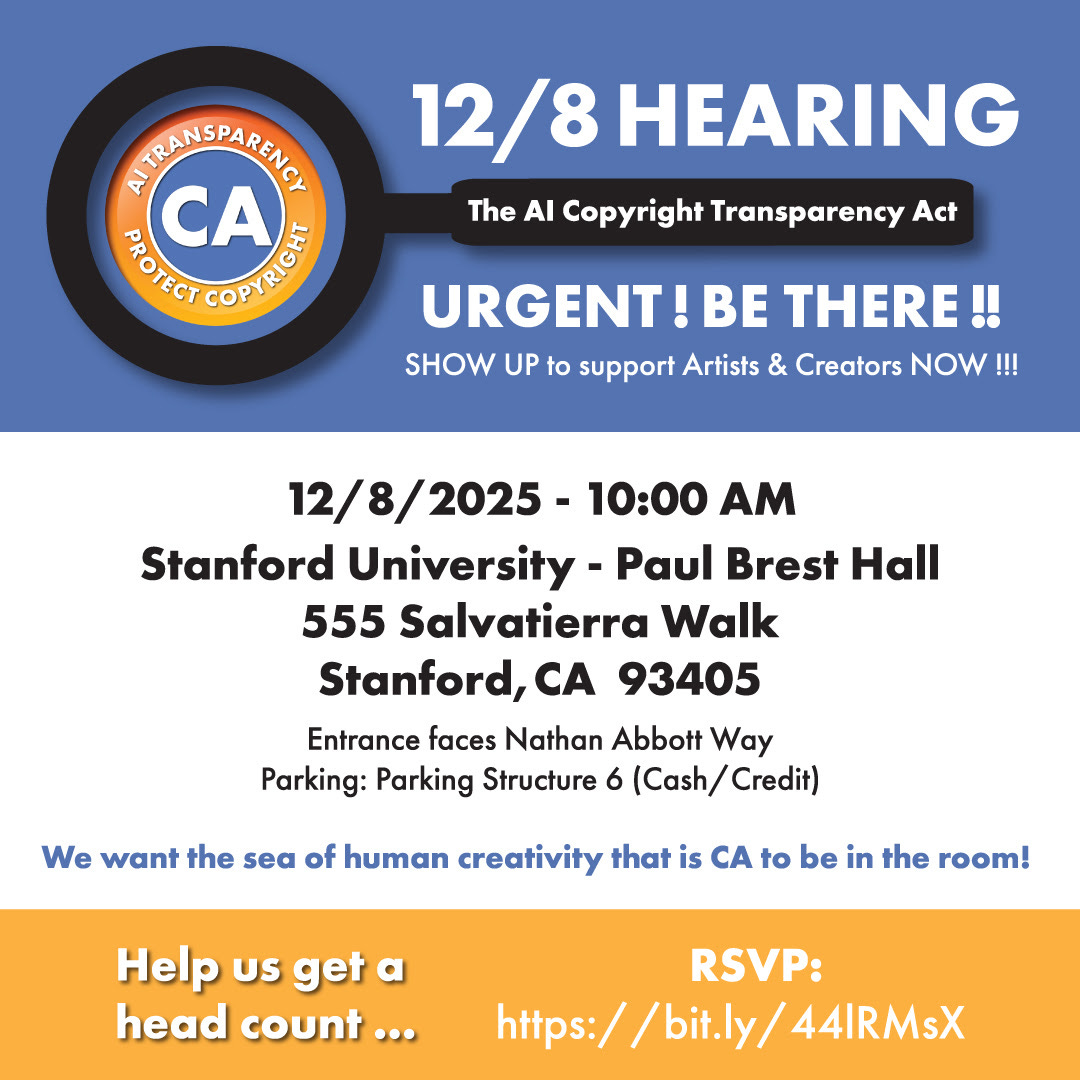
More details, courtesy of the Concept Art Association:
Because we ended up with such a broad and diverse coalition supporting our bill to protect artists and creators, we get a special legislative hearing on the matter. This is an ALL-HANDS-ON-DECK MOMENT!!! Big tech has decided to make AB-412 their #1 target! They know what’s at stake with our bill!!!
This hearing is going to be held in the heart of Silicon Valley. We want as large of a turnout there for the creative industries as we can get. AI models have been built upon a foundation of mass copyright theft. Billions of copyrighted works were taken without anyone’s consent, credit or compensation. Transparency for AI models not only affects us all, but it is essential. If we show up en masse for one another, even while the hearing is being conducted right there in Big Tech’s backyard, the need for our bill will be undeniable.
RSVP and get more details here.
A DELETE SPOTIFY EVENT IN NEW YORK CITY
After I published my post on how to quit Spotify, Nick Plante, a gen Z activist who runs in the Luddite Club circles in New York, reached out with word of one of his upcoming events: An in-person, mass Spotify deletion. Perfect. It’s this Saturday at Boshi’s Place, a music venue in Brooklyn. More details here.
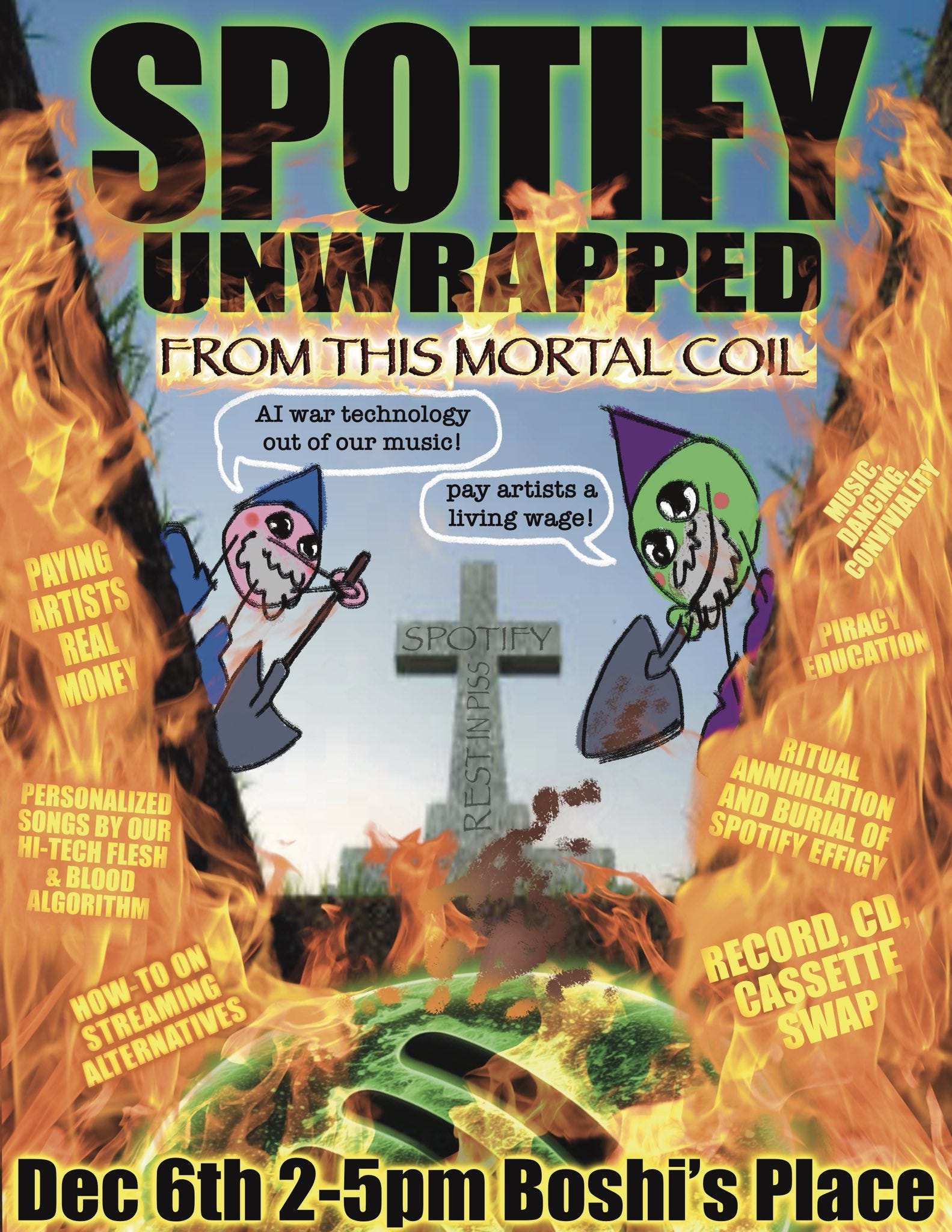
Per Plante, “there will be informational zines, stations for playlist transferral and reflection, a presentation, musical celebration, and a grand finale with piñata.”
Last but CERTAINLY not least, I’m pleased to share this interview with Nathan Grayson. Grayson is a great veteran games journalist—he’s worked at the Washington Post, Kotaku, and beyond—author of the book STREAM BIG about the rise of Twitch, and, most saliently for our purposes today, the co-founder of Aftermath, the worker-owned video games website that just celebrated its second birthday.
In honor of that hallmark, and at the end of a wild year in games, we logged onto Signal to chat AI, labor, and journalism in the gaming world. It’s been lightly edited for length and clarity.
BLOOD IN THE MACHINE: Happy birthday to Aftermath! Thanks for being one of the few shining lights in a decaying media landscape currently flooded with shit. How does it feel?
Nathan Grayson, co-founder of Aftermath: Good on a personal level, bad in the “general state of the world” sense. I’m extremely proud of what we’ve accomplished and how much the site has grown—we’re on the verge of hitting subscriber targets that will allow us to pay ourselves livable salaries and hire another person—but it also feels weird to stand atop what feels like a solid foundation while so many publications and institutions are crumbling beneath our feet. For the first time in my career as a journalist, I can’t be laid off; that’s an incredibly freeing feeling. But much as we’d like to provide tons of other writers and reporters with similar security, we’re still a fledgling organization. At the very least, Aftermath is a much more serious business than it was two years ago, but we’ve still got a lot of growing to do.
One of the best things that Aftermath does, IMO, is report not just on video game culture, but on the labor side, and on working conditions in the games industry. What’s the current status there, and how is Aftermath planning to continue covering it?
Things are in an interesting spot. On one hand, you have more union activity than ever in the US video game industry thanks to the legally binding neutrality agreement Code Workers of America struck with Microsoft shortly before the latter’s deal to purchase Activision Blizzard went through in late 2023, which has resulted in thousands of unionized workers at multiple studios across Microsoft’s portfolio. On the other, Microsoft has ruthlessly laid off around 4,000 game workers since the beginning of 2024, a microcosm of an industry that seems hell bent on cutting its way to “growth” heedless of long-term consequences. The suits running major companies don’t value talent, and unions aren’t big enough yet to truly mount an offensive. All they can do right now is staunch the bleeding, and the wound—self-inflicted, in many ways—is looking awfully bad.
Aftermath will continue to cover labor in the games industry by doing what we’ve always done: center workers first and foremost. The publication is fully worker-owned, so we’ve got to practice what we preach and show solidarity wherever possible. That does not mean uncritically covering unions—while useful, they are far from perfect, and every union has its quirks—but it does mean recognizing and conveying that we’re all part of the same struggle. Things might look bleak right now, but there are more of us than there are of them, and that will always remain true.
What’s your take on the AI situation in the games industry right now, as a front row observer?
To hear some tell it, every major studio is leaning on AI now, while others swear vehemently that they’ll never touch it. Recognizing how unpopular AI is in creative fields, execs have taken to claiming that their companies only use AI for behind-the-scenes processes—research, organization, mocking up various ideas—but then players keep discovering AI artwork in games like Call of Duty. Meanwhile, the likes of Ubisoft, Square Enix, and Krafton have announced intentions to go all in on AI, regardless of how many workers their initiatives end up displacing. And then of course, there’s Microsoft, which is shoehorning AI into every element of its business— including games—like it made some kind of Faustian bargain with the robot devil. It is crucial to understand, however, that gamers generally dislike AI! A lot! Also, many of the aforementioned companies also embraced NFTs, and look how that turned out.
What are some pieces BLOOD readers should check out to get a sense of what Aftermath is all about / that you’re proudest of?
Trying To Get A Job In Video Games Right Now Is Like Crawling Through Hell
The Right’s Charlie Kirk Cancellation Spree Has Emboldened Gaming’s Worst
Months After Microsoft Layoffs, Zenimax Unions Never Stopped Fighting For Impacted Workers
Games Media Can’t Ignore BDS Xbox Boycott
The Politics, Theology, And Hype Behind The First Gamer Saint
Anything else you want to add?
We’re having a sale on subscriptions right now! $1 for your first month, which is a phenomenal deal if you want to come see what we’re about before deciding whether or not to stick around. I know subscription fatigue is a thing—I’m already subscribed to too many websites and podcasts to count—but every subscription really does count for a publication like ours. We are not The New York Times or The Washington Post (both of which, arguably, no longer deserve your subscription money anyway); we’re five people and two regular contributors doing our best to cover a gargantuan, multi-billion-dollar industry.
We believe in holding power to account even if that comes at the expense of access, and independence is the only way to ensure that we’re able to unflinchingly speak our minds and lift up voices that deserve to be heard.
Go check them out, and support them if you can. *I* will add that Aftermath is also selling this great DESTROY AI hoodie designed by artist Kim Hu, which is perfect for the stylish luddite in your life. Alright alright. That’s it for today. More soon. Hammers up.
The statement by the arbitrator misses the point: "If accuracy and accountability is the baseline, then AI ... cannot yet rival the hallmarks of human output, which are accuracy and reliability." The point is not that AI, or any tool, cannot rival humans in terms of factual accuracy. We all know we can trust certain things like calculators to more accurately do math than humans. The point is that AI is not endowed with the ethics, responsibility, and professionalism that journalists practice. To the extent that it is endowed with anything at all of that sort, it has mostly been endowed with that unintentionally, or with the explicit intention of serving the interests of its purveyors.
Really amazed by your journey rising in Technology field. A quick advice for starters like me, how did you manage to climb !