


This week, California governor Gavin Newsom signed a spate of new laws that establish some of the strongest AI protections for workers in the United States. Okay, they’re some of the only AI labor protections in the nation, but it’s good news nonetheless.
They cover a lot of ground: One bans managers from using AI to discipline or fire workers without human oversight, one outlaws any kind of AI surveillance in workplace bathrooms, one bans the use of AI to surveil or predict workers’ emotional states—and yes, a growing number of companies really try to do this—while another designates that licensed healthcare workers must remain the decision makers in clinical settings; not AI.
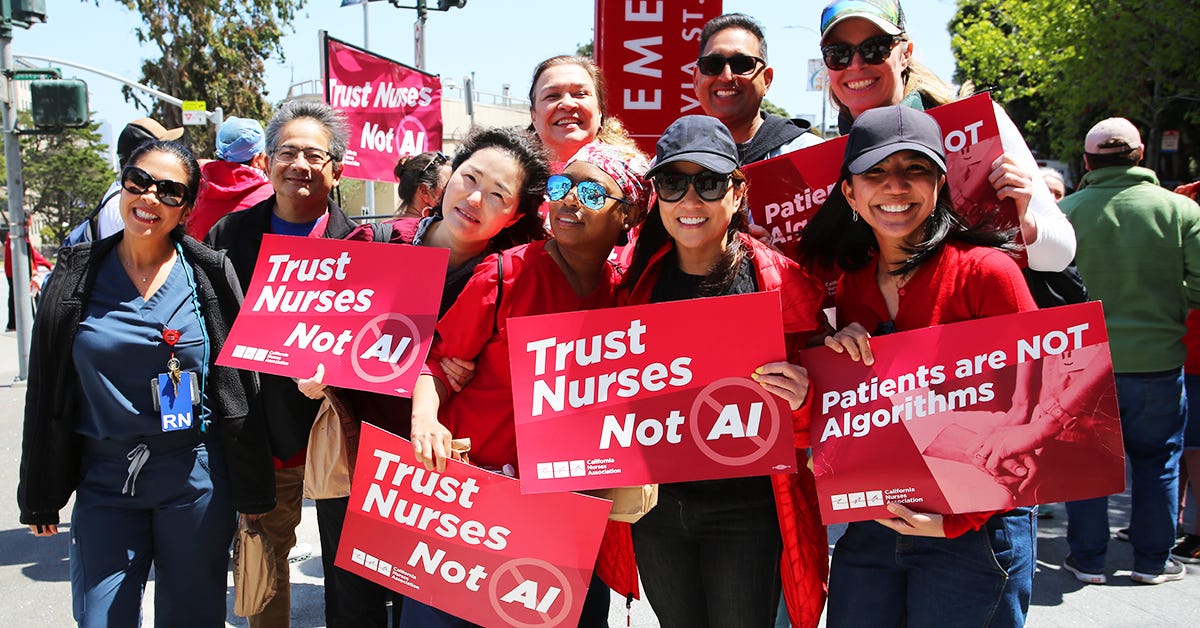
These laws join a number of already-passed bills that aim to protect workers from automation. Earlier this month, Newsom had signed another cr of bills that prevent bosses from replacing workers with AI outright; one prevents administrators from replacing California State University faculty with AI, another designates that public school employees and contractors must be human, and another requires companies to label if a performer is AI-generated.
“This is a breakthrough moment in tech policy,” Annette Bernhardt, Senior Tech Policy Advisor at the UC Berkeley Labor Center, tells me. “Right now, it’s the wild west when it comes to how employers use electronic monitoring and algorithmic management, because there are literally no rules of the road. For sure there’s much more to be done to build out a robust set of worker technology rights for the 21st century labor market, but California’s unions have put the first big stake in the ground.”
In other words: promising stuff! While some of these bills are narrow, and others were scaled down in compromises to secure passage, there are genuinely important protections, guardrails, and lines drawn in the sand on behalf of human workers here. Crucially, the new laws begin to form a framework that advances worker rights in the age of ubiquitous enterprise AI.
This is much-needed, and it’s an achievement that represents a real victory for labor. The California Federation of Labor Unions, led by Lorena Gonzalez, as well as the AFL-CIO, the Teamsters, the California Nurses Association, and many others deserve a ton of credit for fighting this often thankless fight against big tech and the pro-AI lobby, which marshaled their considerable resources to crush similar past efforts. “Today, California’s workers and our unions have changed the national narrative on how Americans can fight back and win against AI taking over our jobs and workplaces,” as Gonzalez put it in a statement.
I’ve covered the intense opposition to AI labor bills in California—I got more into the weeds on the issues last year, when Newsom vetoed or punted more AI labor bills—and seen firsthand the efforts to shut them down. Legislators and labor advocates have told me that they’ve never seen anything quite like it; the tech lobby opened its war chest to influencing local politics in a big way, and
"Despite millions of dollars channeled through a massive corporate-led campaign by the Chamber of Commerce, the tech industry, and their allies, workers fought back and won,” Samantha Gordon, the Chief Advocacy Officer of TechEquity, which backed the pro-labor AI bills, told me. “These bills ensure that workers can't be fired by an algorithm, surveilled without limits, or replaced without a safety net. Policies like these are wildly popular with Californians.”
Elsewhere, Newsom signed the COMPETE act, contentious, pro-worker piece of anti-trust legislation that was watered down before passage to the extent that one of its chief backers all but disowned it.
Newsom also signed a new law to fund local newsrooms; outlets that publish original reporting will be eligible for a $20,000 tax credit per full-time reporter for up to five employees, $15,000 for each after that, and $7,500 for part-time journalists. This, too, is an AI labor law.
“The Community NEWS Act just signed by Governor Gavin Newsom is significant for a lot of reasons,” says Matt Pearce, a former colleague of mine at the LA Times and the current Director of Policy for Rebuild Local News, an org that pushed for the journalism bill. “But among the most important in the AI era is that the law explicitly supports human beings, by making it cheaper to employ the local journalists who do local journalism. The incentives are clear. If you lay off reporters to replace them with robots, the tax credits that supported reporters go away. It literally changes the math of automation.” (Pearce sent me so many thoughts on the passage of the news bill that I’m including them all as a sort of mini-essay below, at his encouragement.)
It’s not all good news this week, however; Newsom vetoed a number of promising bills, too, including one that would have protected nurses who challenge unsafe uses of AI in hospitals and one that would have required public employers to give unions 45 days notice before they purchase or implement AI programs that will impact their workers.
The labor law scholar Veena Dubal has a good threat on all the bills that passed this week, and that were vetoed, for more details:

And the California Federation of Labor Unions has a nice rundown on all the bills that passed here:
“Today, Gov. Newsom signed the Federation’s following sponsored bills into law:
SB 947 (McNerney) which bans bosses from using AI to discipline or fire workers without human oversight and corroborating data. In 2025, Governor Newsom vetoed SB 7, a previous version of the No AI Bosses Act. (Co-sponsored by the Labor Federation and the Teamsters)
SB 951 (Reyes) which modernizes the WARN Act to provide workers additional information on layoffs caused by AI and directs the EDD to study the impact of AI on hiring and the workforce. (Sponsored by the Labor Federation)
AB 1331 (Elhawary) which bans the use of any AI surveillance in workplace bathrooms. (Co-sponsored by the Labor Federation and the Teamsters)
AB 1883 (Bryan) which bans employers from using potentially biased and invasive forms of AI-powered surveillance in the workplace to recognize, infer or predict workers’ emotional states or collect their neural data. (Co-sponsored by the Labor Federation and the Teamsters)
AB 1979 (Bonta) which requires licensed health care professionals to remain the decision-maker in health care clinical practice, not AI. (Sponsored by CNA)
“Earlier this month, Governor Newsom also signed the following sponsored and Labor-supported legislation taking on Big Tech and regulating AI:
SB 928 (Cervantes), which prohibits CSU faculty from being replaced by AI. (Sponsored by the CFA)
AB 2148 (Muratsuchi), which ensures that public school employees and contractors must be people and not AI. (Sponsored by the CFT)
AB 1609 (Zbur): Requires business to provide human customer service reps within 15 minutes of a request. (Sponsored by CWA)
AB 1776 (Aguiar-Curry), which gives the state more tools to combat corporate monopolies that drive down wages, make it harder to unionize and raise prices for consumers. (Co-sponsored by the Labor Federation, UFCW, the Teamsters, NNU-CNA, WGAW and SEIU California, UDW)
SB 1050 (Ashby), which requires advertisers to disclose if a performer is created by AI. (Sponsored by SAG-AFTRA)”
As promising as a lot of this is, as Gordon notes, it’s still early days.
“The fact that passing such common sense protections required a massive groundswell of workers, advocates, and community leaders reveals a great deal about these companies’ aspirations and long-term plans for all of us,” she said. “We look forward to building on these protections and continuing to advance a people-first vision for AI policy in California.”
And workers everywhere should look forward to continuing to fight against corporations angling to embrace mass automation and surveillance, and against big tech’s continued, AI-focused concentration of power. That fight has just begun.
Matt Pearce on the passage of the Community NEWS Act
The Community NEWS Act just signed by Governor Gavin Newsom is significant for a lot of reasons. But among the most important in the AI era is that the law explicitly supports human beings, by making it cheaper to employ the local journalists who do local journalism. The incentives are clear. If you lay off reporters to replace them with robots, the tax credits that supported reporters go away. It literally changes the math of automation.
Well, why does it matter if we have human journalists doing local news instead of having robots scraping live feeds of city council meetings and doing automated writeups? Working journalists know that information is made, not found: Local reporters are still often the proverbial coal miners powering the information grid, by digging up original interviews or unpublished documents that would otherwise not be found in the public domain.
But this kind of work, because it can’t be so easily automated, is often cost-prohibitive because you’re talking about paying a human for journalism that may not earn back its cost because of the hard math of subscription, advertising and grant revenue in the digital information era. If we want quality information getting injected into our information ecosystem, we’re going to have to pay for it somehow, because it increasingly can’t pay for itself.
One of the other hidden costs of automation is the destruction of human talent the local news industry needs in order to keep evolving to keep up with shifting consumer demand. The U.S. has lost more than 80% of its local journalists since 2002, and California alone has lost more than 12,000 local journalist jobs. This hasn’t just hurt the amount of news we deliver to communities but it’s hurt our own ability to adapt. Human beings learn by doing and get better at their work over time; they innovate; they become capable of more ambitious work or exploit entrepreneurial opportunities. To shrink your talent pipeline is, in the long run, a means of reducing your own future.
