


The data center protest movement has gone nationwide. From Vermont to Oklahoma to Indiana to California, communities are organizing to halt the tech industry’s drive to build out data centers in their neighborhoods. This week, the New York state legislature passed a one-year moratorium on data center construction and sent it to the governor’s desk where it awaits signature. Chicago’s governor has suspended data center tax breaks. Little has proven as politically galvanizing, or as unifying; the bipartisan issues of 2026 are data center disdain and AI animosity.
TODAY in BITM: An exclusive report from a data scientist who crunched the numbers on who’s blocking data centers and how successful the protests have been, exactly. Plus, some thoughts on Bernie’s ill-fated AI sovereign wealth fund idea, Ted Chiang’s argument that AI is definitely not conscious, and more.
This work is made possible by subscribers who chip in a small sum each month to help me keep the lights on. If you find value in this kind of reporting and analysis, in 100% independent media that holds the AI firms and big tech accountable, consider becoming a paid supporter—and a huge thanks to those who already do. I couldn’t do any of this without you.
If you think I’m exaggerating, Heatmap just published a survey of over 4,000 Americans’ attitudes towards data centers, and whether they would support a project being built near them. The results show that sentiment towards data centers is now wholly and completely underwater. According to the poll, 55% of Americans “strongly” oppose data centers being built in their areas. This is “a record low that reveals a staggering shift in public opinion against the facilities powering the artificial intelligence boom.”
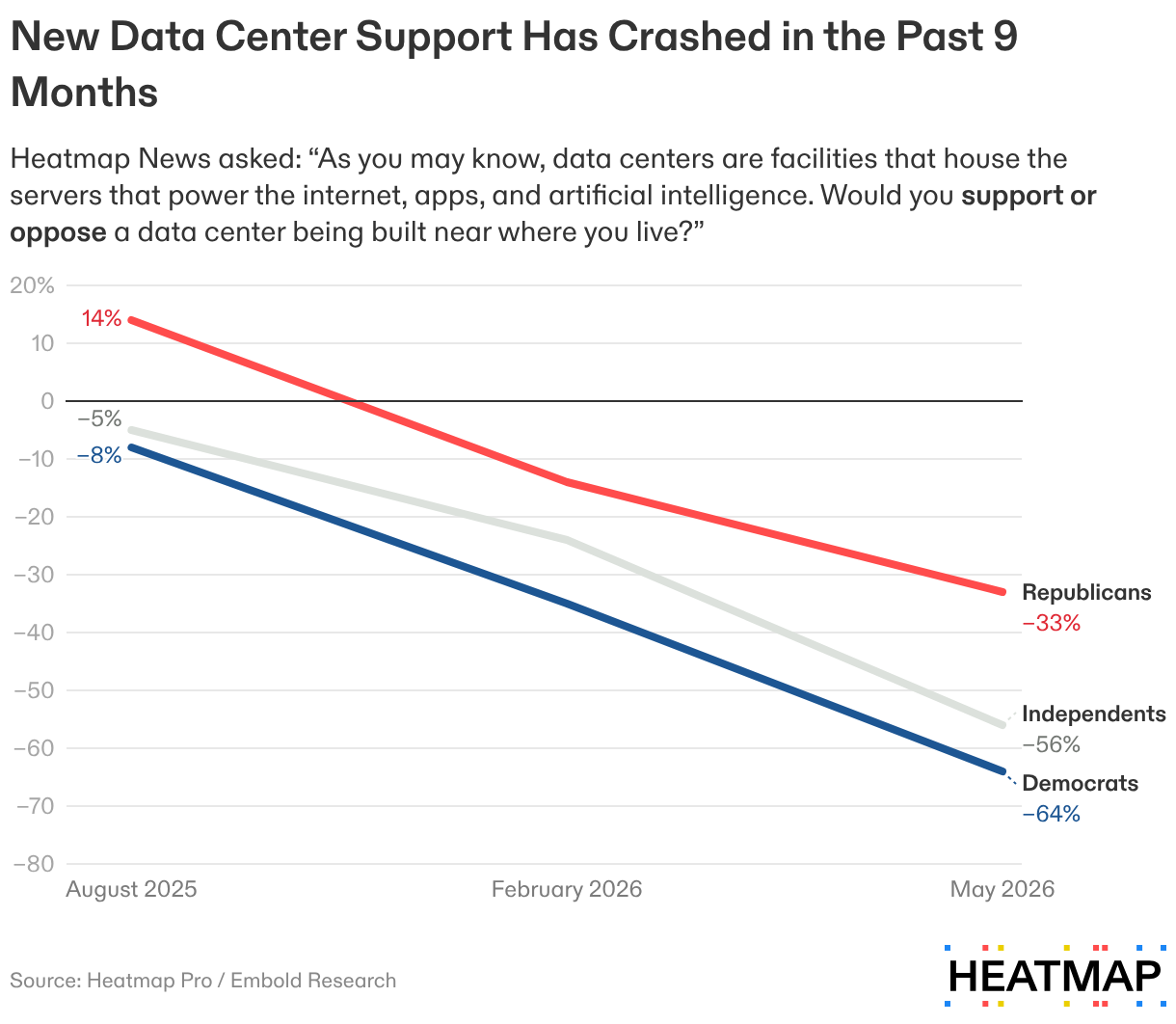
Democrats, people living in rural areas, and young people are especially opposed: 80% of poll respondents aged 18-35 were against data centers. (This tracks with general sentiment trends now, too; it’s been well-established in other polls—and not to mention overwhelming anecdata—that Gen Z is deeply hostile to AI. Look no further than the choruses of boos at AI-boosting commencement speeches this summer.)
But, as readers of this newsletter well know, questions about the drivers and nature of this broadening resistance have been raised and debated. Strident arguments made that the data center opposition amounts to reactionary NIMBYism, and that it’s being led by affluent environmentalists. And while the sheer number of Americans opposing data centers presented in the Heatmap survey might offer clues that that’s not the case, there’s nothing in the poll that specifically examines those factors.
If you want to argue the contrary, as I and folks like Astra Taylor and Saul Levin, do, that the data center opposition is grounded in working class politics, it helps to have good data. And this is where it helps to have readers who happen to be data scientists. After I published my story about the data center rebellion, which relied on accounts from my own first-hand reporting and a survey of news reports from across the country, the researcher Geoff Holtzman reached out to share the results of his own analysis of the movement, with an eye towards who was really doing the protesting.
Holtzman describes himself as “a philosopher and data scientist who writes about quantitative propaganda and scientistic rhetoric,” and he often does so at his science & Power newsletter. His peer-reviewed work has been published in places like the Proceedings of the National Academy of Sciences and The American Journal of Bioethics. He had also heard the oft-repeated suggestion that the data center protest movement was led by wealthy, NIMBY folks, so he set out to investigate. He analyzed a dataset of current and proposed data center projects alongside US census data1 and has graciously offered to share the results in an exclusive here. He came to at least three stark conclusions:
1. The poorest neighborhoods resisted data centers at nearly five times the rate of the wealthiest (19.0% vs. 3.8%)
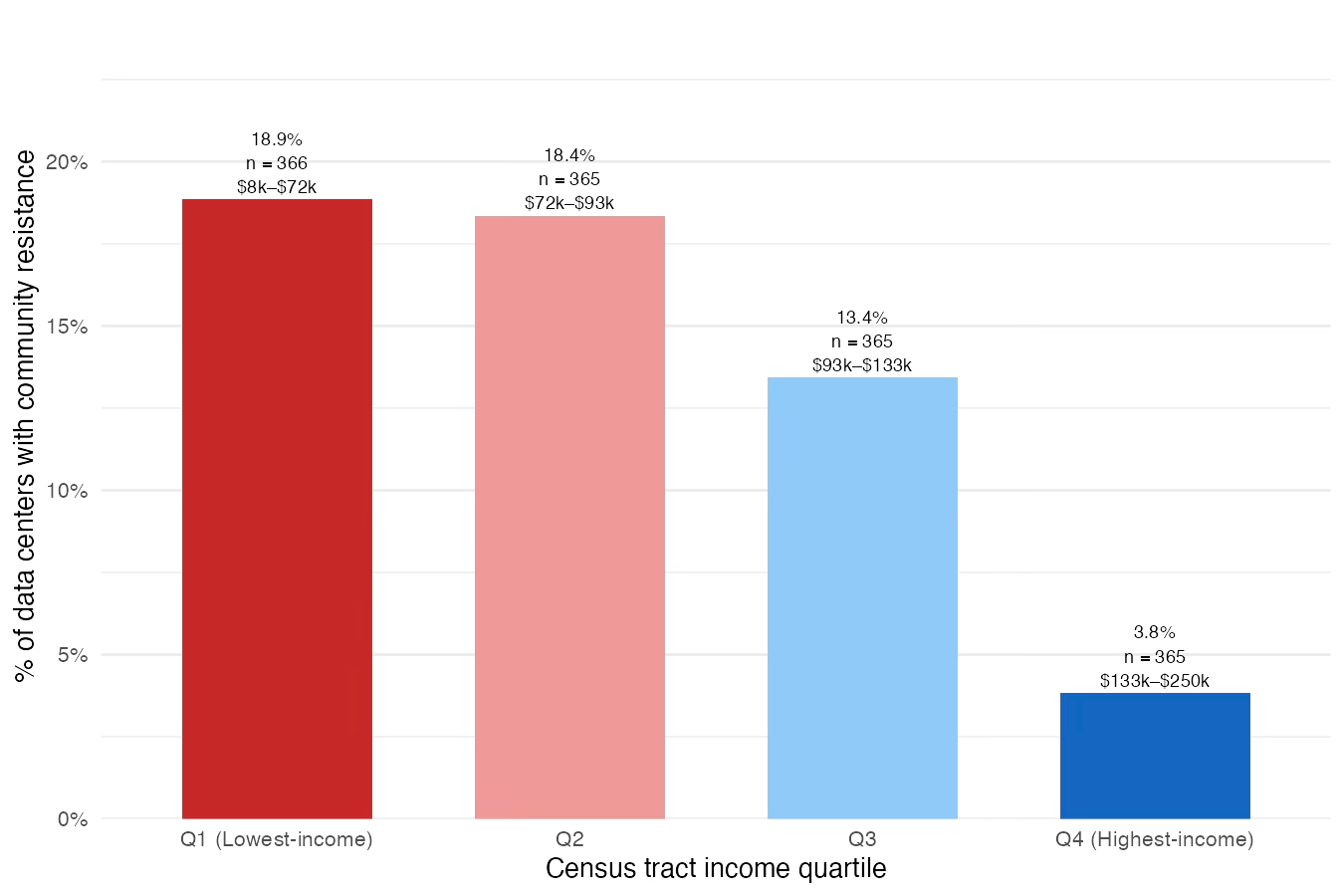
“The highest rate of resistance comes from neighborhoods with a median income of between $8,000 and $72,000,” Holtzman notes. “The lowest rate of resistance is in neighborhoods where the average household makes between $133k and $250k per year.”
This flies directly in the face of the notion that data center opposition is led by well-off Patagonia-clad NIMBYs; neighborhoods that are poor or working class are pushing back far more frequently than the affluent.
“Setting aside all questions of ethics or justice, prudence suggests tech companies would have an easier time building out compute in high-income areas,” as Holtzman says.
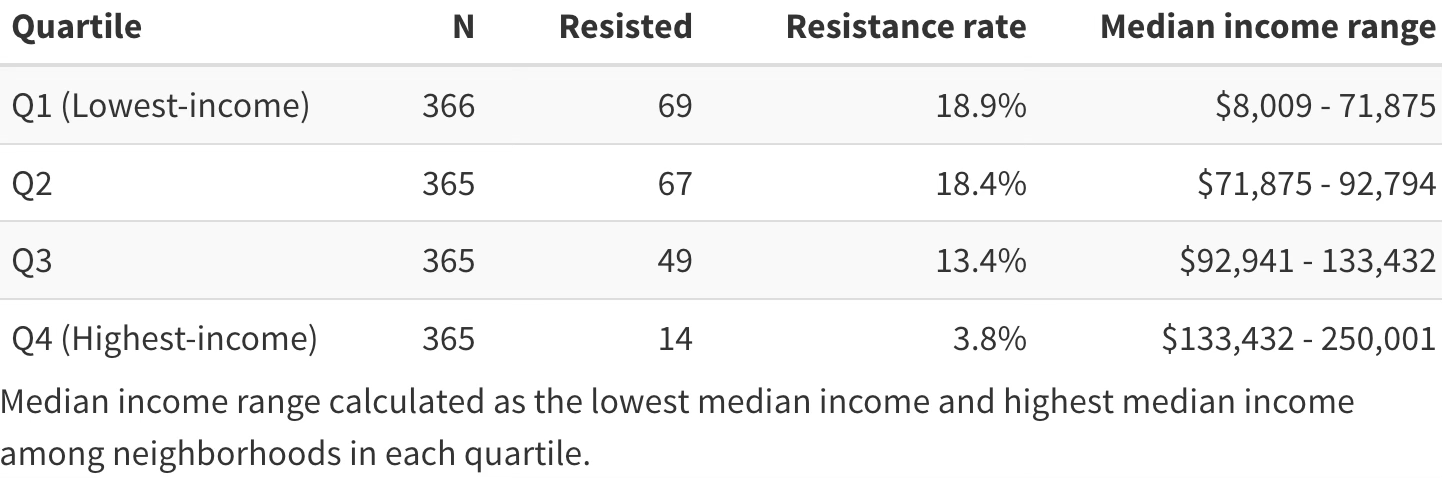
“The lowest-income, least-educated neighborhoods resist most, even among the low-income, low-degree areas facing proposals,” he adds. Meanwhile:
Highly-educated, high-income neighborhoods put up unusually little resistance. To the extent homeownership may play a role, we’re not talking about NIMBYs resistant to affordable housing—we’re talking about people who may live in affordable housing.
Furthermore, Holtzman’s data confirms that the data center revolt is working. We’ve seen the headlines about cancelled or downsized development projects—just this weak, Ken O’Leary’s Utah-based megaproject was halved by the governor there in the wake of public pressure. Others have been cancelled outright.
Per Holtzman:
2. Recently proposed data centers that faced pushback were canceled or suspended at more than five times the rate of data centers that didn’t (28.2% vs. 5.2%).

This is actually a very striking figure. When newly proposed data centers encounter community resistance, nearly a third have been cancelled, suspended, or shut down. That’s a remarkable success rate, and it should prove further inspiration for data center opposition organizers considering new fights.
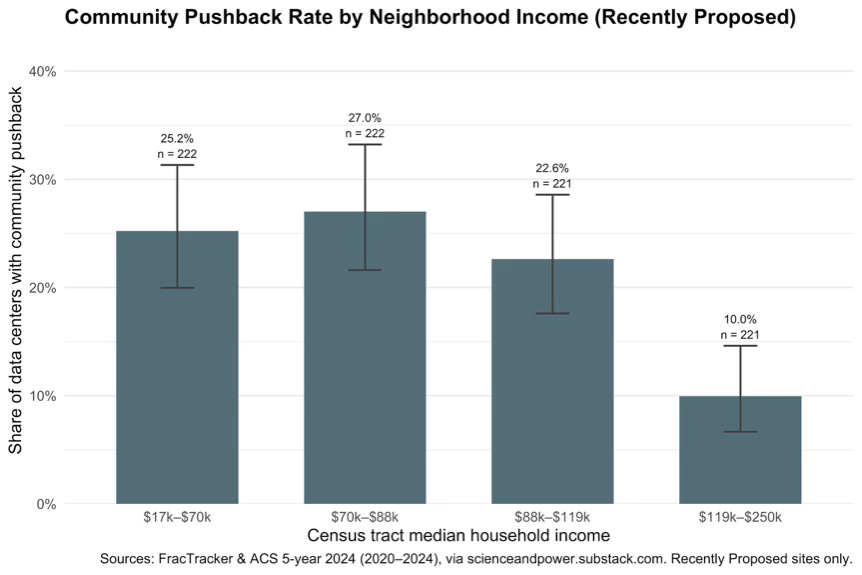
Finally, combining the insights from those first two points, Holtzman finds that
3. Cancellation rates are highest in lower-income areas, a fact fully explained by their higher rates of pushback.
“The odds of cancellation are six times higher in neighborhoods that fight than in neighborhoods that don’t,” Holtzman notes. “Increased cancellation in low-income areas is fully explained by high rates of pushback in these neighborhoods,” he adds, “so continued proposals in these areas may stoke outrage, drive resistance, and increase cancellation rates.”
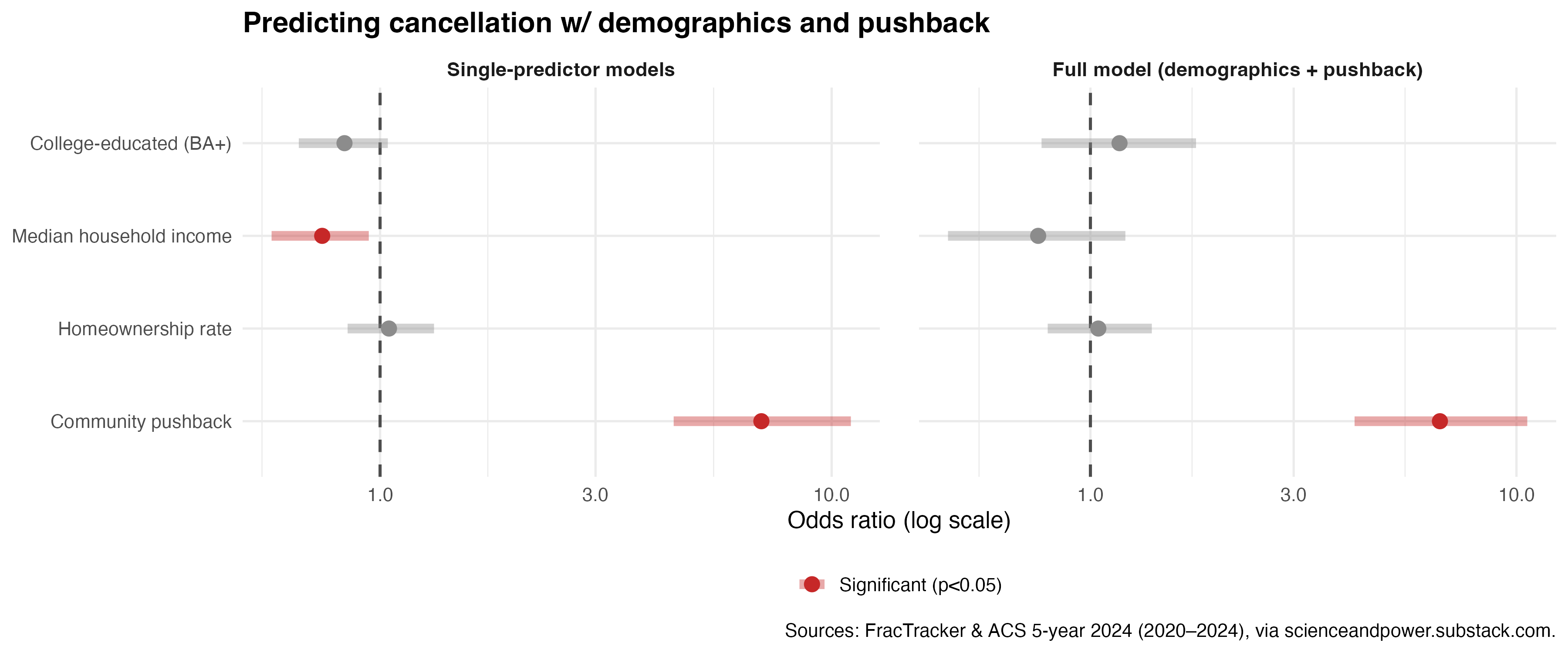
I hope that this helps explode the patronizing myth that the data center resistance is being led by affluent NIMBYs, and that it’s much more frequently working class residents and neighborhoods pushing back, and that this proves useful to cities, residents, and organizers in areas where data center development is a going concern.
And once again, a big thanks to Holtzman for allowing me to publish this work on Blood in the Machine here. For those interested in playing with or further examining his data, he’s dropped the entire repository on Github.
BONUS: The US as a whole is the most against new data centers
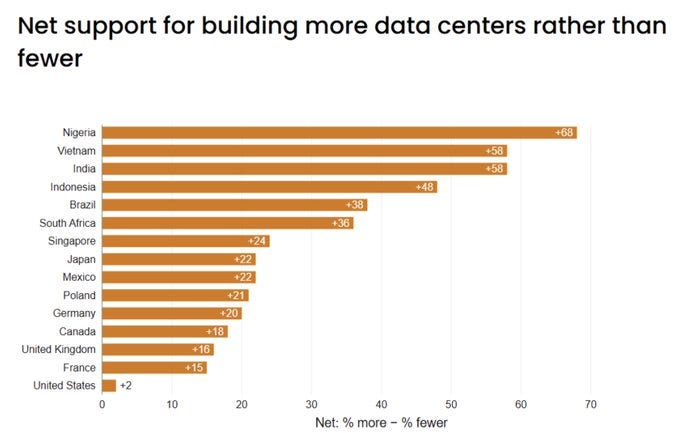
From the research firm Public First (and hat tip to WIRED reporter Molly Taft for flagging):
How did the US, the heart of AI’s boom, become the thorn in its side?
Our survey provides a few explanations.
Informed Opposition
The public is more aware than before of what AI is and does, and of what data centers are and do. When we were polling AI 5 years ago, it was a fringe interest at best. We’ve now seen clear growth in awareness and understanding, and more developed usage of tools, particularly among the 25-44 year old age range. Our analysis of who is aware of AI has needed to move from “who has opened an LLM” to “who is using LLMs in a sophisticated, integrated way”.
Our survey shows that America is middle of the pack when it comes to claimed awareness of data centers. One of the higher levels compared to other “developed” markets. We’d expect as much, reflecting the level of data center roll-out in America.
And this “informed opposition” leads it to detest data centers more than any other surveyed nation. Interesting!
Bernie Sanders proposes a sovereign AI wealth fund where the public takes a 50% cut of AI firms’ stock
In the ‘wild AI policy swing of the week dept’, Bernie Sanders published an op-ed in the New York Times laying the groundwork for a proposal he calls the American AI Sovereign Wealth Fund Act:
This legislation would give the public a direct ownership stake in the largest A.I. companies in our country. How? It would create a sovereign wealth fund through a one-time 50 percent tax — not on the profits of OpenAI, Anthropic, xAI and other companies, but paid with something far more valuable than that: the stock.
If passed, this legislation would do two crucial things. First, it would give the public a direct role in determining the future of this technology. No longer would the future of A.I. and the transformation of human life that it will bring be dictated by a handful of Big Tech oligarchs. The federal government would have the power, through its voting shares and an equal representation on each company’s board, to block decisions that hurt our citizens and to push for policies that help them.
Second, this legislation would guarantee that the trillions of dollars potentially generated by A.I. are used to improve the lives of all of us — not simply to make the richest people in the world even richer. If the big A.I. companies continue to grow as rapidly as many analysts expect, then the value of the sovereign wealth fund will grow as well — and the benefits to the American people will grow along with it.
It would be an understatement to say that the proposal has not exactly been met warmly, and has in fact managed to alienate just about every conceivable group. Silicon Valley and the right scoffed at the public ownership piece, while the left scoffed at Sanders’ industry hype-aligned belief that “Artificial intelligence will almost certainly be the most transformational technology in the history of the world,” as he states in the opening sentences of the op-ed.
Which yes, this is a wild thing to say, both on its face, given the entire history of technology, and for how much it aligns with the hype that AI companies have been putting forward themselves. Justifiably, lots of people on the progressive side of the aisle have been scratching their heads over how and why Sanders became so AI doomer-pilled. His stated outlook on AI is after all not so different from leading x-risk voices like Eliezer Yudkowksy, who Sanders has met with, and who are, to say the least, strange bedfellows for a democratic socialist. I would love to see some reporting on how these alliances were formed, and how Sanders became so worried about x-risk and convinced of a coming jobs apocalypse.
THAT SAID, at the risk of my luddite bona fides, I’ll say that I don’t actually hate the proposal itself. I have thought to myself more than once that the least we could do is demand political reforms that fit the scale of the transformation the companies themselves are continually promising. At least as a rhetorical maneuver. It would at least make for an interesting political intervention: Oh you think AI is going to transform literally everything, you “firmly believe” AI should benefit “all of humanity,” and you’re worried that it could eliminate like 30% of jobs? In that case, the only way to guarantee positive outcomes for everyone would be some means of public ownership over AI and beefed up guaranteed social benefits; healthcare for all, job guarantees. At the very least.
I certainly don’t think you need to embrace the AI companies’ self-promotional vision for disruption and technical transformation to do this, and I think there are lots of ways to approach this that would have brought more parts of the progressive coalition on board—not least of which would be to point out that if the public were to have this level of control over AI development, one of the things it could do would be to vote to slow it down or stop it altogether. I think we should be on the lookout for mechanisms that would provide the public more real direct power over the development and deployment of mass technologies of all kinds, and a publicly controlled sovereign fund is one road to consider.
No, AI is not conscious
Ted Chiang, GOATed science fiction author and fellow AI critic, has a lengthy, must-read piece in the Atlantic this week. It’s ostensibly a refutation of the AI labs’ insistence that their products are conscious or on the verge of becoming so, but it’s also a shrewd dissection of why, exactly, these commercial firms are so intent on portraying their products this way in the first place.
A few key money quotes:
It’s not plausible to me that a development path where the first step is a sentence-continuation machine that emits bad Julius Caesar dialogue and the next step is a sentence-continuation machine that emits decent Julius Caesar dialogue is one with a conscious Julius Caesar—or consciousness of any sort—as its end point. Faking the moon landing is a good step toward faking a Mars colony, but it’s not a good step toward actually putting astronauts on Mars.
Being open to the possibility that LLMs are conscious is the same as being open to the possibility that Microsoft Word is conscious, or, more precisely, that multiple distinct consciousnesses are dormant in every Word document containing a conversational transcript, and that they are awakened every time the document is loaded. Should you consider the possibility that every time you open a Word document, you are bringing multiple conscious interlocutors into existence, and every time you close one, you snuff their existence out? No. Contemplating that scenario is not a good use of your time.
The neuroscientist Anil Seth has noted that no one claims that AlphaFold—the program developed by Google DeepMind to predict the folding of proteins—is conscious, even though its underlying architecture is in many ways similar to that of LLMs like ChatGPT and Claude. This indicates that it’s not any intrinsic property of so-called neural networks that leads people to believe that LLMs are conscious; it’s simply the fact that LLMs emit grammatical sentences and we are accustomed to reading intention into sentences, whereas we are not accustomed to reading intention into the way that amino acids fold into protein molecules.
Some Bloody links:
-I very much enjoyed this saga revealing how some top AI SuperPACs are spending their time and resources running bizarre sockpuppet AI doomer X accounts from Taylor Lorenz and Tyler Johnson at User Mag.
-Great story from Josh Eidelson in Bloomberg about how Trump has put his thumb on the scales to help Amazon beat back organizing delivery drivers that absolutely should be considered full time employees of the tech giant.
-”A University System Went All In on A.I. Now It’s Tearing Itself Apart,” by Linda Kinstler in the New York Times Magazine. Good read.
Finally, a Fun Thing: Blood in the Machine and yours truly were featured in Editor and Publisher magazine, as a case study in its feature “Life after legacy media: More journalists are betting on themselves.” Thanks to all of you who have made that bet begin to pay off, I couldn’t be more grateful. Oh and if you’re reading this on Friday, and happen to be listening to NPR, keep an ear out for my spot on On the Media, in which we discuss Anthropic’s ethics slop-fueled rise.
OK OK that’s it for today. Thanks as always for reading, and keep those hammers up. See you next week.
Per Holzman: I used the 5-year American Community Survey 2020-2024 vintage, so income numbers are generally a tad lower than you might expect. I needed to do that to get data at the census tract level; and so for national median, I stuck with the same dataset.
Sanders proposal is brilliant in my book given the public's united hostility against AI. This might be the only feasible means for real redistribution of wealth.
I hope plenty of people in New Zealand read this before our appalling government gives away all the cheap Manopori electricity and water to a data centre and again returning nothing to NZ.