


For the last week or two, leading AI startup Anthropic has apparently been shopping a bill around to federal lawmakers “to regulate frontier AI safety and security.” The bill is pretty transparently an effort to address public concerns drummed up by the company’s own former and current staff—and its own executive leadership—that the AI systems it’s currently developing may eradicate the human race.
The bill would let the government block a model’s release or use only if it poses a foreseeable, imminent risk of more than $1 billion in damages, or of killing or seriously injuring more than 50 people. The risk s stem from the creation or release of a biological weapon, the model evading its developer’s controls or a cyberattack. The language mirrors that found in California’s AI laws including SB 53, which was signed into law last year.
The most generous reading of the proposed bill would be that it’s an effort to empower the government to intervene when necessary to prevent Anthropic’s perceived worst case scenarios with regards to AI development, advanced by industry stewards with genuine concerns about their own technology. A more accurate reading is that it’s a bad joke, and a remarkably self-serving one.
Before we continue, a little housekeeping: This week, on Wednesday October 28th, I’ll be joining a seminar put on by Study Hall, the great resource hub for freelancers and media workers, to discuss AI in journalism. It’s free to join, and you can register here.
On November 2nd, I’ll be at Princeton, speaking at the university’s launch event for its Princeton Societal AI initiative, along with folks like Audrey Watters and Alondra Nelson. I’ll be joined in conversation with Princeton professors Molly Crockett and Janet Vertesi, it’s going to be great. On November 5th and 6th, I’ll be at Duquesne University for its 2026 Tech Ethics symposium, “Constructing Community, Deconstructing AI: Storytelling, Solidarity, and Faith.” It’s another stacked bill, and another incredible program, with friends of BITM Paris Marx and Molly Crabapple also participating, among others. It’s in Pittsburgh, and open to the public; you can register here. Hope to see you there.
The magazine Current Affairs has announced a policy officially banning AI; the accompanying essay is well worth a read, and not just because it cites yours truly in its reasoning. Finally, I spoke with Inc magazine about why tech CEOs have become the cinematic villains du jour. I can only do a lot of this stuff thanks to subscribers who chip in to keep the lights on here—many thanks!—and so I can do the writing and reporting in the first place. Consider becoming a paid subscriber so I can do so, and you’ll get access to occasional paywalled posts like this one, all forthcoming podcast benefits, and the satisfaction that you’re backing critical independent tech journalism at a time when, arguably, it matters most.
Okay! Back to Anthropic, and its set of self-proposed policies that, I’m sorry, only the most rationalist-pilled and accelerationist AI boosters would find acceptable as a means of “regulating” AI.


This could be mistaken for parody, really. It’s an effort to enshrine into law a standard in which AI models are explicitly legally permitted to carry the risk of killing dozens of people at a time and cause hundreds of millions of dollars in damages without penalty. And, presumably, to insulate Anthropic from liability in the process. (It also strives to impart the impression that the firm is boldly doing something about all these AI fears, and acting the “responsible” custodian of AI its reputation is built on it being. In reality, it’s a means of performing the kind of regulatory capture you’ve perhaps heard so much about, setting its own terms for AI regulation that would ultimately require the company to do very, very little—while sapping the political will for more meaningful efforts.)
Notably, all of the incidents in which an AI model “went rogue” this summer—OpenAI’s software facilitating a hack into competitor HuggingFace’s systems, Anthropic’s software submitting fake tips to the Philadelphia police department, and so on—would, in Anthropic’s bill, be exempt from governmental intervention, despite the fact that some of these acts are felonies.
As Politico put it, “Leading AI labs disclosed a series of incidents this summer, in which AI agents hacked or probed websites and platforms. None reported so far appear to have caused widespread deaths or over $1 billion in damages.” I for one think Anthropic is being incredibly brave here, rising to meet the moment by proposing legislation that forces the company to change precisely nothing at all about how it conducts business. Worse still, the bill contains more swings at preemption: that dubiously legal, still-ongoing, and Trump administration-backed effort to exempt AI companies from state-level laws they find inconvenient.
Now, I would say that the odds that Anthropic’s bill will pass into law in this form are about the same that Catholic Church will agree with the company’s insistence that chatbots are ensouled. It’s nonetheless a reflection of how much clout and cash the AI companies are throwing around on the Hill right now, and of their persisting belief that they can patch up their vast image problem by proposing soft, self-serving AI social policies of their own design. (Just this week, yet another new poll found that a clear majority of Americans think AI is bad for society, and that two-thirds continue to oppose data center construction.)
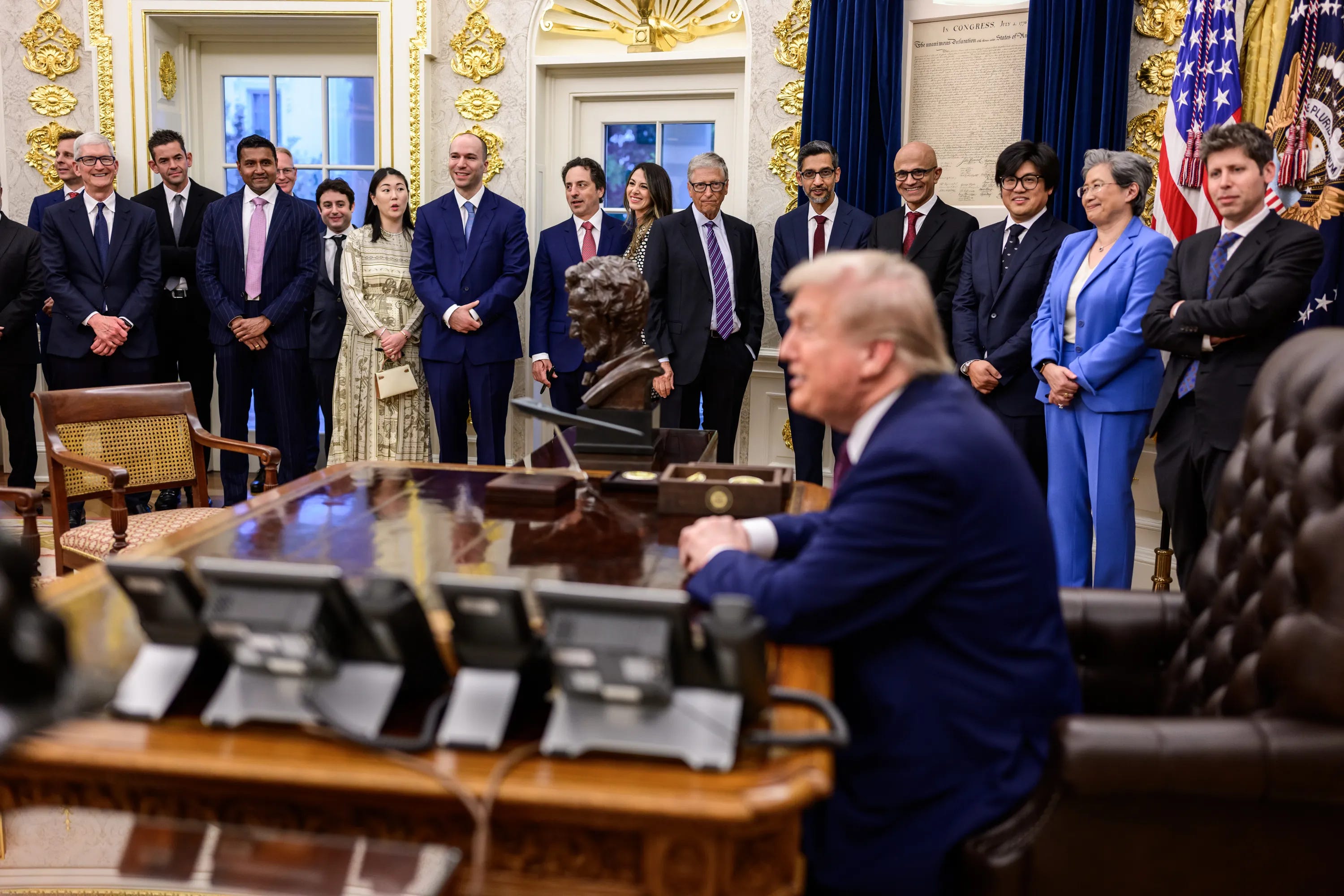
For the rest of us, it’s an urgent reminder and further evidence that we cannot, under any circumstances, let the AI companies alone (continue to) govern themselves. After all, Anthropic’s pitch to legislators is only the most recent effort from the big AI companies—xAI and OpenAI have their ideas, too—and each seeks to win advantage and influence by pushing their specific visions.
Here’s OpenAI’s, as you might recall:
