


Let’s all stand up and give a slow clap to Anthropic. After sparking a major news cycle in the tech media with its April announcement that it had built an AI model, Mythos, so powerful, so dangerous that it threatened to upend the entire civilizational order—and that it was diligently withholding the product from the public so as to protect us from it—the nation’s now-#1 AI startup decided to put Mythos up for sale after all.
Apparently two months’ of protection from the ultra-AI is all the safeguarding we needed. Interestingly, that’s precisely the amount of time that it took Anthropic to translate the press attention around Mythos into a historic $65 billion funding round. What a coincidence. According to its marketing materials, Anthropic’s Claude Fable 5, is a “Mythos-class model” that has been “made safe for general use,” and will be on offer to “organizations taking on their hardest knowledge and coding work.” It’s available now “on the consumption-based Enterprise plan.”
It’s hard for me to exaggerate how shameless this is. Has there ever been a more successful marketing campaign, one that yielded so many billions of investment in so short a time? The Mythos campaign is nothing less than the ne plus ultra of AI ‘doom marketing’, the practice that has helped animate the entire AI boom, and that sees tech companies drum up investor and media interest in their products by registering harrowing claims about the threats those products pose to jobs, norms, even humanity’s very existence. And the media fell for it, hook, line, and sinker.
TODAY in BITM: The anatomy of Anthropic’s disturbingly successful doom marketing campaign. Plus, Elon Musk is a trillionaire after years of his own science fictional marketing efforts, the SUMMER OF LUDD is coming to New York City, and the first-ever D&D game inspired by BLOOD IN THE MACHINE.
As always, this work is made possible by subscribers who chip in each month to help me keep the lights on. If you find value in this reporting and writing—in 100% independent human-made media that holds the AI firms and big tech accountable—consider becoming a paid supporter. A huge thanks to all of you who back me up; I couldn’t do any of this without you.
Now, I know I just spent a whole edition dissecting Anthropic’s press strategy and how it used AI ethics slop to vault itself into the top AI lab slot. But this is just such a perfect doom marketing case study, arriving no fewer than three years after ChatGPT, to boot, when you’d think more folks might be inoculated against self-serving AI company hype, that it demands to be examined in detail. Anthropic’s Mythos stunt takes the cake on every front: Its sheer cynicism, rank opportunism, and, yes, its ultimate effectiveness.
Behold, the anatomy of a successful, trillion dollar company-making doom marketing campaign:
On April 7th, 2026, Anthropic announced that it had built a new AI model called Mythos that “could reshape cybersecurity” and was too powerful to release to the public. Instead, it would be overseen by a consortium of hand-picked tech companies given the cyberpunk-aping name Project Glasswing. “We do not plan to make Claude Mythos Preview generally available, but our eventual goal is to enable our users to safely deploy Mythos-class models at scale,” Anthropic and the consortium note in the announcement. “To do so, we need to make progress in developing cybersecurity (and other) safeguards that detect and block the model’s most dangerous outputs… allowing us to improve and refine them with a model that does not pose the same level of risk as Mythos Preview.” The subtext, that businesses and users will need this next-level powerful AI, is as subtle as a sledgehammer.
The announcement was made via a slick website with some documentary-style sponcon featuring Tech Luminaries intoning about how important cybersecurity is and how AI (and specifically, Anthropic’s new Mythos product) is disrupting it.
Anthropic (and the other top tech companies that stand to benefit from the marketing of a new AI product) then encourage the “too dangerous to release” narrative, perhaps best encapsulated by this Thomas Friedman New York Times column, titled “Anthropic’s Restraint Is a Terrifying Warning Sign.” The column runs April 7th, the same day as the Mythos announcement, meaning Friedman was offered the story well in advance. “Holy cow!” he writes, “Superintelligent A.I. is arriving faster than anticipated, at least in this area. We knew it was getting amazingly good at enabling anyone, no matter how computer literate, to write software code. But even Anthropic reportedly did not anticipate that it would get this good, this fast, at finding ways to find and exploit flaws in existing code.” He raises the possibility that kids might use Mythos to take the electrical grid offline before dinner. Scary stuff! His story also contains the sentence “This is not a publicity stunt,” which is the sort of thing I often find myself having to write about events that are definitely not publicity stunts.
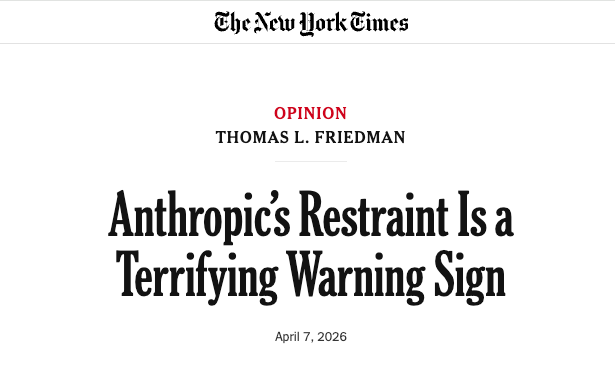
The rest of that week in April is filled with subsequent reports about Mythos, the too-dangerous-to-release model, elaborating on the cybersecurity concerns raised by the model’s existence from news outlets like CBS (“Why Anthropic is saying its new AI model, Mythos, is too dangerous to release”), ABC (“Is Anthropic’s Mythos AI too dangerous for users?”), the Times (“You Can’t Use This A.I.”), and Bloomberg (“How Anthropic Learned Mythos Was Too Dangerous for the Wild”). To name a few.
Anthropic generates both attention, buzz, and goodwill from the press cycle, furthering its reputation as the “ethical” startup, and the foil to the reckless ambitions of chief rival OpenAI, typified by this Bloomberg Opinion headline, “With Mythos, Deserves Support, Not Blacklisting,” which argues Anthropic is doing AI the “right” way.
Anthropic’s pomp and media campaigning successfully obscure the skepticism that brews in the cybersecurity community over its grandiose narrative. By late April, security professionals are roundly criticizing the AI lab’s Mythos claims. Dr. Heidy Kalaf raised red flags about the nondisclosure of false positives, and the way Anthropic was presenting its ‘data’. One developer—a fan of the company, no less—concluded that while Mythos did find some real bugs, the findings were so overinflated as to essentially be “built on misinformation.” The cybersecurity-focused news outlet The Register, meanwhile, declared that “Anthropic’s super-scary bug hunting model Mythos is shaping up to be a nothingburger.”
The criticism barely reaches the level of background noise, and Anthropic pushes on with its narrative. On May 22nd, Anthropic issues a press release, “Project Glasswing: An initial update” that claims, without seriously addressing most of the critics’ concerns, that Mythos has been used to find “more than ten thousand high- or critical-severity vulnerabilities across the most systemically important software in the world.”
On May 25th, Anthropic co-founder Chris Olah turns up at the Vatican for the release of Pope Leo XIV’s encyclical on AI, on the winds of its burnished reputation as the AI company with humanity’s interests at heart.
On May 28th, Anthropic announces it has closed a $65 billion series H funding round that makes it worth nearly $1 trillion and the most valuable AI company in the world, edging out OpenAI.
On June 9th, two months after the initial announcement, Anthropic makes its “Mythos-class” AI model available to the public, or at least, anyone with an Enterprise account: “Today we’re launching Claude Fable 5: a Mythos-class1 model that we’ve made safe for general use.”
As a nice little cherry on top to the whole affair, the guardrails that Anthropic has put up to make it “safe for general use” are so prohibitive that you can’t use it for cybersecurity at all. AKA you can’t use it to do the thing Anthropic has spent the last two months relentlessly hyping; incidentally, users also can’t evaluate whether or not it’s as powerful they claimed, or if the hype was in any way warranted.
To me, this really gives away the game. Of course the doom marketing campaign was never aimed at cybersecurity pros (not least because they’re the ones best equipped to immediately start poking holes in the bigger claims), but the public at large. That’s where the narrative might truly resonate; among those with less of a grasp on the particulars of what the AI model built to find flaws in cybersecurity systems could or could not actually do. We’re left with the story that this big scary powerful AI has been tamed enough for use by business professionals and software engineers—not for cybersecurity purposes, it’s still too powerful for that; but for everything else—who can now access it as part of an enterprise software automation product.
As Gary Marcus has noted, the public release of Mythos comes at a time when a lot of companies are rethinking their AI spend, which continues to yield dubious ROI. In this light the launch can be seen as another way to keep more clients on the hook, at least until that IPO rolls around. Marcus also points out that one reason Anthropic may be better than anyone else in the biz at doom marketing is that its executives were at OpenAI when they pulled off one of the pioneering PR stunts of the genre, via their solemn non-release of an earlier ChatGPT model in 2019, withholding that from the public because it was—guess why!!!!—too dangerous.
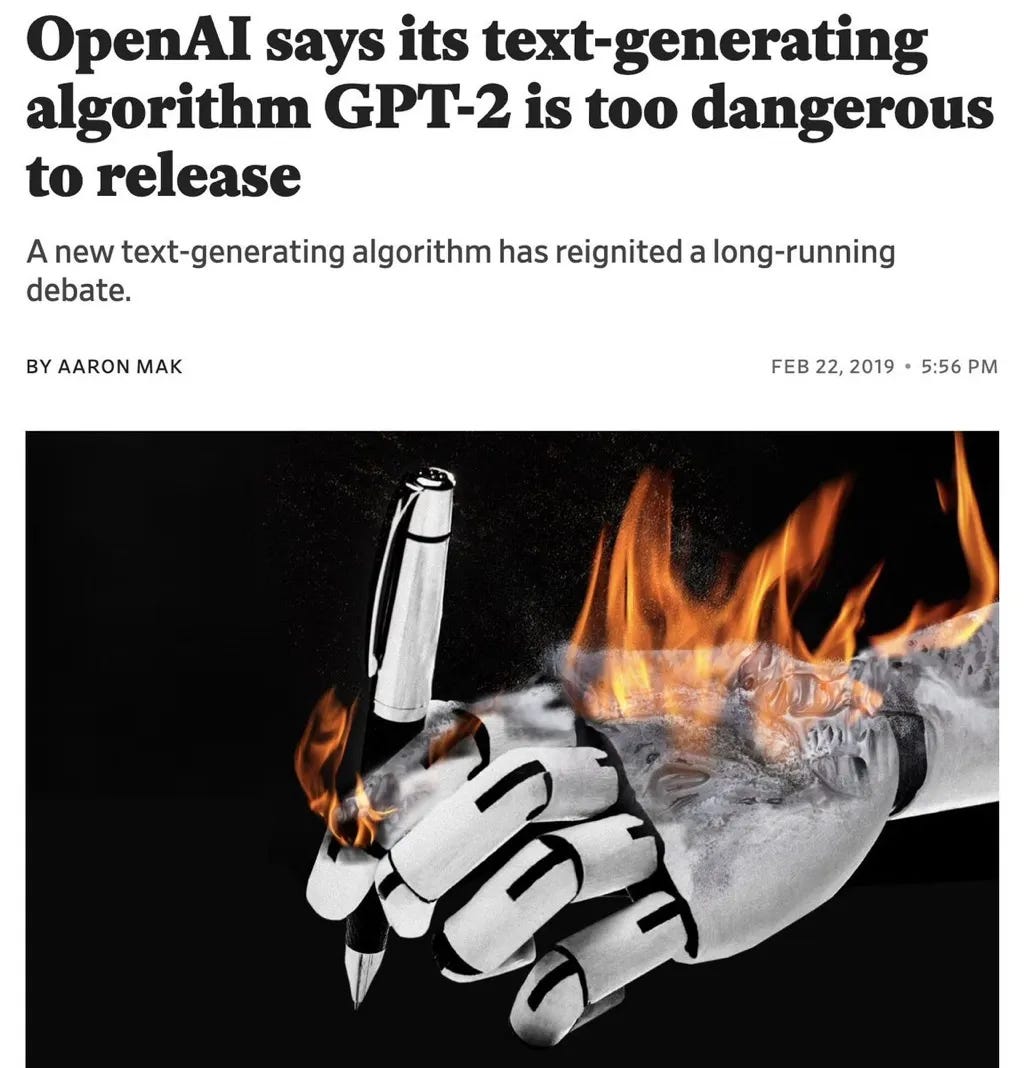
In Anthropic’s defense, it did exactly what it said it was going to do: release an AI model with the same branding as the allegedly world-upending one it spent two months expertly doom-marketing. The annoying thing is that the company pulled it all off. They won. They exploited the media’s inability to pass up a big scary AI narrative with a nominally novel twist (cybersecurity vulnerabilities), to such success that, months later, even putatively smart people like the historian Rutger Bergman are earnestly describing Mythos as “an insanely powerful model capable of hacking anything from power grids to water systems,” despite this being one of the clearest-cut cases of obvious AI product marketing I have seen in my years of covering this industry.
Anthropic leveraged its reputational capital to take a big swing, and the media and investors ate it up. Anthropic doled out its AI ethics slop so expertly that they were able to parlay that positive press from their morally calibrated Mythos non-release into an audience with the Pope, a record-breaking funding round, an IPO, and the much-hyped sale of a new product. (Again, for more details on this broader story, see my last post on Anthropic’s weaponizing of its ethical AI reputation and my chat with NPR’s On the Media about the same topic).
It’s safe to say that Anthropic is not facing nearly enough scrutiny for this admittedly expertly manufactured bit of AI fabulism, and the role it has played in helping to cement the company’s newfound status as the leading AI company. Mythos—def.: “myth, mythology”— indeed.
The world’s first trillionaire is also a world-class mythologizer
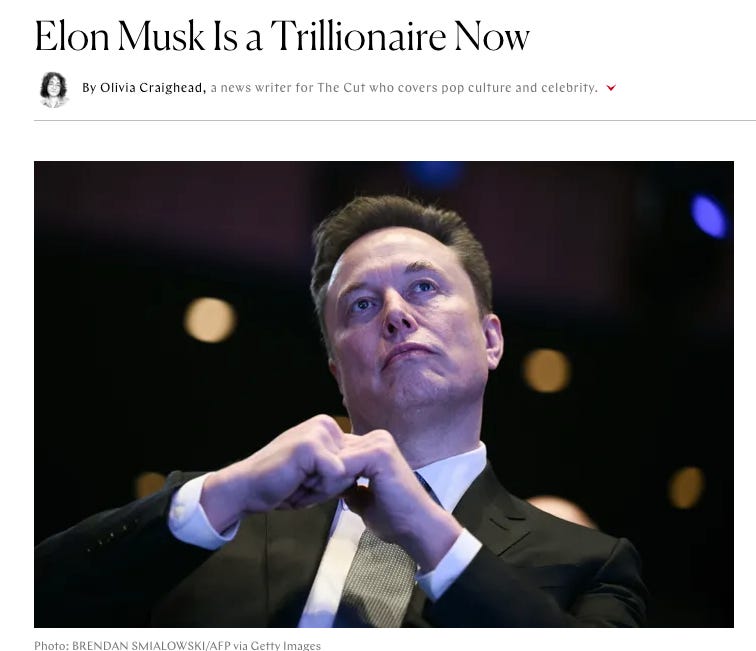
You may have heard about this SpaceX IPO thing. As expected, it’s enormous, and it has minted the world’s first trillionaire in Elon Musk.
Musk has been a force in a lot of novel lines of business, that’s undeniable—privatized rocketry, electric cars, MechaHitler assembly—but arguably his biggest innovation of all has been the relentless science fictionalization of capitalism itself. He has learned over the years how to tell grandiose stories abut the future that appeal to investors and consumers, and how to effectively ignore the stories among those that don’t come true. (He is also responsible for the deaths of literally hundreds of thousands of people.) There were supposed to be thousands of electric robotaxis on the road right now, Teslas were supposed to be fully autonomous, and an army of humanoid butlers are set to walk into our homes any day now.
To this end, the SpaceX IPO in particular was buffeted by tales of orbital data centers (scheduled to arrive in just a few years!) and nothing less than incoming MOON BASES. Again, this sort of fabulizing is abetted, even made possible by an all-too credulous media. Here is how SpaceX defines its mission in its SEC filing:
Our mission is to build the systems and technologies necessary to make life multiplanetary, to understand the true nature of the universe, and to extend the light of consciousness to the stars. To do this, we have formed the most ambitious, vertically integrated innovation engine on (and off) Earth with unmatched capabilities to rapidly manufacture and launch space-based communications that connect the world, to harness the Sun to power a truth-seeking artificial intelligence that advances scientific discovery, and ultimately to build a base on the Moon and cities on other planets.
This industrial scale science fictionalizing is evident in the DNA of every major AI company, from OpenAI promising an artificial general intelligence that would transform the fabric of the world to Anthropic promising that it’s the only one that can safely contain the AI doing all that transforming. Musk is a key reason the companies can get away with putting their speculative narrativizing over having anything resembling a credible business model; he got away with it, for years, first.
In a review of Quinn Slobodian and Ben Tarnoff’s new book, Muskism, Henry Farrell cuts to the heart of what that means in the context of the SpaceX IPO:
All this is held together by an ideology that seems to be at its peak right now. The SpaceX IPO marks the massive expansionary inflation of an entirely imaginary universe. As far as I can tell, no-one actually believes that SpaceX is going to capture its roughly-$23 trillion “total addressable market,” which as Matt Levine points out is “perhaps 20% of the world’s economic output and perhaps 40% of the revenue of the world’s corporations.” But there are lots of people who are willing to go along for the ride for the moment, as long as other people are willing as well.
How long this imaginary universe can possibly expand as the fleets of robotaxis and humanoid butlers and orbital data centers and moon bases—not to mention all-powerful AGI—fail to materialize is another question altogether, and one with possibly severe ramifications for the global economy.

New Yorkers, get ready for the Summer of Ludd
This is a beautiful, beautiful thing, and I’m bummed that I won’t be in New York to experience it. But for those who live in the area, there’s a whole slate of Luddite activity planned across the city—talks, plays, music, conferences, protests—and it looks delightful. There’s even a “Luddite hotline” you can call. One of the organizers sent me the mission statement, which, fittingly, isn’t posted to social media or anywhere else online, so I’ll just share it (with some LIGHT editing for length) here:
GET READY FOR...
THE SUMMER OF LUDD
JUNE 28th – JULY 5th, 2026
More than 120 events will take place across New York City, affirming in-person connection and rejecting the corrosive effects of algorithmic technologies
The first-ever, free-to-the-public SUMMER OF LUDD will take place in New York City from June 28th to July 5th, 2026. Drawing from a rich tradition of social movements and growing out of a burgeoning community of hundreds of organizers, artists, and concerned citizens, the SUMMER OF LUDD will be a joyous celebration of the organic and unpredictable connections that arise and flourish when we reject the extractive surveillance technologies that have increasingly come to dominate our lives.
New York City has become the national center of a dynamic “Luddite Renaissance” that expresses itself in kaleidoscopic prose, political activism, poetry, phone-free dance parties, app deletion events, Luddite tribunals that put tech on trial, and other events of refreshing relevance, all aimed at getting people off Big Tech platforms and into public space.
The SUMMER OF LUDD will include more than 120 events at assorted venues throughout New York City — a weeklong “movable feast” with ongoing, and often simultaneous, pop-up actions such as teach-ins, an original theatrical production telling the story of the original Luddites, a concert series, film screenings, ritualistic ceremonies, workshops, and actions against Big Tech platforms — including the flagship S.H.I.T.P.H.O.N.E. (Scathing Hatred of Information Technology and the Passionate Hemorrhaging of Our Neoliberal Experience) event. The festival will connect the dots between addictive algorithms, social isolation, data center ecocide, automated warfare, job loss, data extraction and surveillance, and accelerating inequity.
In conjunction with the festival, The New School will host the Luddite Conference on Participatory Futures from 10 a.m. to 3 p.m. on June 30th... Admission is free and open to the public, but advance registration is required. Learn more and register to attend here.
The SUMMER OF LUDD is a big tent gathering that welcomes all New Yorkers and anyone who has questioned the role technology plays in their lives. It is a 100% social media-free celebration… Tompkins Square Park will serve as the festival’s home base, and free lunch will be served there daily at 12:30 p.m. starting on Monday, June 29th.
In the run-up to the SUMMER OF LUDD, there will be a press conference on June 23 at 6 p.m. at Tompkins Square Park. This press conference will feature Gowanus the Media Puppet. Additional press conference details will be provided in a forthcoming media advisory.
LEARN MORE ABOUT THE SUMMER OF LUDD:
To get a printed program guidebook detailing the 120+ SUMMER OF LUDD events, please reach out to theofficialsummerofludd@proton.me.
Printed guidebooks will be available at independent community spaces, arts venues, and other cultural gathering places throughout New York City.
The SUMMER OF LUDD does not have a website. Updates about programming can be accessed by calling the Luddite Hotline at (347) 814-5194. This hotline will be updated daily during the festival week with event schedules and other announcements.
KEY DATES:
June 23 – SUMMER OF LUDD press conference at 6 p.m., Tompkins Square Park
June 28 – Festival begins; theatrical production of Luddite Recreations at 5 p.m., Tompkins Square Park
June 30 – The Luddite Conference on Participatory Futures, 10 a.m. to 3 p.m. at the New School. Free to the public, advance RSVP required.
July 4 – S.H.I.T.P.H.O.N.E., 2 p.m., beginning at Tompkins Square Park
July 5 – Closing Ceremony (Lady Ludd guides us into the future), 5 p.m., Tompkins Square Park
Who were the Luddites?
The original Luddites of the 1810s were skilled textile workers who resisted early forms of automation. The tech titans of the Industrial Revolution fractured the lives of workers, by replacing them with automated machinery. This upheaval inspired ten years of civil protest. As a last resort, facing starvation, the Luddites broke the machines, under the banner of their folkloric hero, Ned Ludd. Despite widespread support, the Luddite movement was crushed by the British Crown, and their leaders executed—all in the name of “progress.”
Today’s tech oligarchs — under the same guise of “progress” — accumulate obscene wealth and power at the expense of our agency, employment, privacy, and natural environment.
Algorithms stunt our imagination and sense of what’s possible. The SUMMER OF LUDD restores our capacity to imagine and shape a life-affirming future.
All events are free!
All events are participatory! All generations are welcome!
PROMOTIONS FOR THE SUMMER OF LUDD ARE 100% SOCIAL MEDIA-FREE.
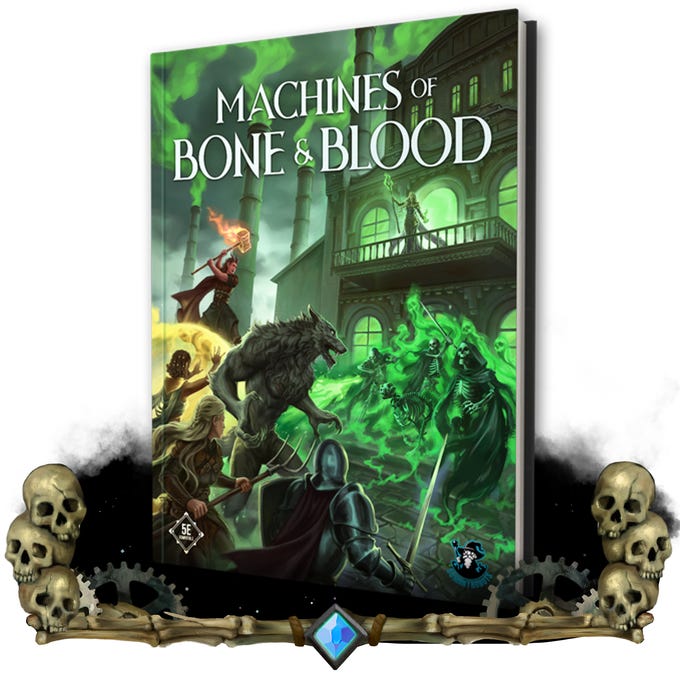
Blood in the Machine has inspired a D&D game
Last, but certainly not least, something very cool: Apparently, a tabletop game designer read Blood in the Machine: The Book, and was inspired to create their own dark fantasy twist on the Luddite saga. The creator reached out, and I said I’d be happy to share the story of the game’s genesis. If you create work inspired by BITM, you get free promo on the blog, it’s just science, I don’t make the rules. So here’s Ben’s story:
Hello! I’m Ben Somers, the primary person behind Somanyrobots Games. I’m an indie tabletop role-playing game developer; specifically, I write books for Dungeons & Dragons, giving players more options and more content they can use in their games.
Before this, though, I worked for a decade and a half in tech, mostly startups, in a wide range of software engineering jobs. By the time I left, LLM-assisted coding was just starting to show up, and the overriding advice to developers was “use it for hobby projects, but you can’t use it at work; we don’t want plagiarized code showing up in our products”. It is wild how the entire software industry has now smashed through that wall like the Kool-Aid Man.
When I shifted to writing D&D books instead, it was with a huge sigh of relief. And, not for nothing, a little pang of guilt. I did what I could to keep AI from taking over (and ruining) my industry, but now it’s a fight I’ve firmly left behind. My first book was about seafaring adventures, mostly apolitical, and was very much an escape from our uncomfortable world. Which is why I got such a bolt of lightning when I read Blood in the Machine!
The story of the Luddites resonated with me deeply, but it also gave me an immediate hook to hang a fantasy world on. Most sword-and-sorcery games don’t have a lot of space to fit an Industrial Revolution in;. But what if I took the dehumanization of those proto-factories and pushed it even farther? If I carried the industrialist’s disregard for human life to its brutal conclusion? In short, what if you had a factory that ran on souls instead of steam?
My new book, Machines of Bone & Blood, depicts a world where necromancers build looms and mills out of bone, attaching skeletal limbs so the machines can operate themselves. Workers are put out to pasture, except for the miserable few that graft undead parts onto their own bodies in order to keep pace. Glorious necrobarons reap the profits, becoming fabulously wealthy by virtue of their proximity to this blasphemous power. In the meantime, workers in cottages form alliances with primeval druids to try and tear down the whole horrible system.
This idea, of an industry literally burning up human souls, doesn’t and shouldn’t feel unfamiliar. Machines of Bone & Blood recasts the industrialists—the tech titans—as necromancers, and if anything, this undersells their moral depravity; nobody would buy a game book about enslaving orphans like Robert Blincoe into 14-hour factory shifts. But it gives me an avenue to write some compelling game options while also telling a story about dehumanization and the horror of unregulated technology. And it gives players of the game an avenue for fighting back, telling stories about trampled workers striking back by tearing down the factories and smashing up the machinery.
Excellent.
Finally finally finally, check out Molly White’s new project, Tech Influence Watch, which tracks the money crypto and AI firms are pouring into federal elections. I’d like to talk with Molly more about this work in the future, but it’s a great project that should be on your radar right now.
OK, enough of my ramblings for today. Thanks for reading everyone, and see you next week. As always—and maybe now more than ever—keep those hammers up.
With Musk, people aren’t just investing in a mythology, they’re investing in a right-wing extremist ideology. How else can you explain almost no one talking about him encouraging and inciting more violence in Belfast, just the day before his massive IPO? And it having zero effect on his IPO? Investment in far right enterprises is at an all-time high and imo THAT is the real story.
Little bit of a sidebar: how does Thomas Friedman still have a career? Do people actually still take him seriously?