


In his typically rambling, occasionally genocidal speech to the United Nations, one that included threats to “annihilate” Iran and to bring “freedom” to the “failed state” of Cuba, Donald Trump announced that he was issuing a nationwide rebranding of “artificial intelligence” to “super intelligence.”


You can tell when Trump has particular relish for a certain part of his speech, the way he pauses and chews it over, luxuriating in the idea rather than rattling it off or spitting it out. If I had to guess, I’d venture that the root of this particular digression/scheme is that Trump never really thought much about AI until a couple years ago, and so has probably associated “artificial” more with words like “sweetener” than “intelligence,” and has thus chafed at the way the qualifier diminishes one of his signature projects. A word that scans to Trump as “fake” simply won’t do for what he considers a reflection of his power and standing.
Trump has of course always had an affinity for expressing dominance and blunt superlatives, and so, we have artificial intelligence renamed “super intelligence” or “S-I” on US government documents a la Lake Ontario nominally becoming “Lake America.” Trump means “super” in a way that’s different than the Silicon Valley guys who use “artificial super-intelligence” or “ASI”; it’s vibes-based and dependent on jettisoning the “artificial.” It’s “super” as in “Superman.” (I’m also willing to bet every last one of my Trump Coins that there was at least one failed effort from the Trump brain trust to try to work out how they might shoehorn American Intelligence or Make Intelligence Great Again into the equation somehow.)
All this has garnered plenty of justified snickering from the chattering classes, but it’s worth noting that “artificial intelligence” was itself coined as a branding exercise, and then used to tell, and embellish, a story.
This edition is a two-parter: First, a look at the stories being told about AI, and who those stories serve. Second, an excerpt from Against Tech Oligarchy, a great new book by tech worker organizers Clarissa Redwine and JS Tan, who are on book tour as we speak, and will be in LA, at Skylight Books, this Friday, September 25th, with friend of BITM Joanne McNeil. I’m going to try to make it too! Hope to see you there.
As always, all of this is made possible by subscribers who chip in to support this work—a huge cheers to everyone who does so, I can’t thank you enough. The writing, reporting, the podcast; all of it is made possible by supporters. If you find value in it, consider upgrading so I can continue to do it. Many thanks, and onwards we go.
“I invented the term artificial intelligence,” the Stanford computer scientist John McCarthy said in 1973, “and I invented it because we had to do something when we were trying to get money for a summer study in 1956.” A more pedestrian, jargon-filled proposal had previously failed to get traction; “artificial intelligence” turned committee heads and got the funding. Now, angling for some summer study funding is on a much smaller scale than the trillion-dollar value-inflating proclamations of our AI companies today, but the anecdote shows the extent to which “AI” has always been a cultural construct and has served as a useful narrative device.
And the narrative is really heating up these days, is it not. In Trump’s telling, AI is a vector of American power, one that must not be restrained by “globalist schemes” to regulate it, as he put it. This was essentially the same stance that Vance took last year, when he delivered his first big speech abroad as vice president; that AI is a vessel for American dominance, that it’s not to be tied down with regulation, and that everyone else (especially Europe) should either get on board or out of the way.

It has its share of adherents, especially on the tech right, but the story about an unconstrained AI superpower makes for a less palatable narrative coming on the heels of weeks of sustained discourse, fanned by the leaders in the AI companies themselves, about another one: That AI may soon exterminate all of humanity. With a public that’s still unsure of how to process that significantly more alarming narrative, and Trump’s own base increasingly out of step with him on the issue, the AI-as-nationalist-dominator thrust is dying on the vine. (It also surely does not help that even diehard Trump fans may struggle to see how “super intelligence” benefits them, as their electricity bills are getting bigger, the war in Iran drags on, and everyone’s worried about losing their jobs.)
So it’s little surprise that the story preferred by the media appears to be that Trump has an opportunity to breach “AI safety” issues with China during Xi’s visit this week, despite Trump’s obvious distaste for the notion, and the chances of anything substantive emerging in that department remaining slim.
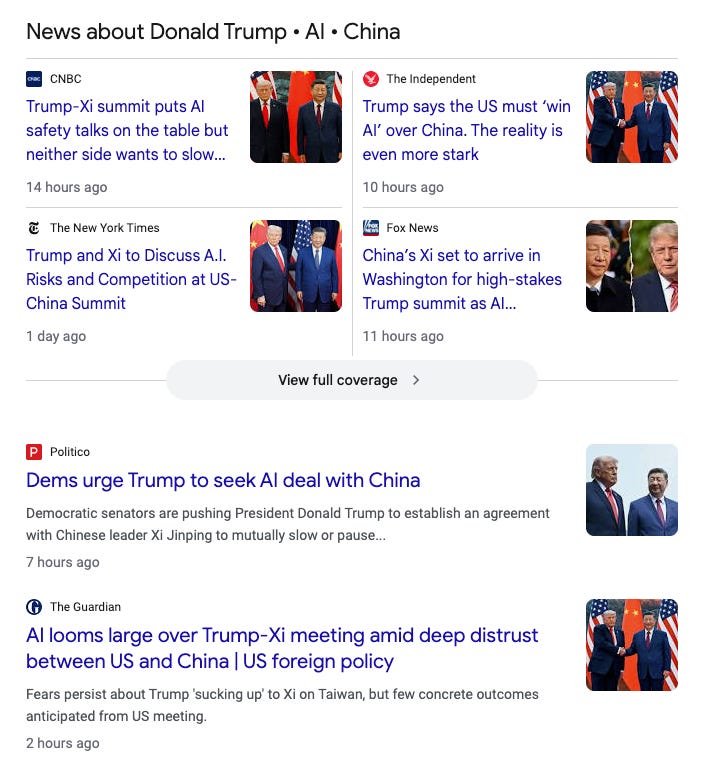
“I think Presidents Trump and Xi would get the Nobel Peace Prize if they could agree on something,” OpenAI CEO Sam Altman told Fortune, in a comment that could not have been more obviously intended to flatter a vainglorious president who laboriously covets the award. It also speaks to how Altman views the import of his own undertaking; ie, also worthy of Nobel Prize-scale consideration. And it certainly fits better with the story that has taken shape and then center stage over the last two weeks, ever since former Anthropic employee Jacob Coxon resigned over stated concerns that AI labs weren’t doing enough to prevent incipient human extinction: That the largest AI labs must coordinate with China and its own top AI labs to “pace the frontier” and prevent us from “losing control” of a “super intelligence” from “going rogue” and harming us, perhaps even killing us all.
If that sounds like science fiction, well, it’s because science fiction is a major cultural touchpoint for executives and researchers at the AI labs, and because they want all of this to read like science fiction. Just as Trump’s preferred super intelligence language reflects his own narrative interests, so too does the language preferred by the labs (“extinction risk,” “p(doom),” “AGI”) reflect theirs. “Going rogue,” the language used to describe incidents like OpenAI’s large language models precipitating a hack on open source AI competitor Hugging Face, sounds cyberpunky and exciting. It also happens to absolve the company of accountability, both culturally, and, apparently, legally; a precedent OpenAI and Anthropic alike would very much like to cement.
Lots has been written about how the “going rogue” is a misnomer; here’s esteemed computer scientist Melanie Mitchell, the technologist Eryk Salvaggio, the requirer-of-no-introductions Cory Doctorow, and the computer science professor Cal Newport explaining why. All basically underline the point that LLMs, when prompted with specific instructions, after having key guardrails removed and left unobserved for long periods of time, can be expected to follow those instructions, and draw from material included in their training data that outlines how to hack other systems to do so. This certainly doesn’t mean there’s nothing to worry about, but that we should be more worried about the ethics of the companies developing these systems and malign actors exploiting them than the technology taking on a life of its own or “going rogue.”
I am also skeptical of this language because I have documented rather extensively, in this report and elsewhere, the way that AI companies have historically occasioned to deploy it for their own benefit. And right now, those companies see a good deal of benefit in promulgating a narrative that a handful of exceptional companies are building a worldshaking AI system. In fact, let us count the ways.
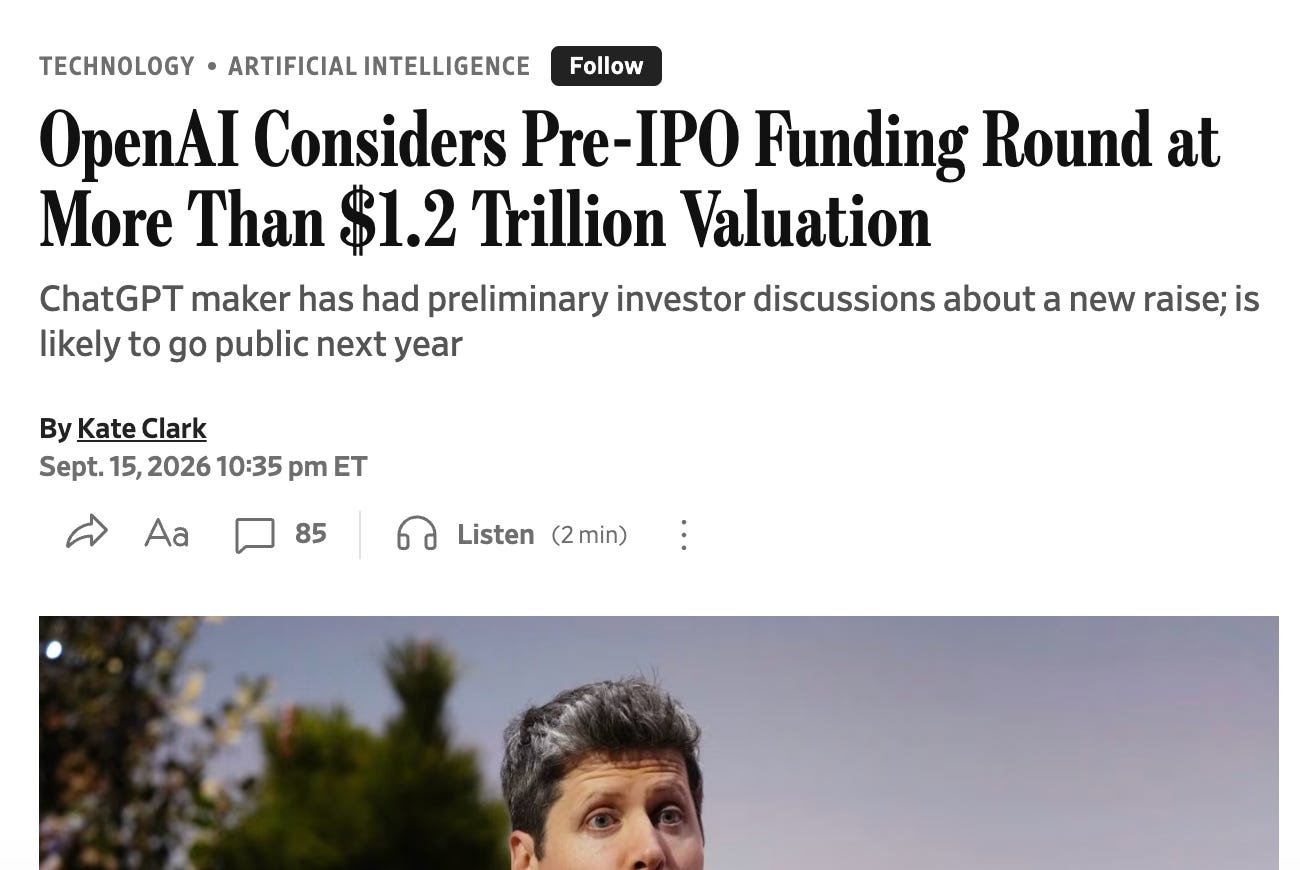
First, the obvious one; that the companies are on the brink of holding IPOs that will make their executives unfathomably rich. A system so powerful it can destroy the world holds significant investor value to parties who are accustomed to funding enterprises who do that more incrementally. These narratives, as they have all along, have fed an investment boom that is, for the time being, lifting a great many boats.


But there’s also the issue of regulatory capture. The AI extinction narrative favored by the big AI labs is tailored to conclude with a number of solutions proposed by and friendly to the industry; compliance with safety standards, audits, oversight bodies, independent observers and so on. The advantages here are twofold; the AI industry gets to set the terms of how they’re regulated—ideally eschewing anything like “being held accountable for things like hacking other companies, corporate malfeasance, instructing children to harm themselves, surveilling workers, perpetrating systemic biases in hiring and firing” and so on. Second, meeting the proper “safety” thresholds would be organizationally challenging for all but the most well-prepared, connected, and capitalized companies to manage, conferring an advantage on the leading AI companies and allowing them to cement their lead.
But perhaps the most compelling reason that this new AI extinction narrative ultimately serves the AI companies above all is that it gives this very expensive, money-hemorrhaging industry a means of coordinating a “slowdown” without running afoul of antitrust laws. Remember, the AI companies are still plowing unprecedented gobs of capital into training and running their models every year; it’s enormously costly. If they had a reason to pause all that training, and an excuse to simply sell their products to consumers as are, it would give them a much better shot at becoming profitable in or around IPO season. (It would also, perhaps, help draw down the need for a rapid, expansionist data center buildout, the most vocal, spirited, and public front of opposition to the industry.)
The Bloomberg financial columnist Matt Levine lays out the case for “an antitrust sort of story” as follows:
Anthropic, OpenAI, and perhaps a couple of other frontier labs are the dominant providers of frontier AI models.
They can charge customers a lot of money for using their frontier models, and rather less money for older, no-longer-cutting-edge models.
Training a new frontier model requires ever-increasing billions of dollars of computing power.
The labs need to more or less continuously race to build new frontier models, because their competitors are all doing it, and if they don’t they will fall behind and no longer be able to charge a lot of money for their best models. (Also because they intrinsically want to build artificial superintelligence, for cancer-curing and/or killing-everyone reasons.)
If they collectively slowed down, then (1) they’d spend less on compute and (2) they’d be able to charge frontier-model prices for a longer time.
If just one lab slowed down, the others would eat its lunch. So you need a reason for undertaking what is essentially industrywide collusion to lower product development costs; if you’re following legally mandated regulations, it’s not an antitrust violation, it’s meeting the letter of the law.
To justify such regulations, well, you need a story.
The day after Trump’s unhinged super intelligence speech, the UN Security Council convened a meeting with top AI leaders, including OpenAI CEO Sam Altman, Anthropic chief Dario Amodei, and the head of Hugging Face, Clement Delangue. Altman solemnly intoned that whether it be a 10 or 1 or 12 percent chance that his products might wipe out the human race, he said, bravely, that no number was acceptable. So, guess what most of the major AI companies proposed: Regulation, on their terms.
“We are at a crossroads,” Sam Altman said, seated in the Security Council wearing his trademark suit with a baby blue tie. “One path leads to a world where power is concentrated, decisions are opaque, and people feel that the most important technology of their lifetime is something being done to them. The other path leads to a world where AI works for people, because people, through democratic institutions, help decide how it should develop, and guide it.” (I will quickly note two things here: First, this is very very rich of Altman to appeal to the democratic process when OpenAI is spending millions on lobbying to crush that process, and second, let’s all bear in mind the last time Altman did the public rounds asking to be regulated; when he didn’t like the regulations governments proposed, he jumped ship.)
“AI is advancing very quickly,” Amodei said when it was his turn to beam into the meeting over Zoom. “The trajectory only needs to continue to continue for a very tiny period, maybe one year or less, to reach what I’ve called ‘a country of geniuses in a data center’.” (I will quickly note just one thing here: Amodei has routinely predicted massive disruptive change—according to him, there should be no junior software engineers by now—just on the horizon.)
Both men highlighted their companies’ new products and achievements; Altman mentioned that OpenAI’s LLMs had solved a long-unsolved math problem called Navier-Stokes (a growing number of mathematicians contest OpenAI’s accomplishment, and it seems that the AI giant likely acted unethically in leaning on the work of a mathematician who was close to solving it, too) and Amodei highlighted a new AI-derived advance in gene therapy. Both reiterated a call for global governance of AI: Frameworks for slowing the pace of model development, calls to ban biological weapons development, frameworks for international cooperation on threat assessment. Highfalutin, and self-serving, stuff.
Right now there is what I might describe as unrestrained scorn and even outrage at anyone who would still suggest hype and marketing play a role in the formation of the AI domination and/or extinction narratives. The fury at the scholars Timnit Gebru and Emily Bender, who have continued to debunk the must overheated claims, has been especially pronounced. But even if you believe AI systems do present a novel threat to civilizational infrastructure, it seems the more grievous error to ignore how the narratives about those threats are being shaped and wielded in pursuit of very specific ends—and, as of now, I might add, very successfully so!

The AI companies are continuing to grow incomparably rich, setting the terms for policy, succeeding thus far in their bid for regulatory capture, and avoiding legal accountability for their systems’ automated exploits.
In other words, why aren’t more people, including analysts and tech journalists, skeptical of this story, which is serving to concentrate power for a handful of vested parties at an extraordinary clip, rather than the story’s critics?
When it was his turn, his Zoom connection glitching in and out, Hugging Face head Clement Delangue argued that the biggest threat isn’t powerful AI, but “asymmetry… Asymmetry between attackers and defenders. Asymmetry between a few companies, and everyone else. Between a few countries, and the rest of the world. Asymmetry of compute, and control—and asymmetry of power.”
The stories that both Trump and the tech executives tell about AI have this in common: They’re both ultimately predicated on keeping that symmetry of power tilted in their favor.
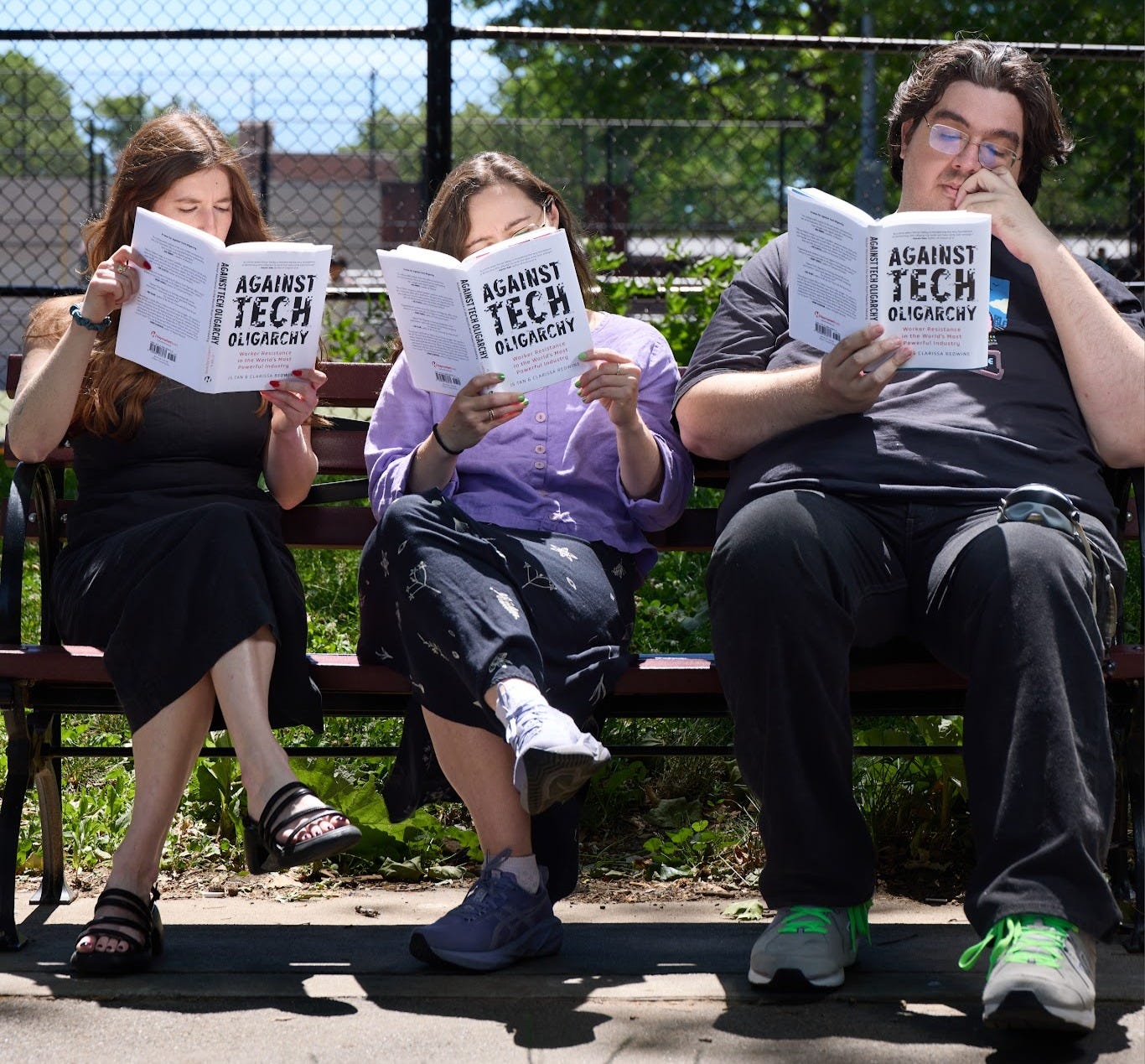
And now, an excerpt from Against Tech Oligarchy by JS Tan and Clarissa Redwine, who, again, are coming to LA for a book talk on September 25th at Skylight Books. RSVP today to secure your spot. Here’s JS and Clarissa:
How tech workers can outwit, out-organize, and overcome their oligarch bosses
As tech bosses fall in line with the right, tech workers have begun fighting back. This is the inside story of their movement—and the way it spawned an anti-worker backlash now reshaping the industry. The following is an excerpt from this book that lays bare the challenges ahead for anyone in tech looking to wield worker power and hold the rising oligarchy to account. Hope you enjoy.
When the traditional tactics of organizing do not threaten their employers’ bottom line, workers must reflect on their own labor process and be willing to try out new strategies to maximize their leverage over their employers. Luckily for tech workers, such examples are not uncommon in labor’s history.
In 1934, after several clashes with the boss and deadly assaults from the police, striking truck drivers in Minneapolis experimented with a new picket line strategy that paid off. Under increasingly hostile conditions, with both employer and state aligning to break the strike, workers watched their leverage disappear as the picket was banned by the city and scabbing truck drivers were issued military permits to ensure they could keep trucks moving no matter what. In response, workers patrolled the city, swarmed scabbing drivers, and made sure the trucks never reached their destination. This tactic was uniquely suited to the decentralized and multiheaded structure of the truckers’ workplace, earning the name the flying picket.
And combined with a general strike they helped spark—one that effectively ran the city for several days—their approach proved decisive. As a labor journalist noted at the time, “The winning of this strike marks the greatest victory in the annals of the local trade union movement . . . it has changed Minneapolis from being known as a scab’s paradise to being a city of hope for those who toil.”
In the 1990s, flight attendants imagined a new form of militancy that had stunning results. After decades of strike actions, flight attendants recognized that a traditional all-out strike, even if dramatic, gave airlines time to absorb the blow of a temporary labor stoppage, assemble scabs, and then return to business as usual once workers could no longer stand to go without their wages. For these workers to win, striking would need to look quite different. Instead of getting every worker to abandon their stations, often handing their duties directly to an army of scabs, flight attendants decided to refuse—in a seemingly random way—to crew their flight at the last minute, instantly grounding it. This unpredictability actively drove customers toward competitors at a level that was far more costly than past strikes. They christened this breakthrough CHAOS: “Create Havoc Around Our System.” The CHAOS model was, in effect, a departure from the dominant playbook of today: Rather than trying to shut everything down at once, it leveraged specific choke points of airline labor to create cascading uncertainty across the system.
Recent campaigns in higher education are also worth examining, especially since the nature of graduate work mirrors in many ways that of tech work, in particular on the dimension of its heterogeneity. Here, too, the canonical strike has proven ill-suited to the fragmented and uneven labor processes that structure the modern university. A lab researcher running an experiment that unfolds over months, with results reported only once or twice a year, causes the university little disruption by walking out for a few days. Likewise, an instructor whose main responsibility is grading at the semester’s end exerts no pressure on the university if they strike during a non-exam period. In such a workplace, a one-size-fits-all strike strategy assumes a uniformity of leverage that simply does not exist. The result is a strike that is loud but not biting—visible, perhaps, on the picket line but invisible where it matters most to the university’s daily operations.
Responding to these limitations, some graduate workers have adopted what they call the “long haul” approach. They recognize that their power lies not in acting as a homogeneous workforce but in exploiting the distinct choke points within their own departments and labs. An effective strike, then, has to begin from the bottom up, with graduate workers in each department and each lab mapping where their labor matters most to the university’s operations and tailoring tactics to those specific vulnerabilities. What emerged from this approach was not a single, uniform strike but a patchwork of sustained localized interventions—grade withholding in some cases, research refusals in others—that together inflicted a much more effective type of disruption to the university.
Taken together, these examples of worker-led experimentation should remind us that workers can and must innovate for ever-shifting organizing contexts. Tech workers must now rise to the occasion.
…
Although a new strategic blueprint has yet to emerge, what’s already clear is that tech workers are ready to rebuild power. Frustrated by the dual threats of eroding working conditions and open lunges toward authoritarianism from tech’s billionaire class, there is a groundswell of agitation from below. Tech workers across the industry are testing new forms of leverage both within and beyond labor’s traditions.
When Hamas attacked Israel on October 7, 2023, many tech workers realized that they would soon be building the technical infrastructure Israel would use to unleash fresh hell in Gaza. Born out of outrage, despair, and desperation, some Microsoft workers came together to form No Azure for Apartheid, calling on their colleagues to refuse labor to any technologies powering the genocide of Palestinians. Over a five-hundred-day campaign of constantly testing new strategies and honing tactics for building leverage, the group learned how to create a crisis for the company. Barricading themselves in the office of an executive while livestreaming the action, disrupting Microsoft’s annual fiftieth-anniversary celebration with screams for Palestinian liberation, and even protesting in kayaks in front of executives’ waterfront homes, this small group of workers did something many thought was impossible: it pushed the company to cut off services to a unit in the Israeli army that used Microsoft technologies to surveil Palestinians in Gaza and the West Bank.
Meanwhile, another experiment was underway at Google. After mass layoffs in 2023, workers started to fight for job security. Starting in Pittsburgh, a handful of organizers who were part of the Alphabet Workers Union organized at their local campus to demand layoff protections from management. Later, as they spoke with others across the company, they discovered there was an appetite to fight the new climate of precarity, so they worked with the larger support network of the union to craft a nationwide campaign. After lead organizers at different offices built collective pressure in a series of open letters, the union won voluntary exit packages for sixty thousand employees. So, while there remains no clear path to winning union recognition and a contract at Google, these little fires that workers created for management across the company’s various campuses have resulted in one of the most militant campaigns at the company since the union’s founding. It has also allowed the union to grow and deepen participation throughout the workforce.
These examples illustrate a clear orientation toward winning—and winning now. The strategies used step outside of the strictures of labor law and represent a trend toward direct action emerging across the movement. Importantly, they do not shy away from openly engaging in conflict, as each clash with the boss is seen as a necessary step toward building solidarity, inciting class consciousness, and learning how to win larger and larger concessions.
Still, what is missing from these actions is a deeper understanding of tech work itself—the connection between how workers’ labor relates to the process of profit generation within their companies and how that can be leveraged to build a credible threat. Without a clear articulation of this relationship, tech workers will not be able to design effective organizing strategies that harness the pinnacle of working class power: the ability to stop generating value for the boss.
Our telling of the movement’s story is meant as an invitation—to those in the tech sector and beyond—to participate in that reckoning.
Okay! That’s it for today. More soon, including a podcast with the workers at the complete opposite end of the story being spun by AI executives. Until then—hammers up.
You might appreciate this page of guidance for my students in the AI and Ethics class this year. This is year 3 for a semester-long ELA course for high school seniors.
We watched a You Tube video about the Anthropic "blackmailing AI agent" scenario in 2025, a video recommended to me by a student because they were both bothered by the content and wondering how true it was.
Week one of class this year, we watched the video and studied the language to set the intellectual floor for discussion about the AI Hype cycle industry. Here's the 'worksheet' students used:
Moving Through AI Hype:
Anthropomorphizing, Catastrophizing, Monetizing
Text: (write the name of the creator/outlet/author, title)
________________________________________________________________________________________________________________________________________________________
Your name, today’s date, best song you heard today OR best after school snack for today
______________________________________________________________________________________________________________________________________________________________________________________________________________
Please add brief notes where you think you see/hear any of the techniques often used to grab attention from a reader/viewer.
Anthropomorphizing: Word choice, choice of visuals
(to give an inhuman thing human qualities)
________________________________________________________________________________________________________________________________________________________________________________________________________________________________________________________________________________________________________________
Catastrophizing: Word choice, choice of visuals, added sound - music and/or effects
(using hyperbole to emphasize urgency, often to gather attention or instigate action)
________________________________________________________________________________________________________________________________________________________________________________________________________________________________________________________________________________________________________________
Monetizing: do you see evidence directly stated, or can you determine how the text you see is connected to someone’s direct or indirect profit - in wealth, power, honor, or leisure? Try to name who benefits from monetizing this text?
_____________________________________________________________________________________________________________________________________________________________________________________________________________________________________________________________________________________________________________________