


I’ve been watching far too much World Cup this summer. It’s great. I’m in Paris, where it’s playing everywhere; in bars, brasseries, on people’s phones on the metro. At night, you can hear cheers erupting from blocks away no matter where you are, for France whenever they’re playing, sure, but also for Argentina and Messi, or for any quality goal really. You also hear plenty of guttural jeering (France’s round of 16 match against Paraguay was especially rich for this) and a good deal of that jeering is now directed at VAR, the virtual assistant referee.
VAR has been the center of at least three (four? five?) stories in sports news the last couple of weeks, and one major story everywhere else, too, with the Folarin Balogun red card that Trump notoriously pushed FIFA to overturn. You’ve got that now-epochal, corruption-tinged Balogun trainwreck, plus VAR handing a Swiss player a yellow card for taking a dive, England scoring after a goal kick hit the skycam and VAR staying silent, a disallowed Egypt goal against Argentina because VAR determined a foul had been committed approximately three hours before Mostafa Ziko put the ball in the net, and, my absolute favorite, a Croatia goal that would have leveled a game against Portugal in the unbelievably tense and exciting final moments getting wiped off the board because the sensors in the ball indicated to VAR that it had in fact subtly brushed overs a players’ head, which the ref did not see because no one possibly could, thus changing the offsides calculus in Portugal’s favor.
The more that I’ve watched these games that grind to a halt for a prolonged and often confusing technological intervention, the more that I’ve read the reams of angry tweets and columns and seen the sports-knowers complaining, the more I simply cannot help comparing VAR to that other ubiquitous, elite-beloved technological intervention, AI. I mean, it’s right there. And I do think it’s well worth asking what role this widely unpopular socio-technical construct (like AI, VAR is at once a technology, a system, a product, and a cultural fixture) is really playing. What does VAR actually do versus what its administrators say it does? Who does VAR ultimately serve? And last but not least, why does VAR persist if so many people despise it?
These are, of course, exactly the kind of questions we routinely ask about AI around here, and beginning to answer them might crack the door to better understanding how AI is interfacing with culture beyond the pitch.
A quick note that this work is made possible by subscribers who chip in a few bucks a month to support it. I try to paywall as little as possible and to keep posts like this one free to read. I can only do that because a small percentage of readers help me keep the lights on. If you find value in this stuff, and you’re able, consider joining their ranks. Thanks, and hammers up.
For those gleefully unaware, VAR is the semi-automated system through which a match official uses video footage and data, now including information collected from sensors embedded in the soccer ball itself, to review and aid in the making of key officiating decisions during a match. Most fans absolutely hate it.
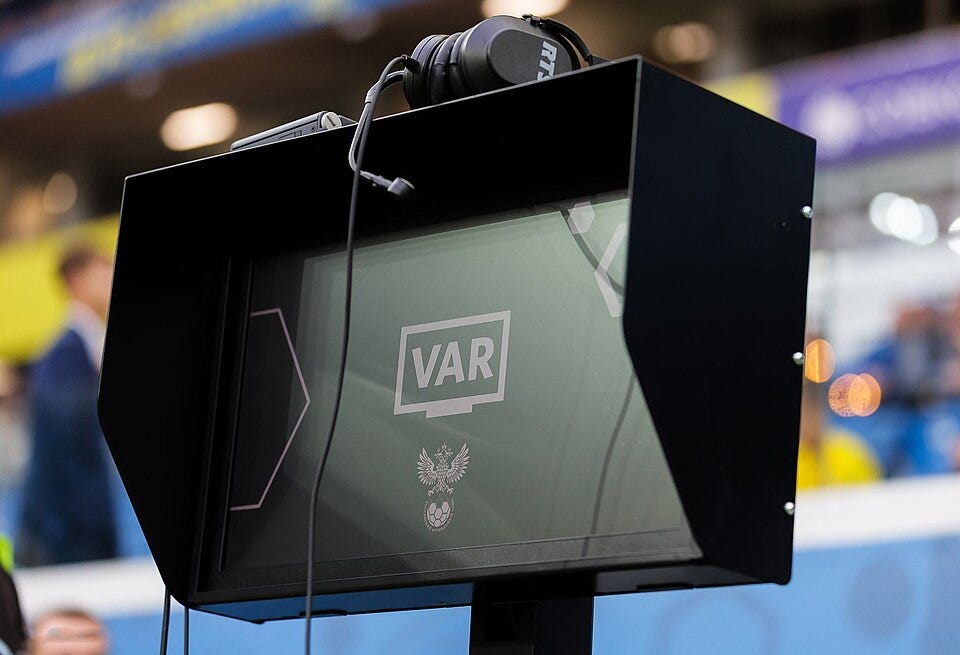

I’m no great scholar of football (or soccer, to all you plebes who have not read a handful of BBC articles about the sport and have thus not been inducted into the upper echelons of the European sport-understanding elite like me) but even I know that VAR made a big stink when it was introduced, and that said stink has never really evaporated.
After being piloted by the Netherlands’ national football league, VAR was more widely integrated into bigger leagues about a decade ago, and formally adopted by the International Football Association Board, football’s main rule-making body, in 2018. The statement IFAB issued at the time announced that “the philosophy of VARs is ‘minimum interference – maximum benefit’ which aims to reduce unfairness caused by ‘clear and obvious errors’ or ‘serious missed incidents’.” A major driving factor was, according to IFAB and FIFA officials, the growing discrepancy between what the ref could see on the ground and what audiences at home and in the stands could see with access to higher-resolution footage and replays they could check on their phones.
“With all the 4G and Wi-Fi in stadia today, the referee is the only person who can’t see exactly what is happening and he’s actually the only one who should,” Lukas Brud, IFAB secretary at the International Football Association, told WIRED about the genesis of VAR in 2018. “We knew we had to protect referees from making mistakes that everyone can see immediately.”
VAR was, in other words, a technological intervention developed to respond to another technological development. The sport’s administrators felt it necessary to promote and protect the integrity of their product (licensed broadcast rights, which bring in many billions of dollars for FIFA, the Premier League, and the like each year) with innovation. You can see the reasoning clearly enough: if viewers at home repeatedly saw that a foul called was clearly not, the game would risk losing face, and, eventually, audiences.
VAR had nonetheless been vehemently opposed by Sepp Blatter, the old school ex-president of FIFA, through the first half of the 2010s, but was embraced and approved by his successor, Gianni Infantino, after Blatter was ousted in the wake of a corruption scandal. It’s been a consistent point of contention and widely detested ever since.
The knocks against VAR are many. Critics argue that VAR impedes the flow of a game for which flow is paramount, causing holdups while officials analyze a play. They grouse that VAR is still too often wrong despite those holdups, and is used too inconsistently and with bias despite all the central claims to create an infallible techno-authority over on-field rulings. VAR promises to eliminate human error, to streamline decision-making processes, to harness cutting edge technology in service of fairness and justice. And yet, what it seems to do, in practice, is make people enjoy the thing it was nominally built to improve, less.
In a poll of 7,000 football fans published just a few months ago, in March 2026, 91% of respondents said the sport is better off without VAR and 81% said they preferred watching matches without the technology. 92% said VAR killed the “spontaneous joy” of celebrating a goal. Just 2% agreed with the statement that “VAR makes football more enjoyable.” Since its implementation in the UK’s Premier League, YouGov polls have consistently found that large majorities of viewers believe VAR “works poorly.”
In other words: It’s a ubiquitous automation and surveillance system, adopted and maintained by those in positions of power with promises of progress and improvement, despite inspiring widespread disdain among those it is promoted it as serving (football players and fans). Its public poll numbers are in the gutter. It even has its own instantly identifiable acronym. VAR is, there is little doubt, the generative AI of the football world.
Furthermore, according to the surprisingly robust academic literature on VAR, the system hasn’t even had much of an impact on gameplay itself at all. In an April 2026 paper published in the journal of Intelligent Sports and Health, economist Seife Dendir analyzed data in 15,000 matches played before and after VAR and found that “VAR appears to have had no effect on goals, red cards or penalty kicks” (emphasis his).
Dendir also notes that
The results indicate that among ten match statistics, the only robust change involved offsides, which decreased in the post-VAR period by 0.5–1.2 per match. For the other statistics, the estimated impact of the VAR is not statistically significant or robust across estimators and leagues. We conclude that the VAR, by and large, does not impact basic game play in professional soccer.
Dendir uses his findings to argue that people shouldn’t hate on VAR so much since it’s not really changing the nature of the sport as played on the pitch, but I think you can argue essentially the opposite, too: VAR may hold up matches, de-beautify the beautiful game, and incur an overwhelming majority of fans’ hatred, but at least it’s not doing anything particularly meaningful, either.
So what is VAR doing, then?
The first we already hit on—it is, in theory, helping to protect the credibility of the leagues in charge of officiating football matches, as well as their profit streams. It’s a product the leagues are selling. VAR can be seen as a big, performative demonstration that soccer leagues are using all the technology and power at their disposal to make the game as good and fair as possible. In a highly technologized age, VAR offers a technological solution that executives and bureaucrats can point to as their Having Done Something to keep up with the times. Even if fans dislike it. Yet again, it’s hard not to see parallels between the implementation of VAR and the widespread, top-down AI adoption, ordered by FOMO’d managers at Fortune 500 companies everywhere over the last three years—often to little meaningful or even detrimental effect to the organization, as recent stories are revealing.
But it’s more than that. VAR is also what Dan Davies might call an accountability sink. Even if VAR doesn’t, per the statistics, work overwhelmingly better than old fashioned human refs making the calls, it’s nonetheless a system the leagues can hold up as an effort to deflect any criticism that matches are unfairly or poorly officiated. It’s not FIFA’s fault if Swiss forward Breel Embolo was thrown out of the game for taking a dive to draw a foul, an offense perpetrated by literally every other player on the pitch that and every other day; it’s VAR’s.
In this way, VAR strives to impart the impression that those who implement it—FIFA, Major League Soccer, the Premier League, whoever—are neutral and free from bias.
This is very obviously not the case. Like every other mode of officiating, VAR is itself an intensely bias-addled system; it’s supposed to be invoked only when certain conditions are met, and only in certain circumstances, but how and when to invoke VAR remains an inevitably biased decision. There is a lengthy document listing all of the VAR rules, called the VAR Protocol, that must be interpreted, at all times, by a team of invisible, off-screen humans. In the controversial Folarin Balogun decision, before Trump and the FIFA top brass bungled their way into the mess, the ref looked at slow-motion footage of the striker’s cleats hitting the Bosnia defenders’ leg; slowed down, artificially displayed, it looked awful, and likely contributed to the red card ruling, which was nearly universally decried as overly harsh shortly after.
Or look at the aforementioned Egypt vs Argentina game. In an extraordinary sequence, an Egyptian player wrested the ball from an Argentinian, Egypt played the ball down the pitch, weaved through Argentina’s defenders, resulting in a quality goal, as they say. VAR was invoked, and it was all wiped away.
Meanwhile, in the same game, a similar-looking play in which an Argentinian player made what looked like serious contact on Egypt’s Mo Salah and initiated a sequence that led to a goal in the opposite net, was left untouched. VAR was never even activated; the invisible technician decided it wasn’t worth a look.
And somehow, the sensors in the ball that sprang to life after brushing a Croatian player’s hair failed altogether to detect getting slammed into a skycam cable, allowing England to capture possession and score their first goal against then-leading Norway.

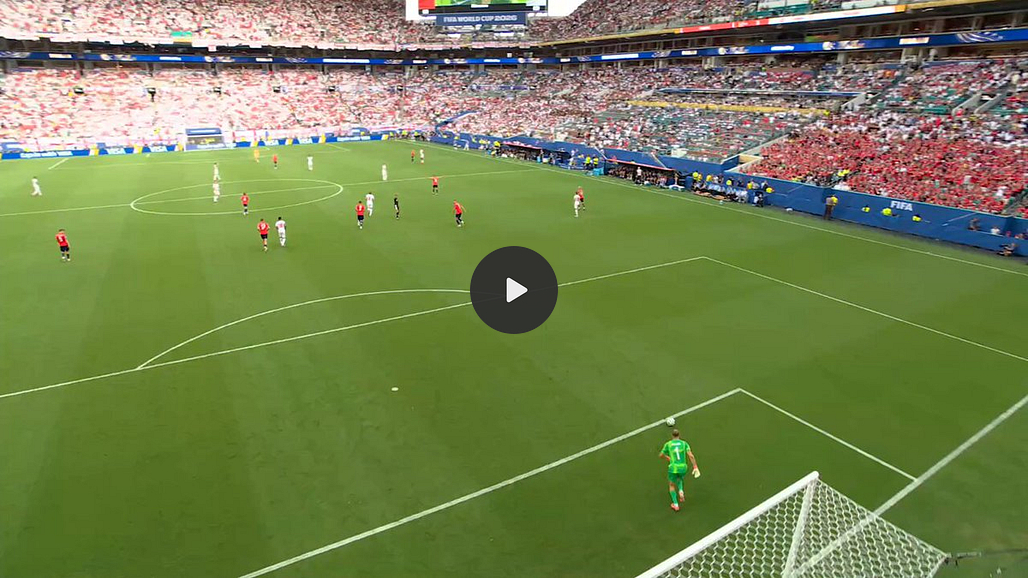

There are numerous actions in nearly every match that could warrant a VAR intervention. It’s up to the human to decide. VAR in other words has not removed bias, but rather moved it around the field, and maybe obscured it from direct view a little.
That VAR decision in Egypt-Argentina has led to probably the most unsustained fury in the World Cup so far (though the Swiss are plenty outraged too) with Egypt’s coach Hossam Hassan alleging that the game was stolen, that FIFA wanted to see Argentina, which hosts the biggest superstar player in the world in Lionel Messi on its team, advance over the North African one:
“We haven’t seen respect or fair play,” he said. “A penalty [for us] was ruled out, it was not even checked by the VAR and our second goal was remarkably, for whatever reason, disallowed… We have all seen the shirt pulled back [by Alexis Mac Allister] and not even a VAR check.”
This feeds into the longstanding criticism that FIFA preferences Europe and teams with star players, that it preferences audience and the profit motive. And it’s hard to discount Hassan. I’ve watched a number of these games, as well as Senegal-Belgium, which I haven’t even mentioned yet; it was a hell of a match with Senegal ahead 95% of the way. Belgium made an epic comeback, but Senegal stabilized, and it looked to be heading to a penalty shootout when VAR controversially awarded a penalty kick to the Belgian side in the waning minutes of overtime.
Look at which way the bulk of the above-described VAR decisions broke; towards Lionel Messi’s Argentina, towards Cristiano Ronaldo’s Portugal, towards European stalwarts Belgium over the poor African nation of Senegal. Towards England over Norway. Towards the teams with superstars and/or rich fanbases, towards Europe. This is why this otherwise enthralling World Cup has struggled to shake the conspiracy theories, the allegations of fixing, the stink of corruption (well okay, FIFA is pretty much always dealing with the stink of corruption). The Athletic described the teams left standing as “the final four of FIFA’s dreams,” and there are plenty of fan theories that posit that’s by design. One is literally referred to as “VAR-gentina.” FIFA has ably helped it all along, demonstrating that it is quite willing to put its thumb on the scales if there is a strong enough profit motive (suspending Ronaldo’s pre-Cup red card to let the superstar play), or if the US president tells it to (Trump calling Infantino to repeal Balogun’s red).
Do I think the refs themselves are fixing games or are in the tank for any particular team? I do not. But I do think that when it’s clear enough which outcomes a power structure prefers, edge case decisions and neutral technological prognostications bend towards them. It’s little wonder that VAR is maligned for being seen as party to, or even sometimes driving, such machinations. From its mere continued existence in spite of fans’ rejections to its apparent administration of FIFA’s will, VAR is a subtle instrument of power.
The irony of this is, again, that if it were left up to fans and players, if the surveys are to be believed, VAR would probably be abolished altogether, or at least seriously and deeply reformed. Even otherwise ardently pro-tech voices take issue with VAR; the Big Technology newsletter ran a story decrying VAR arguing that “Automation Makes The World Cup Worse.”
I agree. So often with VAR, as with AI, the technology’s deployment becomes so intrusive that it erases its stated raison d’etre, its very purpose elusive to the point of being lost. Speeding up and slowing down footage to try to extract intent through the pixels? Rewinding the game to reassess a decision because some guys in a video terminal spotted a foul in the playback? Using cutting edge follicular sensors to ascertain whether or not a ball grazed a human hair or not? What is all this for? Who besides FIFA is finding satisfaction in this process or its outcomes? What does this have to do with football, or why we play and watch it?
VAR has done little to streamline or take the bias out of officiating the game; it has inserted into it a new set of imperatives and biases that serve different functions and parties. It has slim upside, and, if you ask the fans, lots of downside.
Now, if you’re a sports fan and a VAR hater, here’s a quick ask: think about how generative AI is impacting other fields and practices we deem crucial. After all, AI, like VAR, is intruding, often unnecessarily, sometimes absurdly, sometimes disastrously, into key arenas of human practice, against the will of most and for the benefit of the few. Education, the arts, writing, journalism; all awash in AI—and why? So executives, administrators, and opportunists might squeeze a little profit, sate their FOMO, or exert some power. Large numbers of Americans dislike AI with a vehemence a Liverpool fan can well understand. What VAR is doing to football, AI is doing to so much else.
VAR, like AI, is made to feel inevitable, like it’s an ineluctable feature of a modern world. It’s not. It’s a technical system put in place by a scandal-plagued sports association. So maybe, as a thought experiment, it’s worth considering—what if we turned it off?
I’m on a conspiracy tip that David Beckham in all the commercials is an AI model or is almost completely AI airbrushed
Quick note: no such thing as watching "too much" World Cup.