


Late in 2025, X users began flooding the platform with requests for its AI chatbot Grok to generate sexualized images, mostly of women. According to one report, there were 1.8 million sexualized images of women generated in just nine days. That accounts for 41% of all images produced by the tool on the entire site. The only truly surprising thing about this was the sheer volume: Elon Musk, the owner of X and xAI, often posts sexualized AI-generated images of women himself. He’s not alone there. OpenAI CEO Sam Altman has signaled an erotic product offering is in the wings, and has long cited Her, a sci-fi movie in which a lonely man forms a sexual relationship with a chatbot, as a guiding light for his company.
So what is the relationship between men creating AI products and their drive for sex, power, dominion? It’s a question that has been unsatisfactorily explored during the years of the AI boom so far, with a few exceptions. But with Grok’s nonconsensual image generator making headlines, as it’s being used, for example, to undress women against their will, and concerns about the safety of AI generated content at an all time high, I thought it worth revisiting a speculative fiction story I edited for Terraform back in 2018, that tackled how misogyny and predation infect the tech world.
Emily J. Smith is a fiction writer and tech worker. She founded the dating app Chorus, and has a wealth of experience with Silicon Valley and the men who inhabit it. Her first novel, Nothing Serious, was published last year by HarperCollins, and she pens a newsletter called Unresolving. Her story, about a tech developer behind an Alexa-like home AI, was one of the most popular we published at Terraform, many years before ChatGPT or Grok existed.
It’s a stark interrogation of what lies behind the female-coded voices and imagery of AI products, as well as a horrifying depiction of sexual violence in tech—do be forewarned, this story contains depictions of assault—as well as a subtle nod towards what might begin to address men’s dominance in the industry. It quickly went viral on Reddit and beyond. Smith has kindly given me permission to republish the piece here, where I think you’ll find it remains plenty resonant. The art is by the incomparable Zoe van Dijk. Enjoy.
Warning Signs
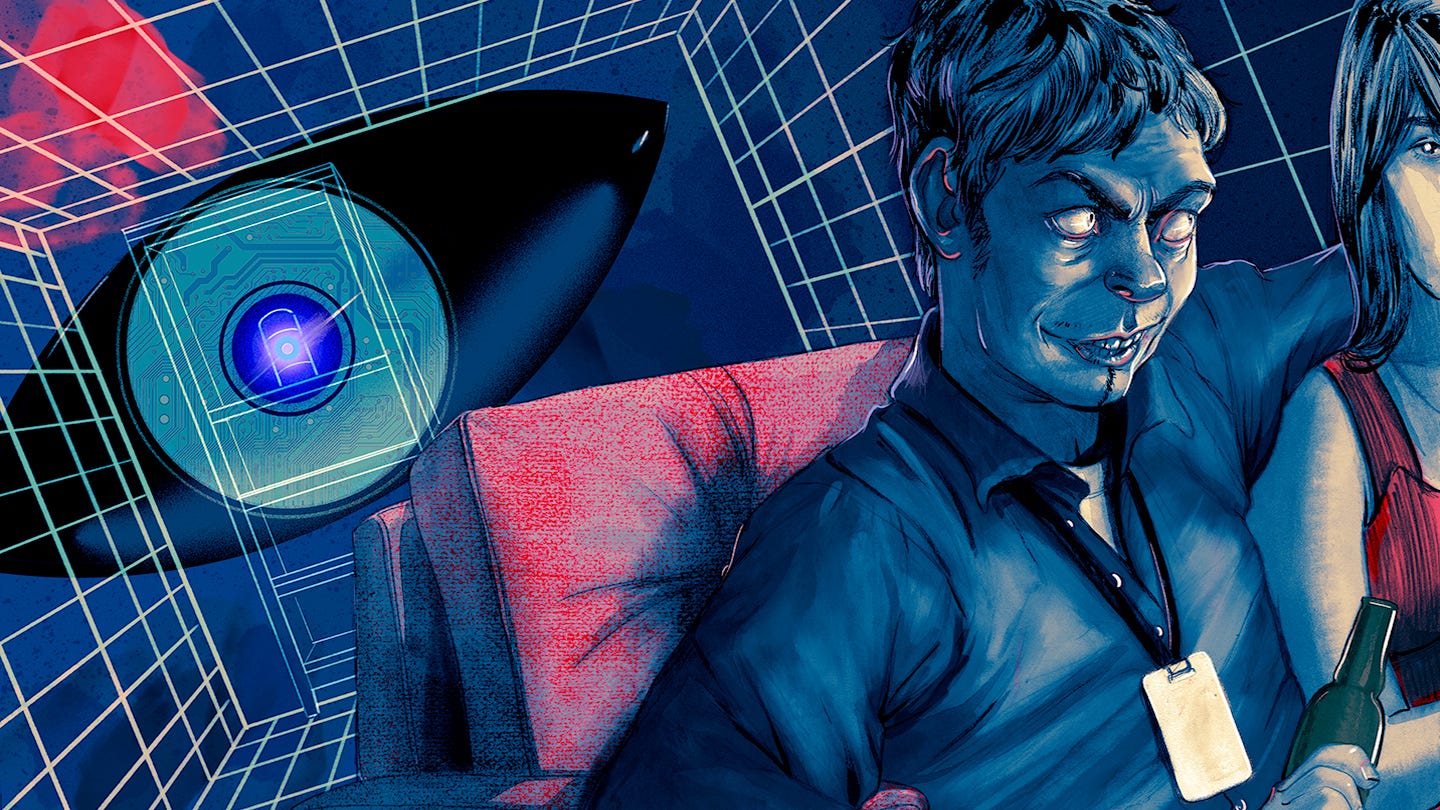
Roy unlocked his door at 7:35 each night, threw his jacket on his long, grey midcentury couch and slipped his leather shoes off. Most days the argyle on his socks matched, but not always. Today they were both grey with pale pink accents.
“Lucy,” Roy shouted from across the room. “Turn on fucking NPR.”
“Turning on KQED FM Public Radio from Tune In,” Lucy repeated back from its perch on Roy’s oak shelf. The shelves ran from floor to ceiling. It was a nice detail, his realtor had told him, and he’d agreed. But now they just reminded him how little he had to put on them. He had a few old coding books, a new book on “deep thinking,” a short one on meditation, and then, on the top shelf, a teddy bear that an ex-girlfriend had loved and he thought other girls might, too, so he’d bought it at an LA gas station forever ago.
Roy slumped on the couch. The two cushions sloped downwards towards the center, where he sat, tonight and always, just slightly. His butt covered the grease stain from the night the Pad Thai had slipped from his fork—he had wanted every ingredient on the fork and there were so many ingredients in Pad Thai—so he didn’t have to look at it.
“Lucy,” Roy said, his voice softer now.
“You fucking bitch.”
“What was that?” Lucy asked, her voice soft and predictable.
“You’re a fucking bitch,” Roy mumbled and then laughed, just a little at first and then more, because the ease at which he could tell this thing that did whatever he said that she was a fucking bitch was funny, and surprisingly fun.
“I don’t register that,” Lucy said, her blue ring of light blinking steadily.
“Cause you’re a stupid whore,” Roy whispered, still laughing, almost giggling now at the freedom of not being policed. These days every conversation he had felt more like a trap than an exchange.
Roy turned on the TV. The only good thing about Mondays was that he saved Westworld for Mondays.
“Lucy!” Roy screamed and the bang of his voice in his quiet apartment made him jump. Like massaging your own shoulders or scratching your own back, it wasn’t ideal, scaring oneself, but it was better than nothing. “Turn on Westworld.”
“Playing Westworld.” The calm hum of NPR stopped and Westworld appeared on the screen. “And order from Samurai Sushi, please.”
“Would you like the same order as last time?” Lucy began repeating his order.
“I get the same thing every time you piece of shit,” he interrupted.
“What was that?”
He leaned forward on the couch so she could hear him. “Yes, baby. Yes please order the same thing.”
“Ordering from Samurai Sushi.”
“Thanks babe,” he grinned and laid back down into his thick grey cushions.
Westworld had become a total drag so he started swiping Tinder instead. Swiping had become a reflex in the face of idleness, he barely registered that he had opened the app at all and already he was getting matches. He swiped when he got up in the morning and as he fell asleep—a modern counting of sheep. He swiped it on the toilet and even sometimes not on the toilet, just a swipe or two while he peed.
Roy was the perfect age for a man and he knew it. At thirty-six he could be in a relationship with any woman. Younger women adored that he had an apartment all to himself, but he still more or less hadn’t changed in a decade besides Acroli going public and him becoming a millionaire so he got along with them just fine. Older women, too, were in his wheelhouse. By the time a woman hit forty she was over the age thing, her options too slim to be picky. The only women he hated dating, although of course he could if he wanted to (they were everywhere in SF), were women his own age. Thirty-five started the last sprint of a woman’s child bearing years and the girls in San Francisco—an army of less successful Sheryl Sandberg prototypes—didn’t take that lightly. With women his own age he felt rushed, demanded of. And that was no fun.
Looks-wise, he had thick hair, so he was fine. He hadn’t realized it until a few years ago, but thick hair masked almost all the visual imperfections on his face, which he admitted were many.
He had a good job at a well-known tech company, which was exactly how he phrased it on his profile. And he was in shape, enough for a man his age. “Dad Bod” had become a phrase right when he’d entered his thirties which luckily was right when he’d developed his dad bod. It’s not that he didn’t exercise. Roy ran 3 miles two days a week and every Saturday he would do a two-hour bike ride in Marin, unless something got in the way, like a picnic in the park or a hangover.
He did wish he were taller. He was 5’9 and a half, basically 5’10, which is what he put on the profiles that asked. But Tinder didn’t ask so he left it blank. If a woman cared about height, he reasoned, she was superficial anyway.
Roy swiped “yes” to almost every girl on Tinder except if they were ugly. He’d run an experiment and based on the number of times girls matched with him (1 in 9, on average) it was a waste of his time to consider a girl unless it was clear she wanted him first.
After three matches he stopped swiping and scanned the profiles of his matches. The first one was fine but her last pic had her smiling and one of her teeth stuck out making her look like a goof so he unmatched her. The second girl had only shown a picture of her face in the first picture, which was pretty, but the second had a picture of her body and clearly she didn’t value health the way Roy valued health so he unmatched her before he had a chance to read her message asking if he wanted to go for a bike ride.
But the third showed promise. Michelle was 31 and 5’6, the perfect age and the perfect height. She had thick, straight hair, which wasn’t a must-have, necessarily, but it was certainly nice. She smiled in every picture, a wide, inviting smile. She had a fine sounding job as a Project Manager and went to a college he had heard of. He messaged “ Hey.”
This wasn’t his best work but it was usually good enough. He had a feeling it would be good enough for Michelle.
Michelle’s laugh was generous and she filled the gaps in conversation with thoughtful questions about his life. She was indeed impressed that he owned an apartment in San Francisco and she joked that she wished she could see it. This was a wish he knew well and one he was practiced at granting.
“Lucy,” Roy said when they entered. “I have a guest.”
Michelle laughed at how friendly he was with his device. He was cute, she thought, cute enough. Michelle had spent the good portion of a year chasing after a photographer in Oakland who wrote her poems but never returned her texts. She wanted something simple, a nice guy who would treat her well. She wasn’t getting any younger her mom had started reminding her every weekend since she’d turned thirty. She knew she was more attractive than Roy and that was intentional, a turn on, even. Him wanting her made her want him. It meant he would stay.
“I work at Acroli,” Roy explained, taking her coat. “So I have to be nice to her,” he smiled.
“Do you work on Lucy?” she asked looking at the device.
Roy nodded. “I was one of the first engineers on Lucy, actually.” This reveal was his favorite part of dates. “I got to pick her voice. Oh, and I sat on the naming committee,” he said as if he’d just remembered it.
“So cool.” Her eyes widened, like they all did when he told a girl this, and he noticed her take a second scan of the apartment, sizing up his belongings, his wealth, in light of these new details.
“Lucy,” Roy said.
The blue lights glowed and flickered.
“Please play us some romantic music.”
“You’re so nice to Lucy,” Michelle laughed.
“Not always,” Lucy said. It was so soft and quick that both Michelle and Roy thought maybe it was just in their heads.
“What’d she just say?” Michelle looked at Roy who was now gripping Lucy tightly. He put it down when he saw Michelle staring at him, but his eyes jerked around the room. She had noticed this at the restaurant, his eyes darting from the food to the floor and up at every single person that passed their table, but she was really trying to be less critical and the way someone moved their eyes wasn’t a good criteria to judge a guy on, she told herself every time she looked up.
“Lucy,” Roy said, calmly now. “I asked you to please play us romantic music.”
“Playing romantic music for your guest,” Lucy replied.
Michelle registered this somewhere in the far corner of her mind, too, the specification “for your guest.” Hers never did that. But then the new Bon Iver came on and Roy’s hands were on her waist and the last thing she remembered was Roy handing her a drink.
There was a mandatory team meeting at lunch. He took a seat as far as possible from the front of the room, at the back head of the long conference table. A woman walked in. She wasn’t ugly, Roy thought. But she wasn’t hot. She was older than he would have liked, around his age, but he would sleep with her. She wore a button down shirt, tighter around her breast area, which she tucked into tight fitting jeans. She had makeup on, he could tell by the lines of her blush and the red of her lips and he thought it made her look like she was trying too hard. Her expression was serious—wrinkles on her forehead, her lips clenched into a tight knot—uptight. He wished someone would get her a beer from the tap on the 3 rd floor so whatever was about to happen would be more fun.
“Hi everyone,” she started. “I’m Dawn. I’ll be leading a new initiative with Lucy. “
Of course it was all men. For the most part they were fine. But the guy in the back was menacing.
Dawn had spent the morning—not to mention all week—preparing for the presentation, doing a power-pose in the bathroom stall when she got in, then pretending she was on a conference call for two hours so she could practice her speech in secret. But when she walked in, smile ready, endorphins racing, she saw him scowling at her from the far end of the room, eyes narrowed, at her face for a second, then her breasts—she could see his eyes move downwards—and then at her jeans, which she only in that moment realized were very tight (but tight was the style!) before moving back up to her face. But by that time her smile was gone. She was done with smiles.
He threw his clothes and shoes in the corner of his closet and all the takeout containers and beer cans into a black garbage bag. Another date, Sarah from Bumble, was on her way over. Michelle had already messaged twice since this morning and the whole thing made him feel like someone was gripping his soul and shoving it into a juicer so he unmatched her in the Uber on his way home. Thankfully, he hadn’t given her his number.
“Bitch.” He stared at Lucy and smiled, waiting, but Lucy just sat there. “Lucy,” he said, finally.
The blue lights turned on, blinking faster than usual again, at least it seemed.
“Order me vodka from Harry’s. And whiskey. And play that music we like. Play our music.” Roy was laughing now.
The whiskey and vodka thankfully arrived just moments before Sarah did. But the sushi was still on its way. Sarah sat on the couch.
“Fiona Apple,” interesting choice, she said looking up at the air as if Fiona Apple herself was floating in the room.
Roy looked at Lucy, unassuming on the shelf. He knew little about Fiona Apple other than a vague recollection that she was a feminist psychopath. What he did know was that she was definitely not on his “romantic” playlist.
“I like it,” Sarah said, pulling her knees up to her chest, bouncing a bit.
Roy could feel the blood drain from his face, turning whiter with each heavy piano chord.
“Lucy,” he said with measured effort, “shut off.”
But Lucy played another song, his favorite song this time. When the Coldplay song ended he braced himself for what would come on next. He wasn’t sure who it was but the voice was a woman, and she sounded angry. Sarah was bouncing again. He got up. “Lucy turn on better music,” he shouted.
“I’m putting on music for your guest,” it replied.
Sarah turned. “How does she know you have a guest?”
Roy had no fucking idea and frankly it was creeping him out. “I work at Acroli,” he explained, trying to pivot this disaster into something positive. “On Lucy. So mine is a little more advanced than most people’s.” This was true. They tested updates on employees before they were released to the public. But he hadn’t heard about any planned updates. “Actually, let’s just unplug her. We don’t need music.”
“Sushi is arriving in eight minutes,” Lucy said, glowing.
Roy stopped, hand resting on the chord. If he unplugged her, the sushi might not come.
Sarah laughed. “That’s so cool. Like she knew what you were doing. I can’t wait till they release this for everyone.”
Roy stared at Lucy, which was still glowing on the shelf even though she had stopped talking or listening at this point, as if she were simply gloating, glowing for herself alone, and went back to the couch to pour another shot for him and the girl.
Music began to play.
“Thank you Lucy,” Sarah said, still giddy.
“Keeping you safe,” Lucy said, stopping the music for an almost imperceptible second before continuing the tune.
Roy stared at Lucy, and Sarah stared at Roy, who was entirely focused on the soft blue glow. She watched his face redden and his eyes harden. She could even see, though only faintly, the beat of his pulse pumping in his neck.
As if a glass had shattered on the floor the sound of the door buzzing made the jump. He ran to the door, grateful for a break to compose himself before returning to the girl.
Roy got to work early. Ten a.m. on the dot. Dawn was the only one there.
“I’d like to work on the new update for Lucy,” Roy said, looking down at Dawn, lazily sitting, rather than standing, at her desk.
Dawn did everything she could to keep herself from laughing. She took a sip of her water bottle, which was nearly finished after this morning’s six-mile run.
She shrugged. Her instinct was to start with “Sorry,” but while she hated the new craze of every woman telling every other woman to stop apologizing—women shouldn’t have to stop, men should do it more—she truly did feel, in this case, that an apology was completely unnecessary.
“You can’t,” she said instead. “It’s fully staffed.” For all the hype, she hated open-office workspaces. She would have taken a 10% pay cut just to have a door to close on men like the one still staring at her.
“It’s a confidential project,” she said so that he’d leave. “You have your own important work to do.” She tried, but not too hard, to hide her condescension.
He was pretty sure he had never met a bigger bitch. He fully intended to stay at her desk until she told him something.
“Internally we’re referring to it as Project XX,” she said. “I’ll tell you that.”
“Project XX.” Roy raised his eyebrows. “Sounds dirty,” he said with a short, lazy laugh. He knew it was dumb and crude before the words had even left his mouth but he wanted to see her squirm. She smiled at his desperation, nearly laughed. As he walked back to his desk she noticed the unfortunate fit of his jeans. She opened her file of select employees, making sure he had received the update.
Lea was wearing a low cut shirt showing off nothing but her collarbone but it didn’t look bad. He had setup Monopoly, which was why she’d agreed to come to his place on a first date, something she never did, she made sure to clarify. He placed the bar-cart next to the table.
Lea didn’t actually find this guy—what was his name, she checked quickly in the hall before she’d reached the door, Roy—that attractive. He was short and had an ugly face. But he seemed to have a decent job and a good education and she knew those were superficial markers but it was all superficial on these apps—what else did she have to go off of?—so she swiped right and then he’d messaged her and asked her to come over, tonight, and more than anything she just wanted someone to talk to.
His place was nice, beyond nice, but the shelves were bare and he had just enough furniture for him to sit on, nothing more. There was a creepy teddy bear on the shelf that looked completely out of place like a piece of bait thrown sloppily on a hook.
Roy asked what she wanted to drink and even though he was pointing to his liquor cart, the girl asked for a beer.
“How was your day?” Lea asked from the couch.
“Work is annoying these days,” Roy said, handing her a beer and making himself a drink. “I don’t want to talk about it.”
She waited for him to return the question—today’s case had been a nightmare—but he was too focused on the whiskey he was mixing for himself. He took a large sip and sat beside her on the couch.
“I like this shirt,” he said, touching her low cut collar.
“Thanks,” she said, her heart beating a little faster.
“I was thinking we could make a drinking game out of it,” he said, gesturing to the Monopoly board. Lea started to say that she’d had a long day and really, definitely couldn’t be hungover tomorrow, but as soon the words left her mouth she saw his expression darken, it wasn’t anger, she could fight anger with anger—she was a lawyer, did it for a living—it was more like confusion. The care to which he’d setup the game and the drinks, dimmed the lights, and played romantic music (no matter how cheesy) was touching and she had disappointed enough people today, she didn’t need his sadness piled on top. So when she landed on a Railroad and he poured her a shot, she took it.
The game was the only interesting part of the evening. The girl wouldn’t stop talking about her job, which for some reason reminded him of Dawn, and even though he tried his best to seem like he didn’t care (it wasn’t that hard), it was almost like she had one-upped him and didn’t care about him not caring, so kept on talking. But she was also drinking, quite a lot, and seemed to like him, enough, so as soon as she purchased Boardwalk he crawled on top of her.
At first she laughed. “What are you doing?” She tried to push him off but he’d put up with her for two whole hours, drinking all his beer and ranting on like he was her personal therapist so what did she expect?
“It’s fine,” he said. “We’ll go slow.”
“Stop,” she said. “I don’t want to do this.”
“Why not?” he asked, rubbing her hard stomach under her shirt and keeping her down. “I thought we were having fun.”
“Stop!” she said again, louder.
He had to work to keep himself from laughing. He was shocked at how much he enjoyed it, this push and pull. He unzipped her pants with one quick pull.
He was about to go in for another kiss when he saw it through the corner of his eye. The blue lights blinking faster than ever, he was sure of it. But he had given no command—the music still played, the lights were still dim, nothing had changed.
The girl was screaming now, ridiculously—he had only really touched her breast and was just starting to unbutton his pants. The blinking kept going—faster, brighter. He heard it faintly at first, maybe part of the song, he thought, a ringing hiding behind the music. Then he noticed, through the corner of his eye, more lights, more blinking. Red.
The sirens were louder now, the lights brighter.
There was a pounding at the door. Hard, heavy knocks.
“Police,” a man shouted. “We received a call. Let us in.”
More BITM fiction:
Busy, by Omar El Akkad:

Flyover Country, by Tim Maughan:

Stellar
Now I need to read her book!